
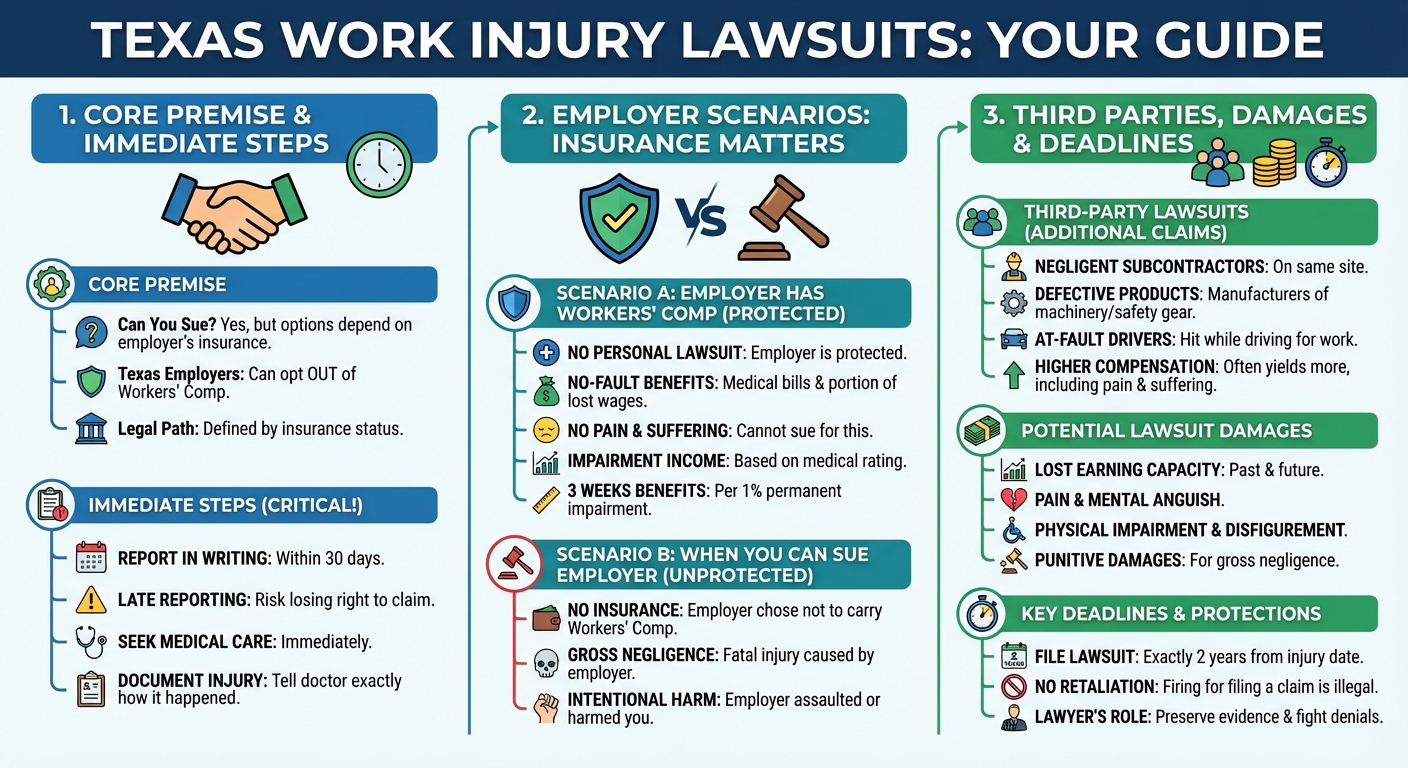
Yes, you can sue for a work injury in Texas, but it depends on your employer’s insurance. If your employer does not carry workers’ compensation, you can sue them directly for negligence. If they do have coverage, you can typically only pursue personal injury lawsuits against negligent third parties.
Can You Sue for a Work Injury in Texas? The Short Answer
Yes, you can sue for a work-related injury in Texas, but your legal options depend heavily on whether your employer carries workers’ compensation insurance. Texas is the only state that allows private employers to opt out of the workers’ compensation system. If your employer is a “non-subscriber” (meaning they do not have workers’ comp), you have the right to sue them directly for negligence. If they do carry workers’ comp, you generally cannot sue them directly, but you may still have grounds to file a third-party lawsuit against other negligent parties.
What happens if you injure yourself at work?
If you injure yourself at work in Texas, you must immediately report the injury to your employer and seek medical attention. Failing to report the incident within 30 days can result in losing your right to claim workers’ compensation benefits or pursue certain legal actions against your employer.
Reporting the Injury Within 30 Days
Under Texas law, the clock starts ticking the moment you are injured or discover an occupational illness. You have exactly 30 days to notify your employer in writing. This notification establishes an official record of the incident. Delaying this step gives insurance companies an excuse to deny your claim, arguing that your injury happened outside of work.
Seeking Immediate Medical Attention
Your health is the top priority, but seeing a doctor also creates the medical documentation necessary to build your case. Be sure to tell the treating physician exactly how the injury occurred on the job. If your employer has workers’ compensation, you may be required to choose a doctor from their approved network.
The Texas Workers’ Compensation ‘Exclusive Remedy’ Rule
When an employer provides workers’ compensation insurance, they are protected by the “exclusive remedy” rule. This means that, in exchange for providing no-fault benefits to injured workers, the employer is generally shielded from personal injury lawsuits.
What Workers’ Comp Covers (Medical Bills and Lost Wages)
If you are covered under a subscriber’s policy, you do not need to prove your employer was at fault to receive benefits. Workers’ compensation typically covers:
- All approved medical expenses related to the workplace injury.
- A portion of your lost wages (usually 70% of your average weekly wage) while you recover.
- Impairment income benefits if you suffer permanent damage.
Why You Generally Cannot Sue a ‘Subscriber’ Employer
Because workers’ compensation is a “no-fault” system, it acts as your exclusive remedy against your employer. Even if your employer’s direct negligence caused your broken bone or back injury, you cannot file a traditional lawsuit against them for additional damages like pain and suffering, provided they maintain active workers’ comp coverage.
Exceptions: When You CAN Sue Your Employer Directly
Despite the exclusive remedy rule, there are specific scenarios where Texas law allows you to take your employer to court.
Your Employer is a ‘Non-Subscriber’ (No Workers’ Comp Insurance)
If your employer chose not to purchase workers’ compensation insurance, they are considered a “non-subscriber.” In this case, you can sue them directly for personal injury. Furthermore, non-subscribers lose key legal defenses; they cannot argue that you were partially at fault or that another employee caused your injury to escape liability.
Gross Negligence Resulting in Wrongful Death
If a worker is killed on the job due to the employer’s gross negligence or a deliberate act, the surviving spouse and heirs can sue the employer for exemplary (punitive) damages, even if the employer has workers’ compensation insurance.
Intentional Harm or Assault by the Employer
Workers’ compensation covers accidental injuries. If your employer intentionally causes you physical harm or assaults you, the exclusive remedy shield is pierced, and you can file a civil lawsuit for battery and intentional infliction of emotional distress.
Third-Party Claims: Suing Someone Other Than Your Employer
Even if your employer has workers’ compensation, you can still file a personal injury lawsuit against a negligent third party who contributed to your accident. Third-party claims often yield higher compensation because they allow you to recover damages for pain and suffering.
Negligent Subcontractors and Vendors
Construction sites and industrial plants are filled with workers from various companies. If an employee of a different subcontractor drops a tool on you or creates a hazardous condition, you can sue that subcontractor’s company.
Defective Machinery and Equipment Manufacturers
If you were injured by a malfunctioning forklift, a defective power tool, or faulty safety gear, you can file a product liability lawsuit against the manufacturer or distributor of the dangerous equipment.
At-Fault Drivers in Work-Related Car Accidents
If you drive for work (such as making deliveries or traveling between job sites) and are hit by a negligent driver, you can file a workers’ comp claim with your employer AND a personal injury lawsuit against the at-fault driver’s auto insurance.
Can I sue my employer for pain and suffering in Texas?
You can sue your employer for pain and suffering in Texas only if they do not carry workers’ compensation insurance (non-subscribers) or if their gross negligence caused a fatal injury. If they have workers’ comp, you cannot sue them for pain and suffering, but you can sue negligent third parties.
Understanding Impairment Ratings and Compensation
When you reach Maximum Medical Improvement (MMI)—meaning your condition is not expected to improve further—a doctor will assign you an Impairment Rating (IR). This percentage reflects the permanent physical damage caused by your work injury and dictates how many weeks of Impairment Income Benefits (IIBs) you receive.
How much payout do you get with a 60% impairment?
In Texas, you receive three weeks of Impairment Income Benefits for every 1% of impairment. A 60% impairment rating equals 180 weeks of benefits. The exact monetary payout depends on your Average Weekly Wage prior to the injury, capped by the state’s maximum weekly benefit limit.
Is suing your employer worth it?
Suing your employer is highly worth it if they are a non-subscriber or if a third party is liable, as it allows you to recover full lost wages, future medical costs, and pain and suffering. Workers’ compensation alone rarely covers the total financial and emotional impact of a severe injury.
Potential Damages Recovered in a Lawsuit
Unlike standard workers’ compensation, a successful personal injury lawsuit allows you to recover:
- 100% of your past and future lost earning capacity.
- Compensation for physical pain and mental anguish.
- Damages for physical impairment and disfigurement.
- Punitive damages in cases of gross negligence.
The Risk of Retaliation and Legal Protections
Many injured workers fear being fired for taking legal action. However, Texas law strictly prohibits employers from retaliating against or wrongfully terminating an employee for filing a workers’ compensation claim in good faith or hiring a lawyer to represent them.
The Statute of Limitations for Texas Work Injury Lawsuits
If you are filing a personal injury lawsuit against a non-subscriber employer or a negligent third party, Texas law gives you exactly two years from the date of the injury to file your claim in court. If you miss this deadline, you will be permanently barred from recovering compensation. Note that this is different from the 30-day deadline to report the injury to your employer.
How a Texas Work Injury Lawyer Can Maximize Your Recovery
Navigating the intersection of workers’ compensation, non-subscriber laws, and third-party liability is incredibly complex. A skilled Texas work injury attorney can identify every possible avenue for compensation.
Investigating the Accident Scene and Gathering Evidence
Evidence disappears quickly after an industrial or construction accident. An attorney will immediately issue spoliation letters to preserve evidence, subpoena safety records, interview witnesses, and consult with occupational safety experts to prove negligence.
Fighting Back Against Insurance Company Denials
Whether you are dealing with a workers’ comp adjuster trying to minimize your impairment rating or a liability insurer blaming you for the accident, an attorney levels the playing field. They handle all communications, negotiate aggressive settlements, and prepare your case for trial to ensure you get the justice you deserve.
 Call (713) 747-7777