
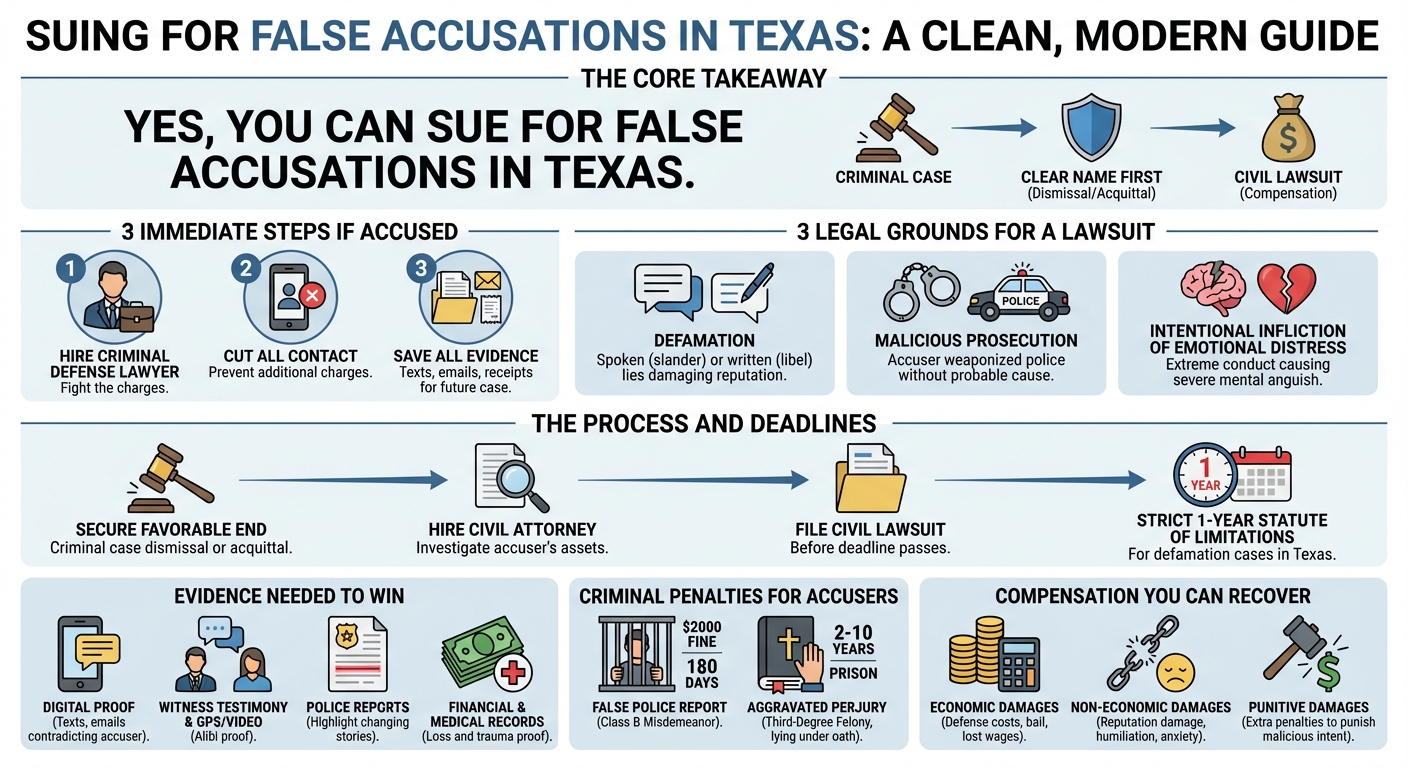
Yes, you can sue for false accusations in Texas. If someone falsely accuses you of a crime, you can file a civil lawsuit for defamation per se, malicious prosecution, or intentional infliction of emotional distress. To succeed, you must prove the accusations were false, unprivileged, and caused you harm.
Can You Sue for False Accusations in Texas?
The Short Answer: Yes, Under Specific Civil Laws
If someone has lied about you to the police, your employer, or the public, you have the right to seek justice. In Texas, you can sue for false accusations by filing a civil lawsuit against the person who made the fabricated claims. Depending on the nature of the lie, you can pursue compensation through claims of defamation, malicious prosecution, or intentional infliction of emotional distress.
The Difference Between Beating the Charge and Suing the Accuser
Defending yourself against a false accusation is a two-part battle. First, you must survive the criminal justice system or workplace investigation. A criminal defense attorney’s job is to keep you out of jail and clear your record. However, criminal courts do not compensate you for your ruined reputation or drained bank accounts. To recover your financial losses and hold the accuser accountable, you must transition to the civil court system and file a lawsuit.
What can I do if someone makes false allegations against me in Texas?
If someone makes false allegations against you in Texas, you should immediately hire a criminal defense attorney, cease all contact with the accuser, and begin preserving evidence like text messages and emails. Once your criminal charges are dismissed or you are acquitted, you can consult a civil attorney to sue the accuser.
Step 1: Secure Criminal Defense Representation Immediately
Before you can sue, you must protect your freedom. Do not speak to the police to “clear things up” without a lawyer present. Law enforcement’s goal is to close cases, not to act as your personal vindicator. Secure a defense attorney to dismantle the false charges first.
Step 2: Do Not Contact Your Accuser
It is natural to want to confront the person lying about you, but doing so can destroy your case. Contacting your accuser can lead to additional charges, such as witness tampering, harassment, or violating a protective order. Let your attorney handle all communications.
Step 3: Preserve Evidence for a Future Civil Lawsuit
Start building your civil case while fighting your criminal case. Take screenshots of social media posts, save voicemails, and back up text messages. Document every dollar you spend defending yourself, as these expenses will become the foundation of your civil damages claim.
3 Legal Grounds to Sue for False Accusations in Texas
Defamation of Character (Slander and Libel)
Defamation occurs when someone makes a false statement of fact to a third party that damages your reputation. If the false accusation was spoken, it is slander; if it was written (including online posts or police reports), it is libel. You must prove the statement was objectively false and caused you tangible harm.
Defamation Per Se: When Accusations Involve a Crime
Texas law recognizes that certain lies are so inherently damaging that you do not need to prove exact financial losses to win your case. Falsely accusing someone of committing a crime—especially a serious offense like sexual assault, theft, or murder—qualifies as defamation per se. The court presumes your reputation was damaged simply because the accusation was made.
Malicious Prosecution: When the Legal System is Weaponized
If your accuser lied to the police with the specific intent of having you arrested, you can sue for malicious prosecution. To win this claim in Texas, you must prove:
- A criminal action was commenced against you.
- The accuser initiated or procured the action.
- The case ended in your favor (e.g., dismissal or acquittal).
- The accuser lacked probable cause.
- The accuser acted with malice.
Intentional Infliction of Emotional Distress (IIED)
If the false accusations involved extreme and outrageous conduct that goes beyond all possible bounds of decency, you may have a claim for Intentional Infliction of Emotional Distress. You must prove the accuser’s actions intentionally or recklessly caused you severe mental anguish.
How to sue someone for falsely accusing you?
To sue someone for falsely accusing you in Texas, you must first clear your name in criminal court. Then, you hire a civil litigation attorney to file a petition in civil court alleging defamation or malicious prosecution. You must file this lawsuit within the strict one-year statute of limitations.
Clearing Your Name First (Dismissal or Acquittal)
Civil courts generally will not hear a malicious prosecution or defamation case while the underlying criminal charges are still pending. You must secure a “favorable termination” of your criminal case—such as a dismissal by the prosecutor, a grand jury “no-bill,” or an acquittal at trial.
Filing a Civil Petition in Texas Civil Court
Once cleared, your civil attorney will draft and file a formal complaint (petition) in the appropriate Texas county court. This document outlines the false statements made, the legal grounds for the lawsuit, and the specific damages you are demanding from the defendant.
Navigating the Texas Statute of Limitations (1 Year for Defamation)
Time is critical. In Texas, the statute of limitations for defamation (libel and slander) is strictly one year from the date the false statement was published or spoken. For malicious prosecution, the clock typically starts ticking on the day your criminal case is officially dismissed or you are acquitted.
What evidence is used to prove false allegations?
To prove false allegations in Texas, you can use digital evidence like text messages and emails that contradict the accuser’s story, witness testimony, surveillance footage establishing an alibi, and police reports highlighting inconsistencies. Financial records and therapy bills are also used to prove the resulting damages.
Digital Evidence: Texts, Emails, and Social Media Messages
The strongest defense against a lie is often the accuser’s own words. Text messages showing the accuser threatening to “ruin your life,” emails admitting to a fabrication, or contradictory social media timelines can completely destroy their credibility.
Witness Testimony and Alibis
Independent witnesses who can verify your whereabouts during the alleged incident are invaluable. GPS data, security camera footage, and credit card receipts can establish an ironclad alibi proving you could not have committed the act in question.
Police Reports and Inconsistencies in the Accuser’s Story
Liars often struggle to keep their stories straight. Your attorney will meticulously compare the accuser’s initial 911 call, their formal police statement, and their testimony under oath to highlight fatal inconsistencies and changing narratives.
Proving Financial and Reputational Damages
To win maximum compensation, you must document your suffering. This includes providing receipts for your criminal defense attorney, pay stubs showing lost wages from being fired or suspended, and medical records detailing treatment for anxiety or depression caused by the ordeal.
What is the penalty for false accusations in Texas?
The penalty for false accusations in Texas depends on the severity of the lie. Making a false report to a peace officer is a Class B misdemeanor punishable by up to 180 days in jail and a $2,000 fine. Lying under oath can result in felony aggravated perjury charges.
Texas Penal Code 37.08: False Report to a Peace Officer
Under Texas law, it is a crime to knowingly make a false statement to law enforcement with the intent to deceive them. If the police discover your accuser fabricated the story, the state can file criminal charges against them.
Class B Misdemeanor Penalties (Fines and Jail Time)
A standard false report is typically charged as a Class B misdemeanor. If convicted, your accuser faces up to 180 days in a county jail and a fine of up to $2,000. They will also have a permanent criminal record for a crime of moral turpitude.
Felony Charges for Aggravated Perjury
If the accuser takes the stand in court or lies under oath during an official proceeding, the stakes increase dramatically. Aggravated perjury is a third-degree felony in Texas, carrying a potential sentence of 2 to 10 years in state prison and up to a $10,000 fine.
Damages You Can Recover in a False Accusation Lawsuit
Economic Damages: Lost Wages and Legal Fees
False accusations are expensive. Through a civil lawsuit, you can demand reimbursement for your out-of-pocket costs. This includes the retainer you paid your criminal defense lawyer, bail bond fees, lost income from missed work, and diminished future earning capacity if your career was derailed.
Non-Economic Damages: Reputational Harm and Mental Anguish
You deserve compensation for the invisible toll of a false accusation. Non-economic damages cover the humiliation of being arrested, the destruction of your standing in the community, and the severe emotional distress, anxiety, and trauma you endured.
Punitive Damages: Punishing Malicious Intent
When an accuser acts with clear malice—intentionally trying to destroy your life—Texas courts may award punitive damages. These are not meant to compensate you, but rather to financially punish the accuser and deter others from weaponizing the justice system.
Why You Need a Texas Civil Litigation Attorney
Transitioning from Criminal Defense to Civil Offense
Criminal defense attorneys are trained to protect you from the state; civil litigation attorneys are trained to aggressively pursue individuals for financial compensation. Once your name is cleared, you need a lawyer who understands the nuances of Texas tort law, defamation standards, and civil procedure.
Evaluating the Accuser’s Ability to Pay Damages
Winning a lawsuit is only half the battle; collecting the money is the other. A skilled civil attorney will investigate the accuser’s assets before filing suit. If the accuser is “judgment proof” (meaning they have no money, property, or insurance), your attorney will advise you on whether a lawsuit is financially viable.
Requesting a Case Evaluation
If you have survived a false accusation and your criminal case has been resolved in your favor, it is time to go on the offensive. Contact a Texas civil litigation attorney to review your evidence, assess your damages, and determine the best legal strategy to reclaim your life and hold your accuser accountable.
 Call (713) 747-7777