
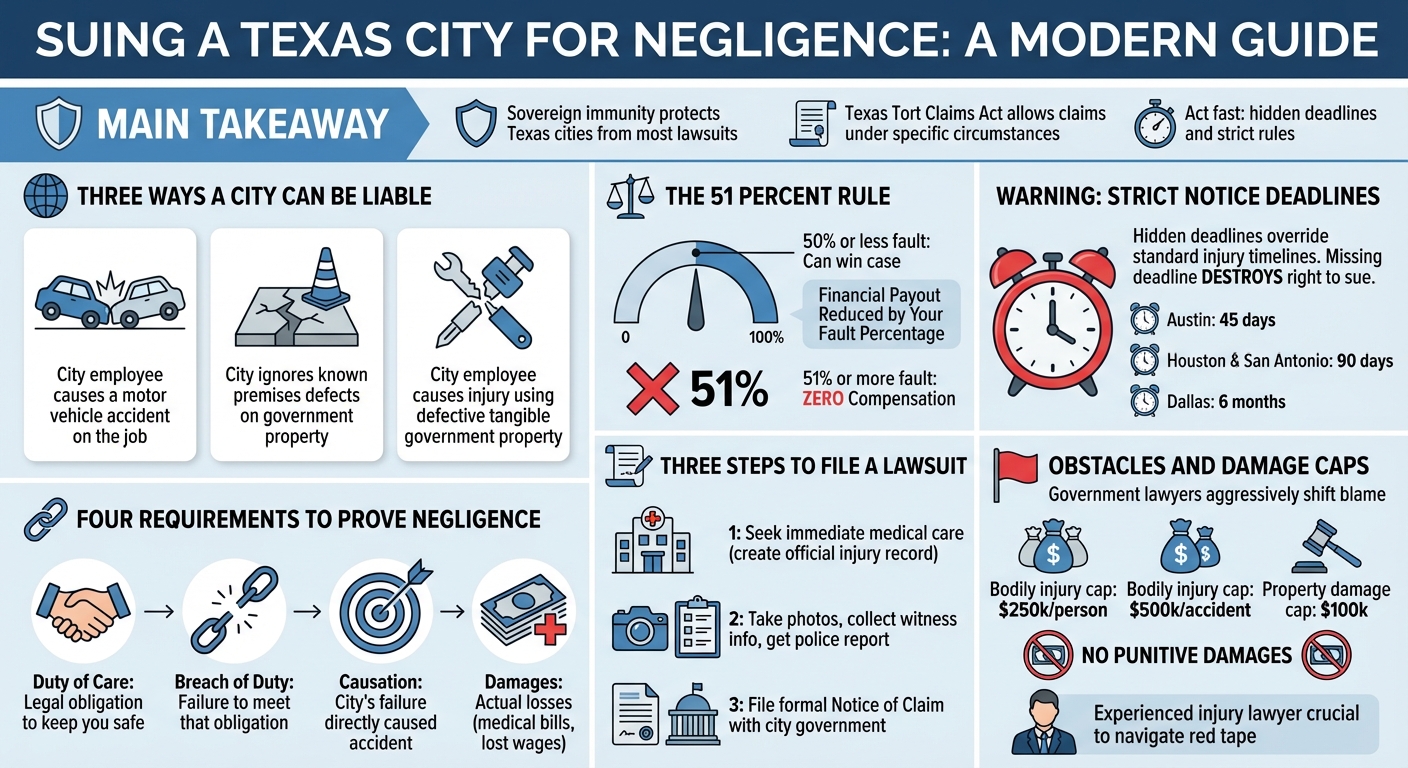
Yes, you can sue a city for negligence in Texas, but only under specific circumstances outlined in the Texas Tort Claims Act. You can typically sue if your injuries were caused by a city employee’s negligent operation of a motor vehicle, a premises defect on city property, or defective city equipment.
Can You Sue a City for Negligence in Texas?
Yes, you can sue a city for negligence in Texas, but it is not as straightforward as suing a private citizen or a corporation. Lawsuits against municipalities are heavily restricted by state law, meaning you can only pursue a claim under very specific circumstances.
Understanding Sovereign Immunity in Texas
In Texas, government entities are protected by a legal doctrine known as sovereign immunity (or governmental immunity for local municipalities). This rule essentially states that you cannot sue the government unless the government specifically gives you permission to do so. If a city employee acts negligently and causes you harm, the city’s default legal position is that it is immune from liability.
The Role of the Texas Tort Claims Act (TTCA)
The exception to sovereign immunity is the Texas Tort Claims Act (TTCA). The TTCA partially waives the city’s immunity, allowing injured citizens to sue local governments for negligence—but only for specific types of accidents. If your injury does not fall into one of the exact categories outlined in the TTCA, your case will likely be dismissed.
When Can a Texas Municipality Be Held Liable?
Under the TTCA, a city in Texas can only be held liable for personal injury, property damage, or wrongful death if the negligence falls into one of three strict categories:
Motor Vehicle Accidents Involving City Employees
You can sue the city if you are injured by a city employee who was negligently operating a motor vehicle or motorized equipment while on the job. Common examples include:
- A city bus colliding with your vehicle.
- A sanitation truck backing into your car.
- A police officer running a red light without sirens active and causing a crash.
Premises Defects on City Property
If you are injured by an unsafe condition on city-owned property, you may have a claim. However, the legal standard is high. You must prove that the city either knew or reasonably should have known about the danger and failed to fix it or warn the public. Examples include unusually deep potholes the city ignored, or a broken staircase in a municipal courthouse.
Condition or Use of Tangible Personal Property
A city can be held liable if you are injured by defective or improperly used tangible property owned by the government. For instance, if a city employee uses a defective piece of maintenance equipment that breaks and injures a bystander, the city could be held responsible.
What are the 4 things required to prove negligence?
The four things required to prove negligence in Texas are: a legal duty of care owed by the defendant, a breach of that duty, causation linking the breach directly to your accident, and actual damages or losses suffered as a result of the injury.
Duty of Care Owed by the City
You must first establish that the city or its employee had a legal obligation to act safely. For example, a city bus driver has a duty to obey traffic laws and drive reasonably to protect other motorists and pedestrians.
Breach of Duty
Next, you must prove the city failed to uphold that duty. This means showing that the employee acted carelessly, such as texting while driving a city vehicle or ignoring a known hazard on public property.
Causation (Direct Link to Your Injury)
It is not enough that the city was careless; their carelessness must be the direct cause of your injury. You must prove that “but for” the city worker’s negligence, you would not have been hurt.
Damages (Actual Losses Suffered)
Finally, you must have quantifiable losses. This includes medical bills, lost wages, property damage, and physical pain and suffering documented through medical records.
What is the 51 percent rule in Texas?
The 51 percent rule in Texas is a modified comparative fault law stating that you can only recover damages if you are 50 percent or less at fault for an accident. If you are found to be 51 percent or more responsible, you cannot recover any compensation.
How Proportionate Responsibility Affects Your Claim
Texas courts use proportionate responsibility to assign a percentage of fault to everyone involved in an accident. If a jury awards you $100,000 in damages but finds you were 20% at fault for speeding, your final payout will be reduced by 20%, leaving you with $80,000.
Why You Cannot Recover if You Are More Than 50% at Fault
Because of the 51 percent rule, city defense attorneys will aggressively try to shift the blame onto you. If they can convince an insurance adjuster or a jury that you were mostly responsible for the incident (51% or higher), the city owes you nothing. This makes gathering strong evidence critical.
How to sue a city in Texas?
To sue a city in Texas, you must first seek medical attention and gather evidence of the city’s negligence. Then, you must file a formal Notice of Claim with the municipality—often within 30 to 90 days of the incident—before filing a lawsuit in civil court.
Step 1: Seek Immediate Medical Attention
Your health is the priority. Going to the emergency room or an urgent care clinic immediately establishes a medical record linking your injuries directly to the accident date and time.
Step 2: Gather Evidence and Obtain the Police Report
Take photos of the accident scene, the city vehicle or property involved, and your injuries. Collect contact information from witnesses. If it was a traffic collision, ensure a police report is filed, even if the at-fault driver is a police officer.
Step 3: File a Formal Notice of Claim
Before you can formally sue, the TTCA requires you to submit a Notice of Claim to the government entity. This document must include a description of the damage or injury, the time and place of the incident, and a description of what happened.
Warning: Beware of 30-Day City Charter Deadlines
While the state of Texas allows up to 6 months to file a Notice of Claim against state entities, individual cities can set their own deadlines via city charters. Missing this deadline destroys your right to sue.
| Texas City | Notice of Claim Deadline |
|---|---|
| Austin | 45 Days |
| Houston | 90 Days |
| San Antonio | 90 Days |
| Dallas | 6 Months |
Is suing the city hard?
Yes, suing a city in Texas is hard because municipalities are protected by sovereign immunity. You must prove your case fits a specific exception under the Texas Tort Claims Act, adhere to extremely strict notice deadlines, and navigate statutory caps that limit the maximum compensation you can receive.
The Burden of Proof Against Government Entities
Government lawyers are highly experienced in defending municipalities. They will scrutinize your evidence to prove the city had no prior knowledge of a hazard or that the city employee was not acting within the scope of their employment when the accident occurred.
Strict Notice Deadlines vs. Standard Statutes of Limitations
In a standard Texas personal injury case, you have two years to file a lawsuit. When suing a city, the Notice of Claim deadline (often 30 to 90 days) acts as a hidden trap. If you wait a year to contact a lawyer, your case against the city is likely already dead.
Damage Caps Under the Texas Tort Claims Act ($250,000 Limit)
Even if you win your lawsuit, Texas law caps the amount of money you can recover from a municipality. For local governments, the maximum payout is capped at $250,000 per person and $500,000 per single occurrence for bodily injury, plus $100,000 for property damage. You cannot sue a city for punitive damages in Texas.
Why You Need an Experienced Texas Injury Lawyer
Navigating Government Red Tape
Suing a city involves bureaucratic hurdles that do not exist in standard car accident or slip-and-fall claims. An experienced attorney knows exactly who to serve with the Notice of Claim and how to structure it to comply with local city charters.
Maximizing Your Compensation Before the Deadline Expires
Because damage caps limit your recovery, every dollar counts. A skilled lawyer will help you fully document your medical expenses, lost wages, and future care needs to ensure you demand the maximum allowable compensation under the TTCA.
Free Case Evaluation
If you were injured by a city employee, a city vehicle, or on dangerous city property, do not wait. The clock is already ticking on your Notice of Claim. Contact our legal team today for a free, confidential case evaluation to protect your rights.
 Call (713) 747-7777