
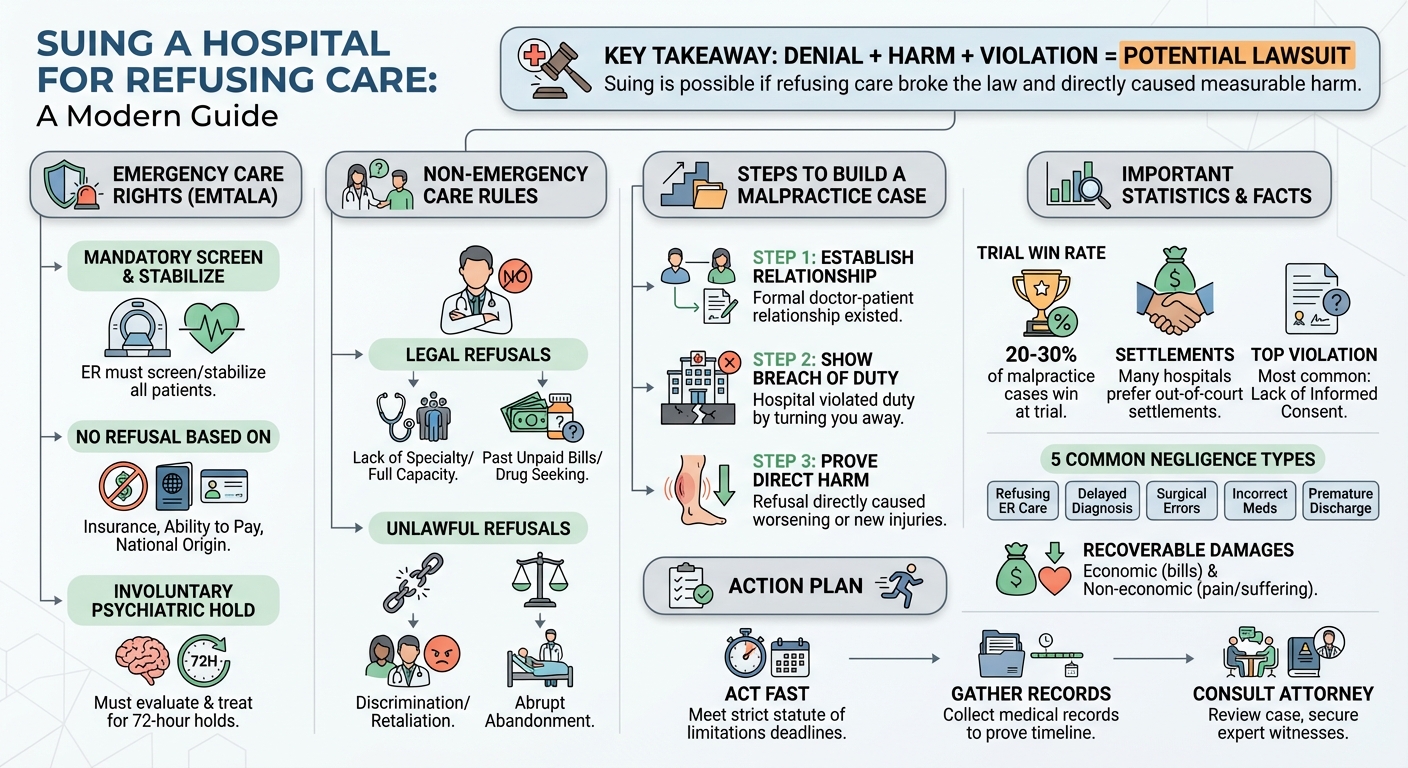
Yes, you can sue a hospital for refusing treatment if their denial violated federal laws like EMTALA or civil rights laws, and directly caused you harm. To have a valid medical malpractice claim, you must prove the hospital had a legal duty to treat you and their refusal worsened your condition.
Quick Answer: Can You Sue a Hospital for Refusing Treatment?
Yes, you can sue a hospital for refusing treatment if their denial violated the law and directly caused you harm. While doctors and hospitals are not legally obligated to accept every patient in non-emergency situations, they cannot turn you away if you are experiencing a medical emergency, nor can they refuse care based on discriminatory reasons.
To win a lawsuit, you generally need to prove that a doctor-patient relationship existed (or an emergency duty of care applied), the hospital breached its duty by refusing treatment, and this refusal directly resulted in measurable damages or a worsened medical condition.
Emergency Rooms and EMTALA: Your Right to Immediate Care
In the United States, emergency rooms operate under strict federal guidelines. The most important is the Emergency Medical Treatment and Labor Act (EMTALA). This law mandates that any hospital emergency department receiving Medicare funds must provide a medical screening exam and stabilize any patient who comes in with an emergency medical condition, regardless of their insurance status, national origin, or ability to pay.
If a hospital turns you away during a heart attack, severe trauma, or active labor because you lack insurance, they have violated EMTALA, giving you strong grounds for a lawsuit.
What is the 72 hour rule for hospitals?
The 72-hour rule typically refers to an involuntary psychiatric hold (often called a 5150 in some states), allowing hospitals to detain individuals experiencing a severe mental health crisis for up to 72 hours. During this period, hospitals are legally required to evaluate and treat the patient, and refusing necessary emergency psychiatric care can lead to liability.
Can a Doctor Legally Refuse to Treat You in Non-Emergencies?
Outside of the emergency room, the rules change. Private practices and non-emergency hospital departments have more discretion over who they accept as patients. However, this discretion is not absolute.
Lawful Reasons for Refusal (Lack of Specialty, Unpaid Bills, Drug Seeking)
A doctor or hospital can legally decline to treat you in a non-emergency setting for several valid reasons:
- Lack of Specialty: The doctor does not have the specific expertise required for your condition.
- Unpaid Bills: You have a history of failing to pay for previous non-emergency services.
- Drug Seeking Behavior: The provider suspects you are attempting to obtain prescription medications fraudulently.
- Full Capacity: The practice is simply not accepting new patients.
Unlawful Reasons for Refusal (Discrimination, Retaliation)
Conversely, a hospital or doctor cannot refuse treatment if the reason violates federal or state laws. Unlawful denials include:
- Discrimination: Refusing care based on race, gender, religion, sexual orientation, or national origin (violates the Civil Rights Act).
- Retaliation: Denying care because you previously filed a complaint against the facility.
- Patient Abandonment: Abruptly stopping treatment without giving you adequate notice and time to find a new doctor once a doctor-patient relationship has been established.
Building a Medical Malpractice Case for Denied Treatment
If you believe you were unlawfully denied care, filing a successful medical malpractice or negligence lawsuit requires proving specific legal elements.
Establishing the Doctor-Patient Relationship
Before a doctor owes you a duty of care, a formal relationship must exist. In an ER, this duty is automatic under EMTALA. In a private setting, the relationship is established once the doctor begins examining you, providing medical advice, or scheduling ongoing treatment. If they refuse to see you before this relationship begins, suing for malpractice is significantly harder.
Proving Direct Harm and Damages
It is not enough to simply be turned away; you must prove that the refusal caused you actual harm. If you were denied care but went to another hospital an hour later and recovered fully, you likely do not have a case. However, if the delay caused your appendix to burst, resulting in severe infection and additional surgeries, you have clear, measurable damages.
What are 5 examples of medical negligence?
Medical negligence occurs when a provider’s care falls below the accepted standard. Five common examples include: 1) Refusing emergency treatment in violation of EMTALA; 2) Misdiagnosing or delaying a critical diagnosis; 3) Committing surgical errors, such as operating on the wrong site; 4) Administering incorrect medications; and 5) Discharging a patient prematurely.
Understanding Patient Rights and Hospital Liability
Every patient has fundamental rights when seeking medical care. When hospitals prioritize profits or administrative convenience over these rights, they open themselves up to liability.
What patient right is most often violated?
The right to informed consent is widely considered the most frequently violated patient right. This occurs when doctors fail to fully explain the risks, benefits, and alternatives of a treatment or procedure, depriving the patient of the opportunity to make an educated decision about their own healthcare.
Taking Legal Action Against a Hospital
Suing a hospital is a complex process that requires gathering medical records, securing expert witness testimony, and navigating strict statutes of limitations.
What are the odds of winning a lawsuit against a hospital?
The odds of winning a medical malpractice lawsuit at trial are historically challenging, with plaintiffs winning roughly 20% to 30% of cases that go to a jury. However, many strong cases never reach trial; hospitals often prefer to settle out of court if the evidence of negligence and harm is compelling.
How Much Compensation Can You Recover?
If your lawsuit is successful, you may be entitled to economic damages (such as additional medical bills and lost wages) and non-economic damages (such as pain and suffering). The exact payout depends heavily on the severity of the harm caused by the refusal of treatment. (For more detailed information on average payouts, you can review our guide on how much you can sue a hospital for negligence.)
Next Steps: Consult with a Medical Malpractice Attorney
If you or a loved one suffered severe medical complications because a hospital refused treatment, you need to act quickly. Medical malpractice claims are subject to strict deadlines. Consulting with an experienced medical malpractice attorney can help you determine if your rights under EMTALA or state laws were violated, allowing you to seek the justice and compensation you deserve.
 Call (713) 747-7777