
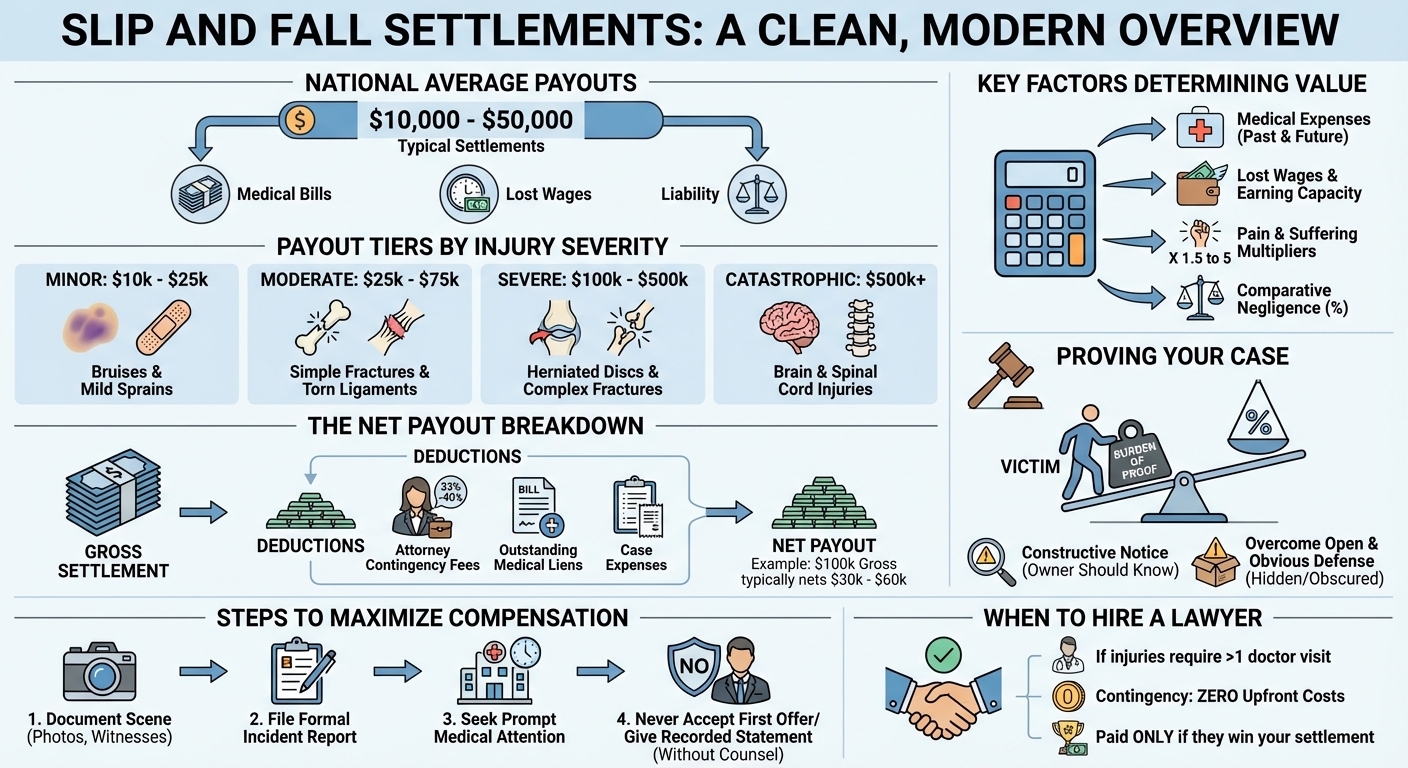
The average slip and fall settlement typically ranges from $10,000 to $50,000 for minor to moderate injuries. However, severe injuries requiring surgery, such as herniated discs or complex fractures, frequently result in settlements between $100,000 and $500,000. Your exact payout depends on medical bills, lost wages, and liability.
What Is the Average Slip and Fall Settlement Amount?
National Average Payout Ranges ($10,000 to $50,000+)
Nationally, the average slip and fall settlement ranges from $10,000 to $50,000. This baseline typically covers minor to moderate injuries, such as soft tissue damage, minor concussions, or simple fractures that heal without surgical intervention. However, cases involving permanent disability or extensive surgery regularly settle for six or even seven figures.
Why ‘Average’ Amounts Can Be Misleading
Looking at a single national average can be highly misleading. A slip and fall settlement is never a flat rate; it is a calculated reimbursement for your specific damages. Two people can slip on the same wet floor and receive vastly different payouts based on their age, income, injury severity, and the specific liability laws in their state.
Slip and Fall Settlement Tiers by Injury Severity
Injury severity is the single largest driver of your settlement value. Insurance companies categorize payouts into distinct tiers based on medical requirements and recovery time.
| Injury Severity | Typical Settlement Range | Common Examples |
|---|---|---|
| Minor | $10,000 – $25,000 | Bruises, mild sprains, minor lacerations |
| Moderate | $25,000 – $75,000 | Simple fractures, torn ligaments, severe sprains |
| Severe | $100,000 – $500,000 | Herniated discs, complex fractures, torn rotator cuffs |
| Catastrophic | $500,000+ | Spinal cord injuries, traumatic brain injuries (TBI) |
Key Factors That Determine Your Settlement Value
To accurately estimate what your case is worth, attorneys and insurance adjusters look at four primary factors:
- Total Medical Expenses (Past and Future Care): This includes ambulance rides, ER visits, surgeries, physical therapy, and projected future medical costs.
- Lost Wages and Diminished Earning Capacity: You are entitled to compensation for the time you missed from work, as well as future income lost if you can no longer perform your job.
- Pain and Suffering Multipliers: Non-economic damages are calculated based on the physical pain and emotional distress caused by the fall. This is often calculated by multiplying your medical bills by a number between 1.5 and 5.
- The Impact of Comparative Negligence on Your Payout: If you were partially at fault (e.g., texting while walking), your settlement will be reduced by your percentage of fault.
How hard is it to win a slip and fall lawsuit?
Winning a slip and fall lawsuit is notoriously difficult because the burden of proof is entirely on the victim. You must prove that the property owner knew or should have known about the hazardous condition and failed to fix it, rather than just proving you fell and got hurt.
Proving the Property Owner’s Negligence
To win, you must establish “constructive notice.” This means showing that the hazard (like a spill or broken stair) existed long enough that a reasonable property owner would have discovered and remedied it. Surveillance footage, maintenance logs, and witness statements are critical here.
Overcoming the ‘Open and Obvious’ Defense
Property owners frequently argue that the hazard was “open and obvious,” meaning any reasonable person would have seen and avoided it. Defeating this defense requires proving that the hazard was obscured, lighting was poor, or you were reasonably distracted by the environment.
Understanding Your Net Payout: Fees, Costs, and Taxes
The gross settlement amount is rarely the amount that ends up in your bank account. Understanding the deductions is crucial for managing your financial expectations.
How much of a $100K settlement will I get?
From a $100,000 settlement, you will typically take home between $30,000 and $60,000. After deducting standard attorney contingency fees of 33% to 40%, plus case expenses and outstanding medical liens or health insurance subrogation claims, the remaining net amount goes directly into your pocket.
Is $100,000 a good settlement?
A $100,000 settlement is an excellent outcome for moderate slip and fall injuries, such as a simple fracture or severe sprain requiring physical therapy. However, if you suffered catastrophic injuries like a traumatic brain injury or require spinal fusion surgery, $100,000 would be considered an inadequate settlement.
What to do with a $500,000 settlement?
If you receive a $500,000 settlement, prioritize paying off any remaining medical debt and setting aside funds for future care needs. Consult a financial advisor to invest the remaining tax-free compensation into low-risk, long-term growth accounts to replace lost earning capacity and secure your financial future.
Attorney Contingency Fees and Medical Liens Explained
Personal injury lawyers work on a contingency basis, meaning they take a percentage (usually 33% to 40%) of the final settlement. Additionally, if your health insurance or Medicare paid for your initial treatment, they have a legal right (a lien) to be reimbursed from your settlement funds.
How to Maximize Your Slip and Fall Compensation
The actions you take immediately following a fall dictate the strength of your claim.
- Documenting the Accident Scene Immediately: Take photos of the hazard (ice, spilled liquid, uneven flooring) before it is cleaned up. Get contact information from witnesses and file a formal incident report with the property manager.
- Seeking Prompt Medical Attention: Go to the doctor immediately, even if you feel fine. Adrenaline masks pain, and a delay in treatment gives the insurance company room to argue your injuries were caused by something else.
- Why You Should Never Accept the First Insurance Offer: Initial settlement offers are notoriously lowball attempts to close the case quickly. Never sign a release or provide a recorded statement without consulting legal counsel.
When to Hire a Premises Liability Lawyer
If your injuries require more than a single doctor’s visit, you should speak to a lawyer. Premises liability cases are highly technical, and insurance companies aggressively defend against them.
Free Case Evaluations and Contingency Fee Structures
Most reputable personal injury attorneys offer free, no-obligation case evaluations. Because they operate on a contingency fee basis, you pay nothing upfront, and they only get paid if they successfully recover a settlement or verdict on your behalf.
 Call (713) 747-7777