
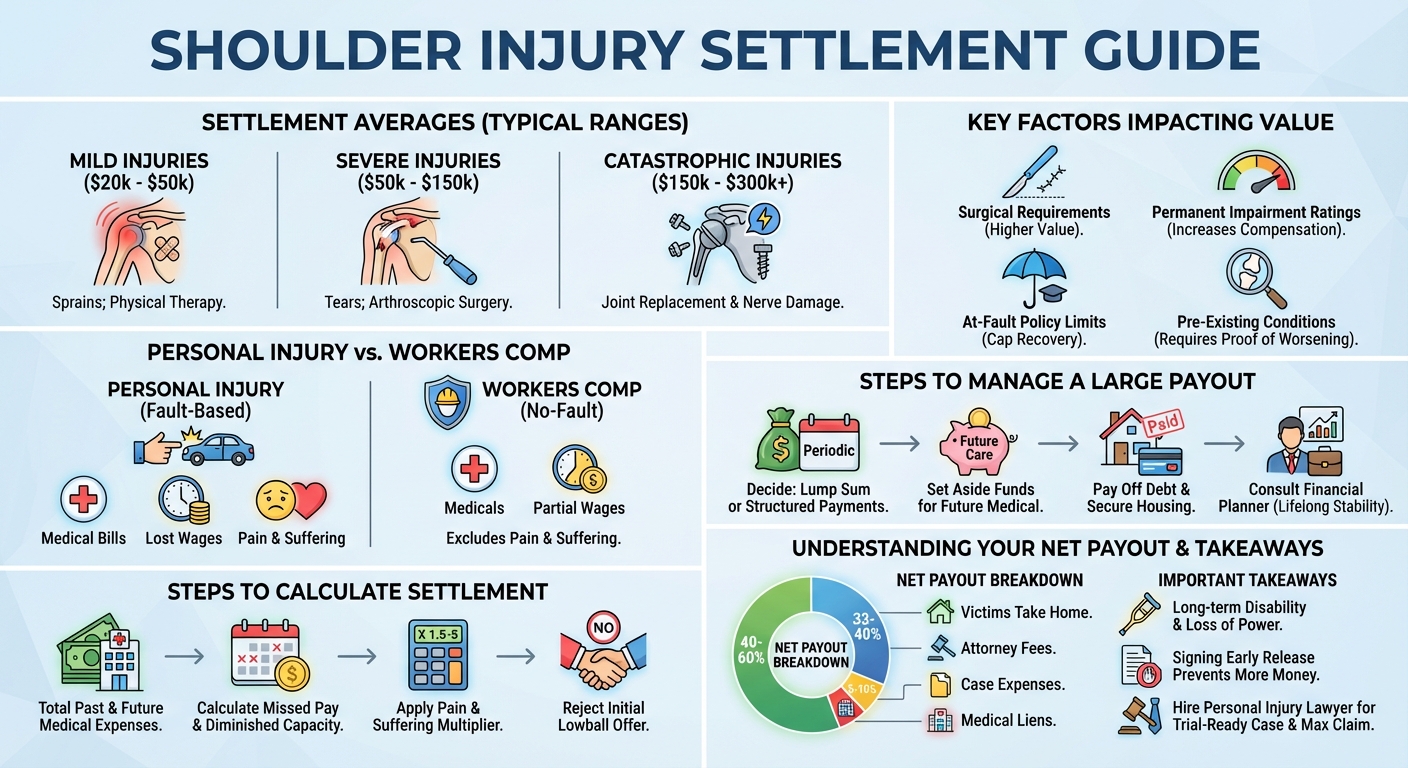
The average compensation for a shoulder injury ranges from $20,000 to $50,000 for mild sprains. Severe injuries, such as torn rotator cuffs requiring surgery, typically settle between $50,000 and $150,000. Catastrophic shoulder injuries involving joint replacement or permanent nerve damage often exceed $150,000 to $300,000.
Shoulder Injury Compensation Amounts: A Guide to Average Settlements
A severe shoulder injury can instantly derail your life, making simple tasks like lifting groceries, driving, or performing your job impossible. Because the shoulder is a complex, highly mobile joint, injuries here often require extensive medical treatment, prolonged physical therapy, and sometimes surgery. If your injury was caused by someone else’s negligence or a workplace accident, understanding typical shoulder injury compensation amounts is critical to protecting your financial future.
Why Shoulder Injuries Yield Significant Payouts
The shoulder relies on a delicate network of muscles, tendons, and ligaments. Damage to the rotator cuff, labrum, or surrounding nerves rarely heals overnight. Insurance companies and juries recognize that these injuries cause significant functional impairment. Payouts are often substantial because victims frequently face long-term disability, chronic pain, and a diminished ability to earn a living.
The Difference Between Personal Injury and Workers’ Comp Claims
How you were injured dictates the type of claim you file, which directly impacts your compensation:
- Personal Injury Claims: Filed when a third party is at fault (e.g., a car accident or slip and fall). These settlements compensate for medical bills, lost wages, and pain and suffering, often leading to higher payouts.
- Workers’ Compensation Claims: Filed for on-the-job injuries regardless of fault. These cover medical expenses and a portion of lost wages, but they do not pay for pain and suffering. Payouts are usually capped based on state impairment schedules.
What is the average payout for a shoulder injury?
The average payout for a shoulder injury ranges from $20,000 to $50,000 for minor sprains. However, severe injuries like torn rotator cuffs requiring surgery typically result in payouts between $50,000 and $150,000. Catastrophic cases involving shoulder replacement or permanent nerve damage frequently exceed $150,000 to $300,000.
| Injury Severity | Typical Settlement Range | Common Examples |
|---|---|---|
| Mild to Moderate | $20,000 – $50,000 | Sprains, strains, minor dislocations requiring physical therapy. |
| Severe | $50,000 – $150,000 | Torn rotator cuffs, labral tears, fractures requiring arthroscopic surgery. |
| Catastrophic | $150,000 – $300,000+ | Shoulder replacement, severe nerve damage (brachial plexus), permanent disability. |
Mild to Moderate Injuries (Sprains and Strains): $20,000 – $50,000
Soft tissue injuries that heal with rest, medication, and a few months of physical therapy fall into this tier. While painful, the lack of surgical intervention and permanent impairment keeps these settlements on the lower end.
Severe Injuries (Torn Rotator Cuff, Labral Tears): $50,000 – $150,000
If your injury requires arthroscopic surgery to repair a torn tendon or ligament, the value of your case increases significantly. The higher medical bills, extended time off work, and increased pain and suffering drive these settlements into the six-figure range.
Catastrophic Injuries (Shoulder Replacement, Nerve Damage): $150,000 – $300,000+
Injuries requiring total shoulder arthroplasty (replacement) or those causing permanent nerve damage yield the highest compensation. These victims often face a lifetime of restricted movement, chronic pain, and the inability to return to their previous profession.
How much should I settle for a shoulder injury?
You should settle for an amount that fully covers your past and future medical bills, lost earning capacity, and pain and suffering. Never accept an initial offer without calculating long-term rehabilitation costs, as shoulder injuries often require ongoing physical therapy or future surgical interventions.
Calculating Your Total Medical Expenses (Past and Future)
Your settlement must reimburse you for ambulance rides, ER visits, imaging (MRIs), surgeries, and physical therapy. Crucially, it must also account for future medical needs. If your doctor states you will need a shoulder replacement in ten years due to post-traumatic arthritis, that cost must be included today.
Factoring in Lost Wages and Diminished Earning Capacity
You are entitled to compensation for the paychecks you missed while recovering. If your shoulder injury prevents you from returning to your heavy-lifting job and forces you into a lower-paying role, you can also claim “diminished earning capacity” to cover the lifetime difference in your income.
Evaluating Pain and Suffering Multipliers
In personal injury cases, insurance adjusters often use a multiplier (typically between 1.5 and 5) applied to your total medical bills to calculate pain and suffering. A severe rotator cuff tear requiring surgery will command a higher multiplier than a minor sprain.
Why You Should Never Accept the First Offer
Insurance companies routinely lowball unrepresented victims, hoping they will accept a quick check before realizing the full extent of their injuries. Once you sign a release, you cannot ask for more money later. Always consult an attorney before accepting an offer.
Key Factors That Impact Your Shoulder Settlement Value
The Need for Surgery (Arthroscopy vs. Arthroplasty)
Surgery is the biggest driver of settlement value. Minimally invasive arthroscopic repairs increase the value, but open surgeries or total joint replacements (arthroplasty) push settlements into the highest tiers due to the invasive nature and long recovery times.
Permanent Impairment Ratings
If you do not regain 100% of your shoulder mobility, a doctor will assign you a permanent impairment rating. A higher rating translates to more compensation, particularly in workers’ comp cases where payouts are directly tied to this percentage.
The Defendant’s Insurance Policy Limits
Even if your case is worth $500,000, you can generally only recover up to the at-fault party’s insurance policy limits. If a driver hits you and only carries $30,000 in bodily injury coverage, that may be the maximum you can recover unless other liable parties are identified.
Pre-existing Conditions and How Insurance Companies Use Them
Adjusters love to blame shoulder pain on “degeneration” or pre-existing conditions, especially in older victims. A skilled attorney will use medical imaging and expert testimony to prove that the accident aggravated or accelerated the condition, making the defendant legally responsible.
How much of a $100K settlement will I get?
From a $100,000 settlement, you can typically expect to take home between $40,000 and $60,000. This net payout is calculated after deducting standard attorney contingency fees—usually 33% to 40%—along with court costs, case expenses, and any outstanding medical liens or unpaid hospital bills.
Understanding Attorney Contingency Fees (Typically 33% to 40%)
Most personal injury lawyers work on a contingency fee basis, meaning they only get paid if you win. The standard fee is 33.3% if the case settles before filing a lawsuit, and often increases to 40% if the case goes to litigation.
Deducting Medical Liens and Unpaid Bills
If your health insurance, Medicare, or a hospital paid for your accident-related treatment, they have a legal right (a lien) to be reimbursed from your settlement. Your attorney will negotiate these liens down to put more money in your pocket.
Case Expenses and Court Costs
Filing fees, expert witness fees, and costs for obtaining medical records are advanced by your attorney and deducted from the final settlement. These typically account for 5% to 10% of the total settlement in a litigated case.
Example Breakdown: Your Net Take-Home Payout
- Gross Settlement: $100,000
- Attorney Fee (33.3%): -$33,333
- Case Expenses: -$2,500
- Medical Liens/Bills: -$15,000
- Your Net Take-Home: $49,167
What to do with a $500,000 settlement?
With a $500,000 settlement, you should first set aside funds for future medical care and shoulder surgeries. After securing your health needs, prioritize paying off high-interest debt and securing stable housing. Finally, consult a financial planner to explore structured settlement options for long-term stability.
Lump Sum vs. Structured Settlement Options
You can receive your payout as a single lump sum or a structured settlement (tax-free periodic payments over time). Structured settlements protect you from spending the money too quickly and provide a guaranteed income stream.
Setting Aside Funds for Future Medical Care and Surgeries
Do not spend the money allocated for future medical care. If your doctor anticipates a future shoulder replacement, place those funds in a dedicated, interest-bearing account so the money is there when you need it.
Paying Off High-Interest Debt and Securing Housing
Eliminating credit card debt and paying off your mortgage (or securing stable housing) are the smartest immediate uses of a large settlement. This reduces your monthly overhead, which is crucial if your earning capacity has been permanently reduced.
Consulting a Financial Planner for Long-Term Stability
A sudden influx of half a million dollars can be overwhelming. A fiduciary financial planner can help you invest the remaining funds conservatively, ensuring the settlement lasts for the rest of your life.
Maximize Your Shoulder Injury Claim with a Houston Personal Injury Lawyer
How Nguyen Injury Law Fights Insurance Company Tactics
Insurance companies use tactics like “social inflation” arguments and disputes over minor property damage to devalue legitimate shoulder injuries. At Nguyen Injury Law, we understand how defense attorneys operate. We build trial-ready cases with comprehensive medical evidence to force adjusters to pay full value for your torn rotator cuff or joint replacement.
Free Case Evaluation: Find Out What Your Shoulder Injury is Worth
Don’t let an insurance adjuster dictate the value of your health. If you suffered a shoulder injury in Texas, contact Nguyen Injury Law today for a free, no-obligation case evaluation. We will review your medical records, calculate your true damages, and fight for the maximum compensation you deserve.
 Call (713) 747-7777