
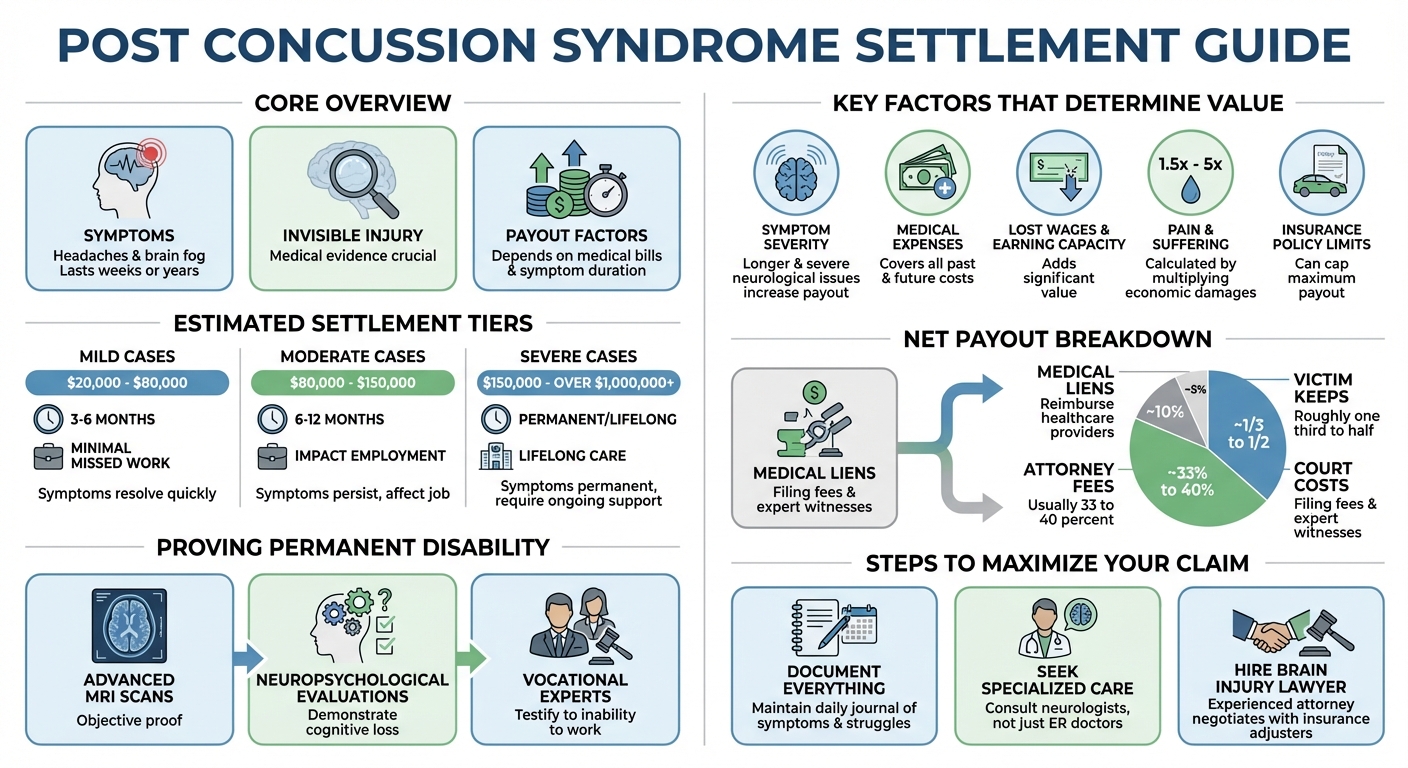
The average settlement value for post-concussion syndrome ranges from $30,000 to $80,000 for mild cases. However, severe cases involving permanent cognitive impairment, chronic migraines, or long-term disability frequently settle between $150,000 and $500,000 or more. Payouts depend heavily on medical expenses, lost wages, and symptom duration.
Understanding Post-Concussion Syndrome Settlement Values
Post-concussion syndrome (PCS) is a complex condition where concussion symptoms—such as headaches, dizziness, and cognitive difficulties—last for weeks, months, or even years after the initial injury. Because brain injuries are largely invisible, determining a fair settlement value requires a deep understanding of medical evidence, financial losses, and long-term impacts.
What is the average payout for post-concussion syndrome?
The average payout for post-concussion syndrome typically ranges from $30,000 to $80,000 for mild cases. However, severe cases involving long-term cognitive impairment or permanent disability frequently settle between $150,000 and $500,000 or more. The final amount depends heavily on medical expenses, lost wages, and symptom duration.
Why PCS settlement amounts vary so widely
Unlike a broken bone, a brain injury does not show up on a standard X-ray, and symptoms are highly subjective. Insurance companies often attempt to downplay PCS, arguing that symptoms are exaggerated or pre-existing. Consequently, settlements vary widely based on the quality of your medical documentation, the credibility of expert witnesses, and the specific jurisdiction where your claim is filed.
Tiered settlement ranges: Mild vs. Moderate vs. Severe
To better understand potential outcomes, it helps to look at PCS claims in tiers based on severity:
| Severity Tier | Typical Settlement Range | Characteristics |
|---|---|---|
| Mild | $20,000 – $80,000 | Symptoms resolve within 3-6 months; minimal missed work; conservative treatment. |
| Moderate | $80,000 – $150,000 | Symptoms last 6-12 months; requires specialized therapy; noticeable impact on daily life and employment. |
| Severe | $150,000 – $1,000,000+ | Symptoms persist over a year or become permanent; inability to return to previous career; requires lifelong care. |
Key Factors That Influence Your PCS Settlement Amount
Severity and duration of neurological symptoms
The longer your symptoms last, the higher the potential settlement. Chronic migraines, severe light sensitivity, vertigo, and personality changes require ongoing medical intervention and drastically reduce your quality of life, which directly increases your compensation.
Current and future medical expenses
A comprehensive settlement must cover all past and future medical bills. This includes emergency room visits, MRI/CT scans, consultations with neurologists, vestibular rehabilitation, cognitive behavioral therapy, and prescription medications.
Lost wages and diminished earning capacity
If your PCS prevents you from working, you are entitled to compensation for lost wages. More importantly, if cognitive deficits prevent you from returning to your specific profession—especially cognitively demanding jobs—you can claim “diminished earning capacity” to cover the lifetime of income you will lose.
Calculating pain and suffering (The Multiplier Method)
Insurance adjusters and attorneys often use the multiplier method to calculate non-economic damages (pain and suffering). They take your total economic damages (medical bills + lost wages) and multiply them by a number between 1.5 and 5. A mild concussion might warrant a 1.5 multiplier, while severe, life-altering PCS could warrant a 4 or 5.
Long-Term Impacts: Is Post-Concussion Syndrome a Permanent Disability?
Is post-concussion syndrome a permanent disability?
While most people recover within a few months, post-concussion syndrome can become a permanent disability. If symptoms like severe memory loss, chronic migraines, or cognitive deficits persist for over a year and prevent you from working, it may be legally and medically classified as a permanent impairment.
How permanent cognitive impairment increases settlement value
When PCS is deemed permanent, the financial stakes rise exponentially. Settlements must now account for decades of lost earning potential, lifelong medical care, and permanent loss of enjoyment of life. These cases frequently push into the high six-figure or seven-figure range.
Proving long-term disability to insurance companies
Insurance companies will fight permanent disability claims aggressively. Winning these cases requires objective evidence, such as neuropsychological evaluations, advanced imaging (like DTI or functional MRIs), and testimony from vocational rehabilitation experts who can prove you are no longer employable in your field.
Breaking Down Your Net Payout: Where Does the Money Go?
How much would I get out of $100,000 settlement?
Out of a $100,000 settlement, you can typically expect to take home between $33,000 and $55,000. Approximately 33% to 40% goes to attorney fees, while the remainder covers medical liens, expert witness fees, and court costs. Your lawyer will negotiate medical liens to maximize your net payout.
What to do with a $500,000 settlement?
If you receive a $500,000 settlement, first set aside funds to cover ongoing medical care and immediate financial needs. Next, consult a financial advisor to invest the remaining net payout—often through a structured settlement or conservative index funds—ensuring long-term financial stability to replace lost earning capacity.
Understanding attorney fees, medical liens, and court costs
- Attorney Fees: Most personal injury lawyers work on a contingency fee basis, meaning they take a percentage (usually 33% to 40%) only if you win.
- Medical Liens: Health insurance providers or hospitals may place a lien on your settlement to recover the costs of care they provided.
- Court Costs: These include filing fees, deposition costs, and fees paid to expert witnesses.
Real-World Post-Concussion Syndrome Settlement Examples
Example 1: Mild PCS from a rear-end car accident
A driver was rear-ended at a stoplight and suffered a concussion. Symptoms like headaches and brain fog lasted for four months. They missed three weeks of work and required physical therapy for neck pain and vestibular therapy for dizziness. Estimated Settlement: $45,000.
Example 2: Severe PCS with permanent cognitive impact from a commercial truck crash
A 40-year-old software engineer was hit by a negligent commercial truck driver. They developed severe PCS, resulting in permanent memory deficits, chronic migraines, and an inability to stare at screens, ending their career. Estimated Settlement: $850,000.
How insurance policy limits cap potential payouts
Your settlement is heavily dependent on the at-fault party’s insurance policy limits. Even if your PCS is worth $500,000, if the negligent driver only carries a minimum $30,000 state liability policy, that $30,000 may be the maximum you can recover unless you have underinsured motorist (UIM) coverage.
How to Maximize Your Concussion Injury Claim
Documenting your symptoms thoroughly from day one
Keep a daily symptom journal. Record when you experience headaches, memory lapses, or mood swings. This subjective documentation, when paired with medical records, paints a compelling picture of your daily suffering for insurance adjusters and juries.
The importance of working with neurologists and TBI specialists
Emergency room doctors are trained to rule out life-threatening brain bleeds, not to diagnose long-term PCS. To maximize your claim, you must seek treatment from neurologists and traumatic brain injury (TBI) specialists who can properly diagnose and document your ongoing syndrome.
Why you need an experienced brain injury lawyer to fight social inflation tactics
Insurance companies increasingly use “social inflation” narratives to justify lowballing claims, arguing that juries are awarding too much money. An experienced personal injury attorney knows how to counter these tactics, utilizing expert testimony and aggressive negotiation to ensure your post-concussion syndrome is valued fairly and accurately.
 Call (713) 747-7777