

Table of contents
Yes, you can sue for nerve damage after surgery if the injury was caused by medical negligence rather than a known surgical risk. To have a valid medical malpractice claim, you must prove that the surgeon or healthcare provider breached the standard of care, directly causing your nerve injury.
Can You Sue for Nerve Damage After Surgery?
Waking up from surgery with numbness, tingling, or loss of motor function can be terrifying. If you are experiencing these symptoms, you are likely wondering about your legal options.
The Short Answer: Yes, Under Specific Conditions
You can sue a surgeon, anesthesiologist, or hospital for nerve damage if the injury was the direct result of medical negligence. To have a valid claim, you must prove that the healthcare provider breached the accepted standard of medical care during your procedure, and that this breach directly caused your nerve injury.
Understanding Medical Malpractice vs. Unavoidable Complications
Not every surgical complication qualifies as medical malpractice. The human body is complex, and nerves are incredibly delicate. Sometimes, nerves are damaged even when a surgeon performs the procedure flawlessly. A malpractice lawsuit hinges on whether a similarly trained medical professional would have made the same mistake under the same circumstances. If the answer is no, you may have a case.
Medical Negligence vs. Known Surgical Risks
Does Signing a Consent Form Waive Your Right to Sue?
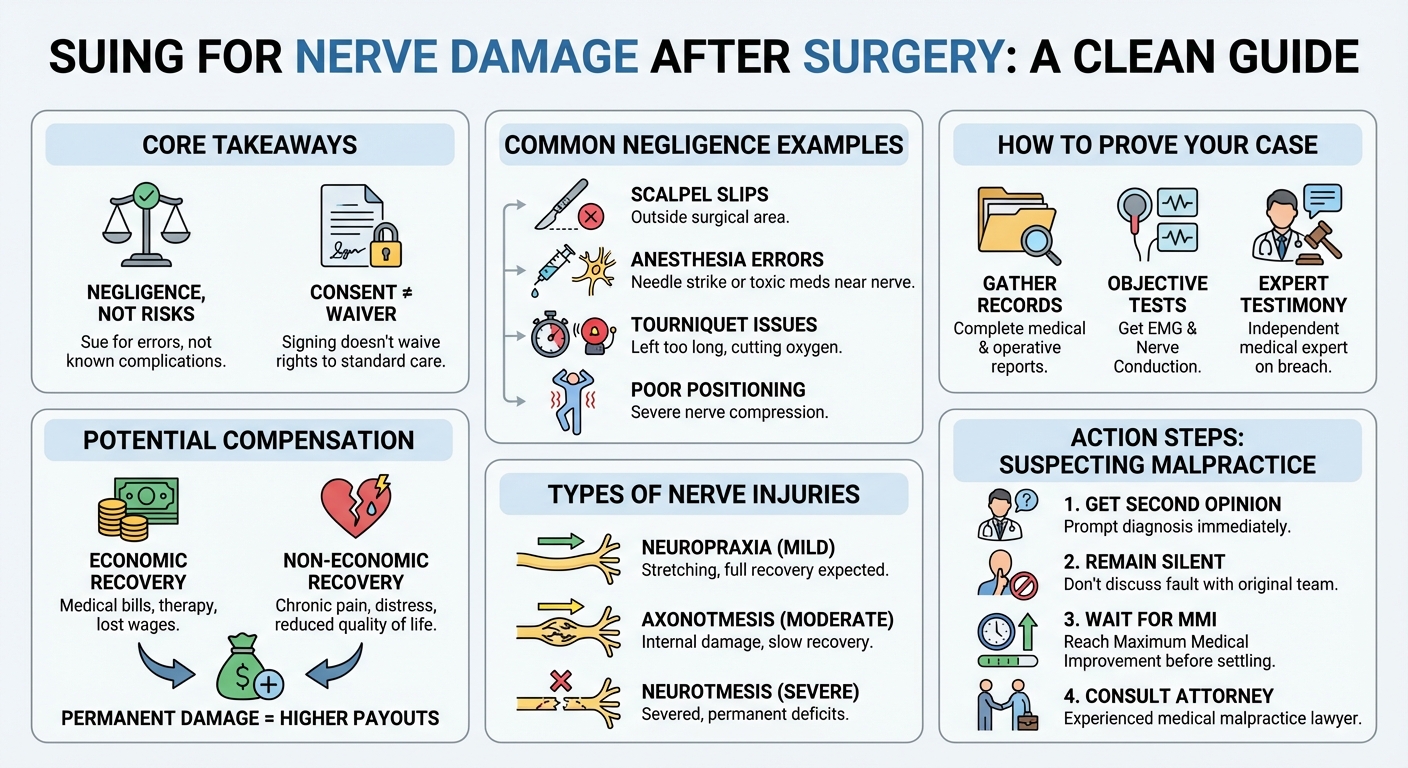
A common misconception is that signing an informed consent form prevents you from taking legal action. This is false. While a consent form acknowledges that you understand the known risks of a procedure, it does not give the surgical team permission to be careless. You cannot consent to medical negligence or substandard care.
Examples of Surgical Negligence
Nerve damage becomes actionable malpractice when it stems from preventable errors. Common examples include:
- Scalpel Slips: Accidentally severing or nicking a nerve that is not in the immediate operative field.
- Anesthesia Errors: Striking a nerve directly with a needle during an epidural or regional block, or administering toxic medication near a nerve root.
- Improper Tourniquet Use: Leaving a surgical tourniquet on for too long, depriving nerves of blood flow and oxygen.
- Poor Patient Positioning: Failing to properly pad or position a patient during a long surgery, leading to severe nerve compression.
How to Prove Nerve Damage After Surgery?
To prove nerve damage after surgery, you must establish that a medical professional breached the standard of care. This requires gathering comprehensive medical records, undergoing diagnostic tests like EMG or nerve conduction studies, and securing testimony from a qualified medical expert who can confirm the surgeon’s negligence caused your injury.
Gathering Medical Records and Operative Reports
Your medical records are the foundation of your case. Your attorney will meticulously review the operative report, anesthesia logs, and nursing notes to identify any deviations from standard surgical protocols or unexplained complications during the procedure.
The Role of EMG and Nerve Conduction Studies
Subjective complaints of pain or numbness are not enough for a lawsuit. You need objective medical evidence. Electromyography (EMG) and Nerve Conduction Velocity (NCV) tests measure the electrical activity in your muscles and nerves, pinpointing the exact location and severity of the damage.
Securing Expert Medical Testimony
In medical malpractice cases, the law requires an independent medical expert to testify on your behalf. This expert—usually a surgeon in the same specialty as the defendant—will review your files and explain to the court exactly how the original surgeon failed to meet the standard of care.
Can You Get Compensation for Nerve Damage After Surgery?
Yes, you can get compensation for nerve damage after surgery if it resulted from medical malpractice. Victims can recover economic damages, such as past and future medical bills and lost wages, as well as non-economic damages for pain, suffering, and the loss of overall quality of life.
Economic Damages (Medical Bills, Lost Wages)
Economic damages reimburse you for out-of-pocket financial losses. This includes the cost of corrective surgeries, physical therapy, mobility aids, and medications. It also covers lost wages if you had to miss work, or loss of future earning capacity if the nerve damage forces you to change careers or stop working entirely.
Non-Economic Damages (Pain and Suffering, Loss of Quality of Life)
Nerve damage often causes chronic, burning pain (neuropathy) that can disrupt your sleep, relationships, and mental health. Non-economic damages compensate you for this physical pain, emotional distress, and the loss of enjoyment of life.
What is the Average Settlement for Nerve Damage?
There is no single average settlement for nerve damage, as case values vary widely based on severity. Minor, temporary injuries might settle for tens of thousands of dollars, while permanent, debilitating nerve damage causing chronic pain or paralysis can result in settlements or verdicts exceeding a million dollars.
Factors That Increase Settlement Value
Insurance companies and juries look at several variables when calculating a settlement payout. Here is a breakdown of what impacts your case value:
| Factor | Lower Settlement Value | Higher Settlement Value |
|---|---|---|
| Severity of Injury | Mild tingling, temporary numbness | Complete paralysis, loss of limb function |
| Duration | Heals within a few months | Permanent, lifelong damage |
| Impact on Career | Able to return to the same job | Forced into early retirement or disability |
| Clarity of Negligence | Disputed cause of injury | Blatant surgical error documented in records |
Why Permanent Damage Yields Higher Compensation
Permanent nerve damage requires lifelong medical management. Because the victim will continuously suffer from pain or loss of function, the courts award higher compensation to cover decades of future medical care and sustained emotional distress.
Does Nerve Damage Ever Go Away?
Nerve damage can sometimes go away, depending on the severity of the injury. Mild nerve stretching or compression often heals fully within weeks or months. However, severe injuries involving completely severed or crushed nerves may result in permanent numbness, weakness, or chronic pain that never fully resolves.
Temporary vs. Permanent Nerve Injuries (Neuropraxia vs. Neurotmesis)
- Neuropraxia: The mildest form of nerve injury, usually caused by minor stretching or compression. The nerve remains intact, and full recovery is expected within a few weeks to months.
- Axonotmesis: The protective sheath remains intact, but the nerve fibers inside are damaged. Recovery is possible but slow, as nerves grow at a rate of about one inch per month.
- Neurotmesis: The most severe injury, where the nerve is completely severed. Without surgical intervention, recovery is impossible, and even with surgery, permanent deficits are common.
How Your Long-Term Prognosis Impacts Your Lawsuit
You should never rush to settle a medical malpractice claim before reaching Maximum Medical Improvement (MMI). MMI is the point at which your doctor determines your nerve damage has healed as much as it ever will. Settling before this point risks leaving money on the table for future treatments you didn’t know you needed.
Steps to Take If You Suspect Surgical Malpractice
Seek a Second Medical Opinion Immediately
If your surgeon dismisses your complaints of numbness or pain as “normal,” seek a second opinion from an independent neurologist or specialist. Prompt diagnosis is crucial for both your physical recovery and your legal case.
Do Not Discuss Fault with the Original Surgeon
While you should report your symptoms to your surgical team, avoid making accusations or discussing potential lawsuits. Anything you say can be noted in your medical file and used by the hospital’s legal team to undermine your claim.
Consult a Medical Malpractice Attorney
Medical malpractice cases are notoriously complex and subject to strict statutes of limitations. If you suspect your nerve damage was caused by a surgical error, contact an experienced medical malpractice attorney for a free case evaluation. They can help you secure your records, hire the right medical experts, and fight for the compensation you deserve.