

Table of contents
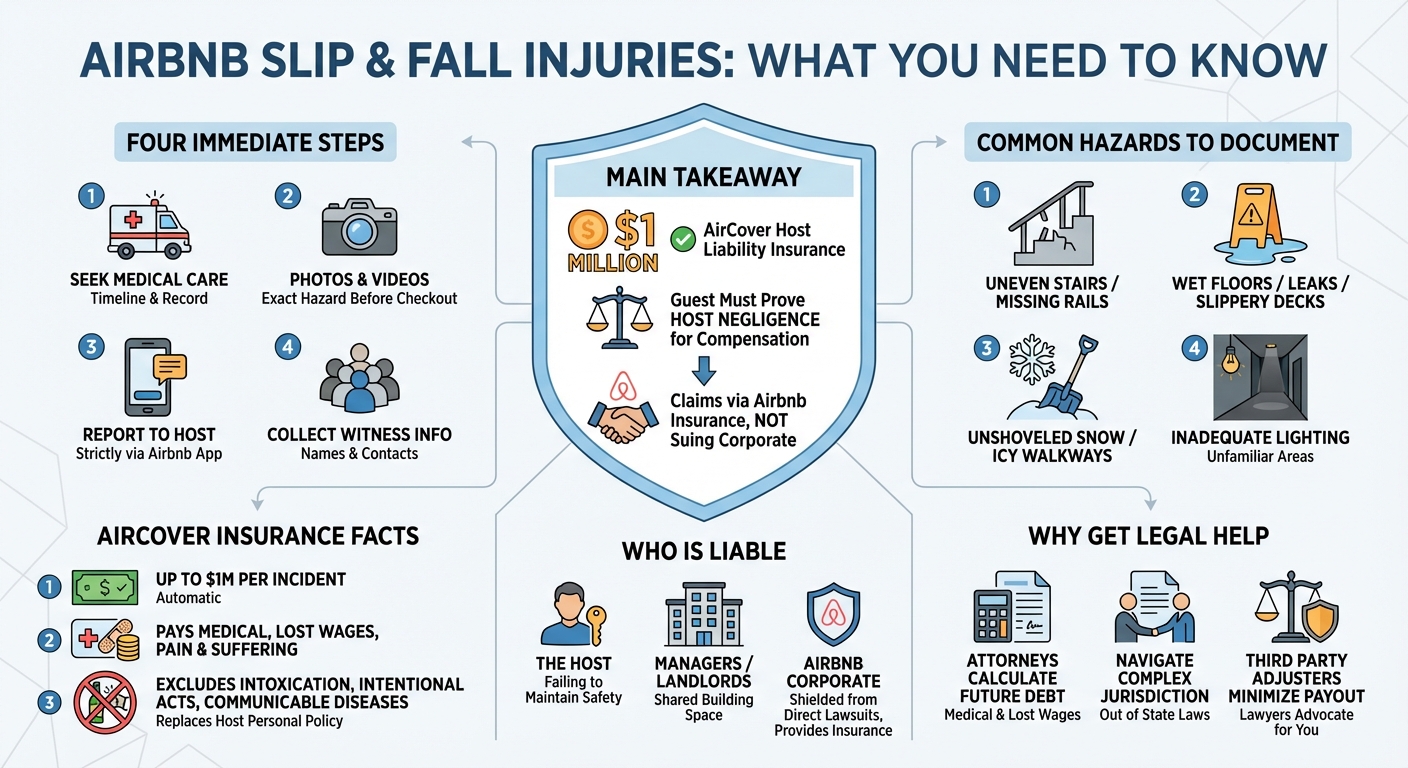
If you suffer a slip and fall at an Airbnb, Airbnb’s AirCover provides up to $1 million in Host Liability Insurance. To secure compensation, you must prove the host’s negligence caused your injury. Immediately seek medical attention, document the hazard with photos, and report the incident through the Airbnb app.
What to Do Immediately After a Slip and Fall at an Airbnb
Suffering a slip and fall injury while staying at an Airbnb can quickly turn a vacation into a legal and medical nightmare. Because Airbnb properties are privately owned but booked through a corporate platform, liability can be complex. Taking the right steps immediately after your accident is critical to protecting your health and your potential injury claim.
Seek immediate medical attention
Your health is the top priority. Even if your injuries seem minor, adrenaline can mask the pain of fractures, concussions, or soft tissue damage. Visit a local urgent care or emergency room right away. A prompt medical evaluation creates an official medical record linking your injuries directly to the date and time of your Airbnb stay.
Document the hazard with photos and video before checkout
Evidence disappears quickly in short-term rentals. Before you leave the property, use your smartphone to take clear photos and videos of the exact hazard that caused your fall. Capture wide angles of the room and close-ups of the defect—whether it is a puddle of water, a broken stair tread, or a torn rug. If poor lighting contributed to the fall, take a video demonstrating the visibility issues.
Report the injury to the host via the Airbnb app
Notify your host about the accident as soon as possible, but strictly use the Airbnb app’s messaging system to do so. This creates a time-stamped, written record of the incident that Airbnb corporate can access. Stick to the basic facts of what happened and avoid apologizing or making statements that could be interpreted as admitting fault.
Collect witness contact information
If anyone else witnessed your fall—including family members, friends, or neighbors—write down their names and contact information. Witness statements can be invaluable later when proving that the hazard existed and directly caused your injury.
Who Is Liable for an Airbnb Slip and Fall Accident?
Determining who is legally responsible for your medical bills and lost wages depends on the specific circumstances of the property and the accident.
Host Negligence and Premises Liability
Under the legal concept of premises liability, property owners have a duty to maintain a safe environment for their guests. If an Airbnb host knew (or reasonably should have known) about a dangerous condition and failed to fix it or warn you about it, they can be held liable for your injuries.
Landlords and Property Management Companies
Many Airbnb hosts do not actually own the property they are renting out. If the host is a tenant, the actual property owner or the building’s property management company might share liability, especially if the fall occurred in a common area like a shared hallway, lobby, or exterior staircase.
Can You Sue Airbnb Corporate Directly?
Suing Airbnb directly is notoriously difficult. Airbnb classifies itself as a third-party booking platform, not a property owner or manager. Their Terms of Service include liability waivers designed to shield the corporation from lawsuits regarding host negligence. However, instead of suing Airbnb directly, injured guests typically seek compensation through Airbnb’s insurance policies.
Does Airbnb cover slip and fall?
Yes, Airbnb covers slip and fall accidents through its AirCover program, which includes up to $1 million in Host Liability Insurance. If a guest is injured due to a host’s negligence—such as a wet floor or broken stairs—this insurance is designed to compensate for medical bills and related damages.
Understanding Airbnb AirCover and Host Liability Insurance
AirCover is automatically included for all Airbnb hosts. It acts as the primary insurance policy when a guest suffers bodily injury or property damage during a stay. This means you do not necessarily have to go after the host’s personal homeowner’s insurance, which often excludes short-term rental activities anyway.
The $1 Million Coverage Limit
The Host Liability Insurance provides up to $1 million in coverage per incident. This pool of money is meant to cover your medical expenses, rehabilitation costs, lost wages, and pain and suffering. However, simply getting injured does not guarantee a payout; you must still prove that the host’s negligence caused the accident.
Exclusions: What AirCover Does Not Pay For
AirCover has specific exclusions. It generally will not cover injuries caused by intentional acts, injuries resulting from a guest’s own intoxication or reckless behavior, or issues related to communicable diseases. Additionally, it does not cover property damage that you cause to the host’s home—that falls under a different section of AirCover.
Common Hazards That Cause Slip and Fall Injuries in Short-Term Rentals
Short-term rentals often lack the rigorous safety inspections required of traditional hotels. Common hazards include:
- Uneven stairs and missing handrails: Older homes or poorly renovated spaces frequently feature steep, uneven steps or lack proper handrails, violating local building codes.
- Wet floors, leaks, and slippery pool decks: Undetected plumbing leaks, recently mopped floors without warning signs, or unmaintained pool areas are prime culprits for slip and falls.
- Unshoveled snow and icy walkways: In colder climates, hosts who fail to promptly clear driveways, walkways, and exterior stairs put arriving and departing guests at severe risk.
- Inadequate lighting in hallways and exteriors: Guests are unfamiliar with the layout of an Airbnb. Burned-out bulbs or a lack of exterior lighting can easily lead to a dangerous trip and fall at night.
Airbnb Rules, Host Policies, and Damage Claims
While navigating an injury claim, guests often encounter various Airbnb rules and host metrics. Understanding these can help clarify the difference between host business practices and your legal rights.
What is the 75-55 rule in Airbnb?
The 75-55 rule is a common Airbnb hosting strategy aiming for 75% occupancy while pricing the rental 55% higher than local long-term rental averages. While this rule helps hosts maximize their rental revenue and profitability, it has absolutely no impact on guest injury claims or premises liability cases.
What is the 80/20 rule for Airbnb?
The 80/20 rule for Airbnb is a business principle suggesting that 80% of a host’s revenue or positive reviews comes from 20% of their efforts or top-tier listings. Like other hosting metrics, this rule strictly relates to property management and does not affect your rights in a personal injury claim.
How long can Airbnb force me to pay for damages?
If a host accuses you of property damage, Airbnb requires them to submit a claim through the Resolution Center within 14 days of your checkout, or before the next guest arrives. If you refuse to pay, Airbnb may step in, review the evidence, and potentially charge your payment method.
When to Hire a Personal Injury Lawyer for Your Airbnb Claim
Handling a premises liability claim against a massive corporation’s insurance provider is not a DIY project.
Why dealing with AirCover adjusters requires legal help
Airbnb’s insurance is managed by third-party adjusters whose primary goal is to minimize payouts. They may argue that you were at fault for the fall, that the hazard was “open and obvious,” or that your injuries are not as severe as you claim. An experienced attorney knows how to counter these tactics and protect your rights.
Maximizing your settlement for medical bills and lost wages
A slip and fall can result in mounting medical debt and missed time from work. A personal injury lawyer will properly calculate the full extent of your damages—including future medical care and pain and suffering—ensuring you do not accept a lowball settlement offer.
How our nationwide network and local attorneys can help
Because Airbnb rentals are often located in different states than where you live, jurisdictional issues can complicate your claim. Working with a legal team that understands both local premises liability laws and Airbnb’s corporate insurance structure is the best way to secure the compensation you deserve.