
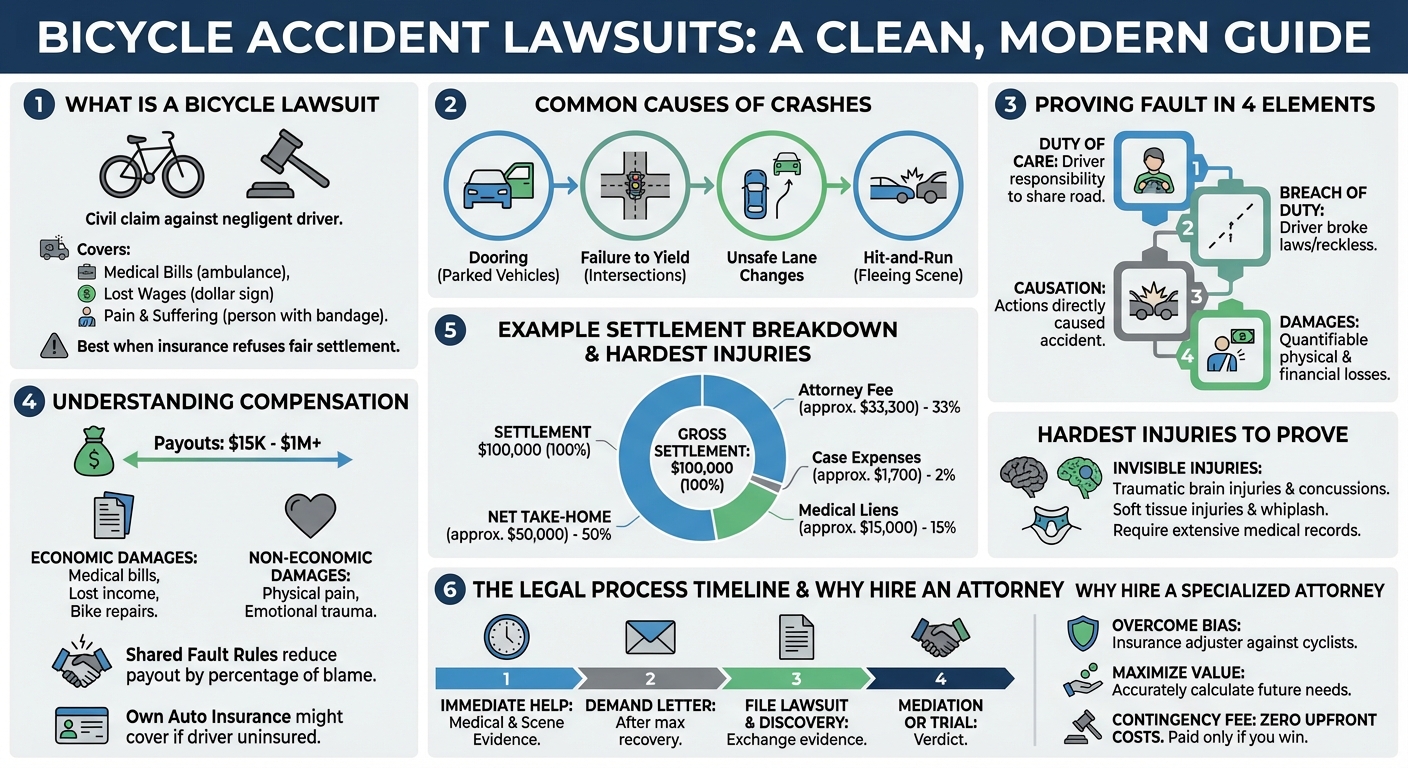
A bicycle accident lawsuit is a civil claim filed by an injured cyclist against a negligent party, usually a motorist. To win, you must prove the driver breached their duty of care, directly causing your injuries. Successful lawsuits recover compensation for medical bills, lost wages, and pain and suffering.
Bicycle Accident Lawsuits: A Complete Guide to Claims and Settlements
Being struck by a vehicle while riding a bicycle can be a life-altering event. Because cyclists lack the physical protection of a car, crashes often result in catastrophic injuries, mounting medical bills, and extended time away from work. A bicycle accident lawsuit is a civil claim designed to hold negligent drivers accountable and secure the financial compensation you need to rebuild your life. This guide breaks down the legal process, how settlements are calculated, and what you can expect when taking legal action.
When Should You File a Bicycle Accident Lawsuit?
You should consider filing a lawsuit if you were injured by a negligent driver and their insurance company refuses to offer a fair settlement. While many claims are resolved out of court, filing a formal lawsuit forces the insurer to take your damages seriously.
Common Causes of Bicycle Crashes (Dooring, Intersections, Hit-and-Runs)
Most bicycle accidents stem from driver inattention or recklessness. Common scenarios include dooring (when a parked driver opens their door directly into a cyclist’s path), failure to yield at intersections, unsafe lane changes, and hit-and-run incidents where the driver flees the scene to avoid liability.
Proving Negligence: Duty, Breach, and Causation
To win a bicycle accident lawsuit, your attorney must prove four legal elements:
- Duty of Care: The driver had a responsibility to share the road safely.
- Breach of Duty: The driver violated traffic laws or acted recklessly.
- Causation: The driver’s actions directly caused the collision.
- Damages: You suffered quantifiable losses, such as injuries and financial hardship.
Dealing with Uninsured or Underinsured Motorists
If the at-fault driver lacks sufficient insurance, you are not necessarily out of options. Your lawyer can look into your own auto insurance policy’s Uninsured/Underinsured Motorist (UM/UIM) coverage, which often extends to you even when you are riding a bicycle.
How much compensation for a bicycle accident?
Compensation for a bicycle accident varies widely, typically ranging from $15,000 for minor injuries to over $1 million for catastrophic harm. The exact amount depends on your medical expenses, lost income, long-term care needs, and the at-fault driver’s insurance policy limits.
Calculating Economic Damages (Medical Bills, Lost Wages, Property Damage)
Economic damages reimburse you for out-of-pocket expenses. This includes emergency room visits, surgeries, physical therapy, the cost of replacing your damaged bicycle, and any wages lost while you were unable to work.
Calculating Non-Economic Damages (Pain and Suffering, Loss of Enjoyment)
Non-economic damages compensate you for the intangible impacts of the crash. This covers physical pain, emotional trauma, PTSD, and the loss of ability to enjoy hobbies or daily activities you participated in prior to the accident.
Understanding Settlement Payouts: Is $100,000 a good settlement?
Yes, $100,000 is often considered a good settlement if your medical bills are low and you have fully recovered. However, if you suffered severe injuries like a traumatic brain injury or require lifelong care, $100,000 may be entirely inadequate to cover your long-term damages.
Evaluating Policy Limits vs. Actual Damages
A major factor in any settlement is the defendant’s insurance policy limit. If a driver only carries $25,000 in bodily injury liability, recovering more than that amount can be difficult unless the driver has substantial personal assets or you have applicable UM/UIM coverage.
How Shared Fault (Comparative Negligence) Impacts Your Payout
Insurance companies often try to blame the cyclist to reduce their payout. Under comparative negligence laws, your compensation can be reduced by your percentage of fault. For example, if you are awarded $100,000 but found 20% at fault for riding without a light at night, your payout would be reduced to $80,000.
How much of a $100K settlement will I get?
From a $100,000 settlement, you will typically take home between $40,000 and $60,000. This net amount is calculated after your attorney deducts their standard contingency fee (usually 33% to 40%), case expenses, and any outstanding medical liens or unpaid hospital bills.
Standard Contingency Fees (33% to 40%)
Most personal injury lawyers work on a contingency fee basis, meaning they only get paid if you win. The industry standard is 33.3% if the case settles before litigation, and it may increase to 40% if a lawsuit is filed and goes to trial.
Deducting Medical Liens and Case Expenses
Before you receive your check, your lawyer must pay off any medical providers or health insurance companies that placed a lien on your settlement. Additionally, case expenses like court filing fees, expert witness costs, and police report retrieval fees will be deducted.
Example Calculation: Your Net Take-Home Amount
| Item | Estimated Deduction | Remaining Balance |
|---|---|---|
| Gross Settlement | $0 | $100,000 |
| Attorney Fee (33.3%) | -$33,300 | $66,700 |
| Case Expenses | -$1,700 | $65,000 |
| Medical Liens | -$15,000 | $50,000 (Net Take-Home) |
What is the hardest injury to prove?
The hardest injury to prove in a bicycle accident is often a mild traumatic brain injury (TBI) or soft tissue damage. Unlike broken bones, these invisible injuries do not always show up on standard X-rays or MRI scans, making them easy for insurance companies to dispute.
Traumatic Brain Injuries (TBIs) and Concussions
Even with a helmet, cyclists can suffer concussions that lead to long-term cognitive issues, memory loss, and mood changes. Because symptoms can be subtle or delayed, insurers frequently argue that the TBI is exaggerated or unrelated to the crash.
Soft Tissue Injuries and Whiplash
Damage to muscles, ligaments, and tendons can cause excruciating chronic pain. However, because these injuries are subjective and difficult to quantify visually, defense attorneys often downplay their severity to minimize settlement offers.
Why Medical Documentation is Critical
To overcome skepticism regarding invisible injuries, you must seek immediate and continuous medical care. Detailed medical records, specialist referrals, and expert testimony from neurologists or orthopedic surgeons are essential to proving the existence and impact of your injuries.
The Bicycle Accident Lawsuit Timeline: Step-by-Step
Step 1: Immediate Medical Treatment and Evidence Gathering
Your health is the priority. Seek medical attention immediately, even if you feel fine. Simultaneously, gather evidence: take photos of the scene, keep your damaged bike and helmet, and obtain the police report and witness contact information.
Step 2: Sending the Demand Letter to the Insurance Company
Once you reach maximum medical improvement (MMI), your attorney will draft a demand letter outlining your injuries, liability arguments, and the total compensation requested. This triggers the initial negotiation phase.
Step 3: Filing the Complaint and Entering Discovery
If the insurer refuses to offer a fair settlement, your lawyer will file a formal complaint in civil court. Both sides then enter the discovery phase, exchanging evidence, taking depositions under oath, and consulting accident reconstruction experts.
Step 4: Mediation, Negotiation, or Trial
Before going to trial, a judge will typically order mediation. A neutral third party will attempt to help both sides reach an agreement. If mediation fails, your case will proceed to trial, where a judge or jury will determine the final verdict and compensation.
Why You Need a Specialized Bicycle Accident Attorney
Overcoming Insurance Adjuster Bias Against Cyclists
Insurance adjusters often harbor a built-in bias against cyclists, assuming they were riding recklessly or ignoring traffic laws. A specialized attorney knows how to counter these tactics using traffic camera footage, witness statements, and local cycling laws.
Maximizing Your Settlement Value
Unrepresented victims routinely accept lowball offers that fail to cover future medical needs. An experienced lawyer accurately calculates your lifetime damages and has the litigation resources to threaten a trial, which forces insurers to offer maximum compensation.
Free Consultations and No Upfront Fees
Hiring a bicycle accident lawyer carries no financial risk. Reputable firms offer free initial consultations to evaluate your claim and operate on a contingency fee basis. You pay nothing out of pocket, and they only collect a fee if they successfully recover money for you.
 Call (713) 747-7777