
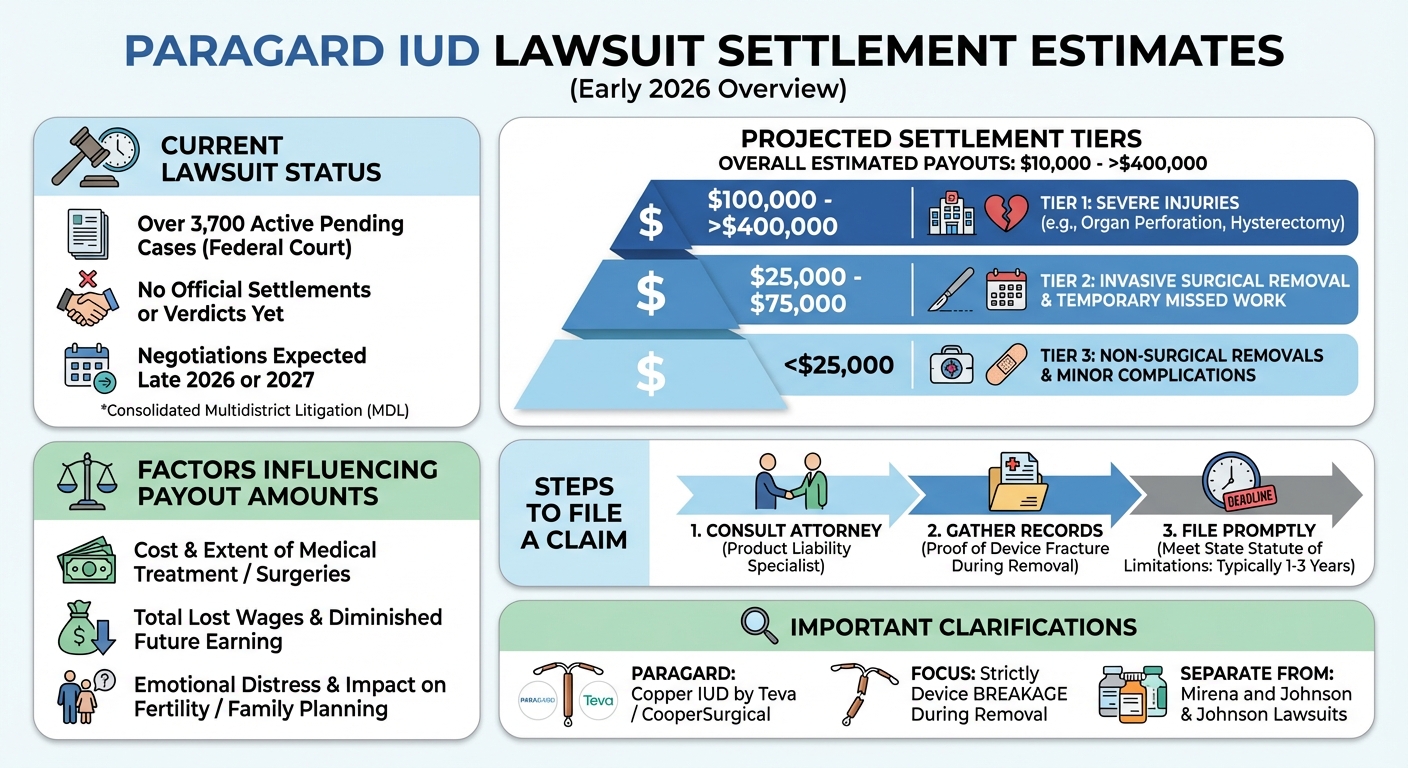
While no official settlements have been finalized, legal experts estimate that Paragard IUD lawsuit settlement amounts will range from $10,000 to over $400,000. Payouts will likely be divided into tiers, with Tier 1 cases involving severe injuries like organ perforation or hysterectomy receiving the highest compensation.
Paragard IUD Lawsuit Settlement Amounts: 2026 Payout Estimates
As of early 2026, there have been no official global settlements or jury verdicts in the Paragard IUD litigation. However, based on historical data from similar defective medical device lawsuits, legal experts can project realistic settlement ranges. If the manufacturers (Teva Pharmaceuticals and CooperSurgical) agree to a global settlement, payouts are expected to range from $10,000 to over $400,000 per plaintiff.
Because the Paragard lawsuits are consolidated into a Multidistrict Litigation (MDL) rather than a standard class action, compensation will not be a flat rate. Instead, settlement amounts will be calculated based on the specific damages and injuries each individual suffered when their copper IUD fractured during removal.
Projected Settlement Tiers for Paragard Lawsuits
When mass torts resolve, settlement administrators typically use a “tier” system to distribute funds fairly. Cases with the most catastrophic injuries receive the highest compensation. Here is the projected tier structure for Paragard settlements:
Tier 1: Severe Injuries, Organ Perforation, and Hysterectomy ($100,000 – $400,000+)
Plaintiffs in this top tier have suffered life-altering complications due to the broken IUD. To qualify for Tier 1 compensation, medical records generally must show:
- Uterine or organ perforation caused by migrating IUD fragments.
- The medical necessity of a full or partial hysterectomy.
- Permanent loss of fertility or severe, chronic pelvic pain.
- Multiple invasive surgeries to locate and remove the broken pieces.
Tier 2: Invasive Surgery Required for Removal ($25,000 – $75,000)
Tier 2 cases involve significant medical intervention but do not result in permanent infertility or organ loss. Expected criteria include:
- Requirement of a hysteroscopy, laparoscopy, or laparotomy to retrieve the fractured IUD arms.
- Moderate recovery time with temporary missed work.
- No permanent damage to the reproductive organs.
Tier 3: Minor Complications and Non-Surgical Removals (Under $25,000)
This tier applies to plaintiffs who experienced a device fracture, but the broken pieces were removed relatively easily without invasive surgery. These cases usually involve minor outpatient procedures, minimal lost wages, and a quick recovery period.
Key Factors That Will Determine Your Individual Payout
If you are filing a Paragard lawsuit, your attorney will build a case to maximize your compensation based on several distinct factors.
Extent of Medical Treatment and Surgeries
The core of your claim value relies on your medical bills. The more invasive the procedures required to remove the broken IUD fragments, the higher your potential settlement. Out-of-pocket costs for hospital stays, imaging, and specialist consultations will all be factored into your payout.
Lost Wages and Diminished Earning Capacity
If your injuries or subsequent surgeries forced you to miss work, you are entitled to claim lost wages. In severe cases where chronic pain or permanent disability affects your ability to work long-term, you may also receive compensation for diminished future earning capacity.
Impact on Fertility and Future Family Planning
For many women, the most devastating consequence of a Paragard fracture is the loss of fertility, particularly if a hysterectomy was required. Juries and settlement administrators place a high financial value on the emotional distress and loss of reproductive ability, which significantly drives up Tier 1 settlement amounts.
Current Status of the Paragard MDL (March 2026 Update)
Active Case Count and MDL Consolidation
The Paragard litigation is centralized in the U.S. District Court for the Northern District of Georgia (MDL No. 2936). As of early 2026, there are over 3,700 active lawsuits pending in the MDL. The court has been actively managing discovery and preparing for “bellwether” trials—test cases that will help both sides gauge how juries respond to the evidence.
When Will Paragard Settlements Actually Be Paid?
Mass torts take time. Settlement negotiations usually begin in earnest only after a few bellwether trials have concluded. If the plaintiffs win these initial trials, the manufacturers will face immense pressure to offer a global settlement. Legal experts anticipate that meaningful settlement talks could begin in late 2026 or 2027, with actual payouts following shortly after an agreement is reached.
Clearing Up Confusion: Paragard vs. Mirena and J&J Lawsuits
Because there are multiple medical device lawsuits in the news, plaintiffs often confuse the details. It is important to note:
- Paragard is a non-hormonal copper IUD manufactured by Teva Pharmaceuticals and CooperSurgical. The current lawsuits focus strictly on the device breaking during removal.
- Mirena is a hormonal IUD made by Bayer. In 2017, Bayer offered a $12.2 million settlement for Mirena lawsuits involving organ perforation. This is completely separate from Paragard.
- Johnson & Johnson (J&J) is facing massive litigation for talcum powder and transvaginal mesh, but J&J does not manufacture Paragard.
Frequently Asked Questions About Paragard Compensation
Does everyone get the same amount of money in a class action lawsuit?
No. The Paragard litigation is organized as a Multidistrict Litigation (MDL), not a traditional class action. In an MDL, each plaintiff retains their individual lawsuit. Settlement amounts are determined by a tier system based on the specific severity of your injuries, medical expenses, and recovery time.
How do I join the Paragard lawsuit?
To join the Paragard lawsuit, you should first consult with an experienced product liability attorney. They will help you gather your medical records, specifically surgical notes proving the IUD fractured during removal. Your lawyer will then file your individual complaint and transfer it into the ongoing federal MDL.
What is the deadline to file a Paragard claim?
The deadline to file a Paragard claim is governed by your state’s statute of limitations for product liability. This window typically ranges from one to three years from the date the IUD broke during removal or the date you discovered the injury. Contacting a lawyer promptly is crucial.
How much will each person get from Johnson and Johnson settlement?
Johnson & Johnson does not manufacture the Paragard IUD, so there is no J&J settlement for these specific claims. Paragard was manufactured by Teva Pharmaceuticals and CooperSurgical. Any J&J settlements you hear about likely refer to separate mass torts, such as talcum powder or transvaginal mesh lawsuits.
 Call (713) 747-7777