

Table of contents
How Truck Accident Settlements Are Calculated: The Complete Guide
Commercial truck accidents are fundamentally different from standard car crashes. Because fully loaded semi-trucks can weigh up to 80,000 pounds, the resulting injuries and property damage are often catastrophic. Consequently, calculating a truck accident settlement requires a much deeper analysis than a typical fender-bender.
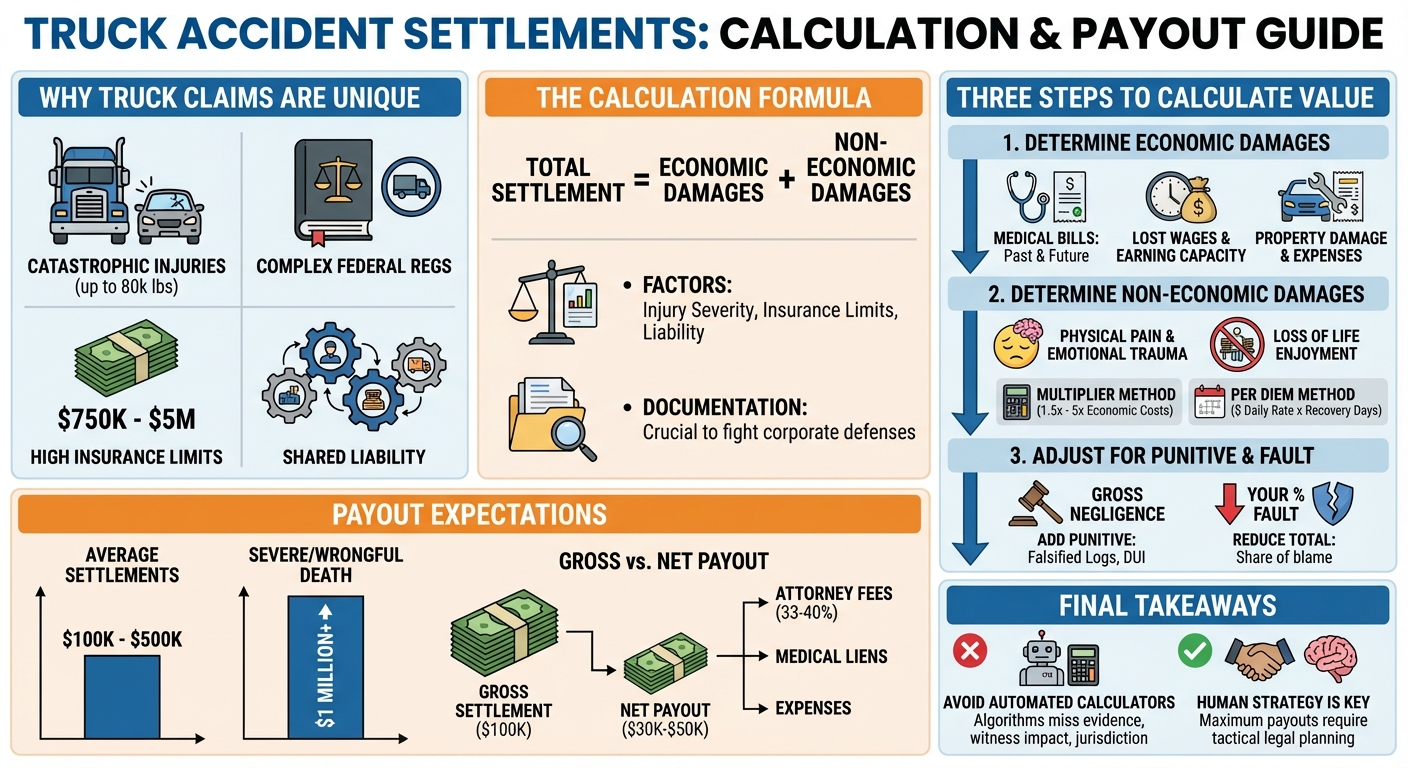
Truck accident calculations differ from standard auto accidents primarily due to the severity of the injuries, the complex web of federal trucking regulations (FMCSA), and the presence of massive commercial insurance policies. Multiple liable parties—including the driver, the trucking company, the cargo loader, and the vehicle manufacturer—can also complicate the final settlement value.
The Basic Formula: How Are Truck Accident Settlements Determined?
A truck accident settlement is calculated by combining your economic damages—such as medical bills, future care costs, and lost wages—with your non-economic damages, like pain and suffering. Adjusters typically use a multiplier method based on injury severity, while also factoring in commercial insurance policy limits and liability.
While standard auto insurance policies might cap out at $30,000 or $50,000, federal law requires commercial trucks to carry minimum liability coverage ranging from $750,000 to $5,000,000 depending on the cargo. These higher policy limits mean that calculations are heavily scrutinized by corporate defense teams, making precise documentation essential.
Step 1: Calculating Economic Damages (The Hard Costs)
Economic damages form the foundation of your settlement calculation. These are the objective, quantifiable financial losses you have suffered.
- Past and Future Medical Expenses: This includes emergency room visits, surgeries, hospital stays, physical therapy, and projected future medical care. For catastrophic injuries, a life care planner is often hired to calculate lifetime medical costs.
- Lost Wages and Loss of Future Earning Capacity: If your injuries prevent you from returning to work, or force you into a lower-paying job, your settlement must account for the income you would have earned over your lifetime.
- Property Damage and Out-of-Pocket Expenses: This covers the replacement value of your totaled vehicle, rental car costs, home modifications for disabilities, and even travel expenses to medical specialists.
Step 2: Calculating Non-Economic Damages
Non-economic damages compensate you for the subjective, invisible losses caused by the crash, such as physical pain, emotional trauma, and loss of enjoyment of life.
What is a typical amount of pain and suffering?
A typical amount for pain and suffering is calculated by multiplying your total economic damages (like medical bills) by a factor of 1.5 to 5. For example, if you have $50,000 in medical bills and a multiplier of 3 is used, your pain and suffering would be $150,000.
Insurance adjusters and attorneys generally use two primary methods to calculate this figure:
- The Multiplier Method: As mentioned above, hard economic costs are multiplied by a number between 1.5 (for minor injuries) and 5 or higher (for permanent, life-altering injuries like paralysis or traumatic brain injuries).
- The Per Diem Method: A specific dollar amount (often based on your daily wage) is assigned to every day you suffer from the injury, from the date of the accident until you reach maximum medical improvement.
Step 3: Factoring in Punitive Damages and Liability
Not all settlement calculations stop at compensatory damages. In cases of gross negligence, punitive damages may be added to punish the trucking company and deter future misconduct. This often applies when there are severe FMCSA violations, such as falsified logbooks, forced fatigued driving, or a driver operating under the influence of drugs or alcohol.
However, your final calculation can also be reduced by comparative fault. If an investigation determines you were 20% at fault for the crash (for example, by speeding), your total settlement value will be reduced by 20% under shared liability laws.
Average Payouts: What to Expect
How much are most truck accident settlements?
Most truck accident settlements range between $100,000 and $500,000, though cases involving severe, permanent injuries or wrongful death frequently settle for $1 million or more. The exact amount depends on the extent of your medical bills, lost wages, and the commercial insurance policy limits available.
How much sue getting hit by a truck?
If you are hit by a commercial truck, you can typically sue for the full extent of your damages, which often range from tens of thousands for minor injuries to multi-million dollar amounts for catastrophic harm. You sue for medical costs, lost income, pain and suffering, and potentially punitive damages.
The Net Payout: Understanding Your Take-Home Amount
How much of a $100K settlement will I get?
From a $100,000 settlement, you will typically take home between $30,000 and $50,000. This net amount is calculated after deducting standard attorney contingency fees (usually 33% to 40%), case expenses, and any outstanding medical liens or health insurance subrogation claims.
Understanding the difference between the gross settlement and the net payout is crucial. Your attorney will negotiate with medical providers and health insurance companies to reduce your outstanding liens, maximizing the tax-free cash that actually goes into your pocket.
Why You Shouldn’t Rely on Online Settlement Calculators
While an online semi-truck accident settlement calculator might provide a rough estimate, it cannot account for the nuances of a complex commercial claim. Automated tools cannot evaluate the strength of the evidence, the likability of witnesses, or the specific jurisdiction where the lawsuit will be filed.
A successful claim requires human strategy. Knowing when to demand policy limits, when to file a lawsuit, and how to leverage corporate negligence are skills no algorithm possesses. To understand why patience and tactical planning yield higher payouts than quick calculations, read our guide on The Art of Settlement: Why Timing, Strategy, and Patience Matter in Your Houston Injury Claim.