
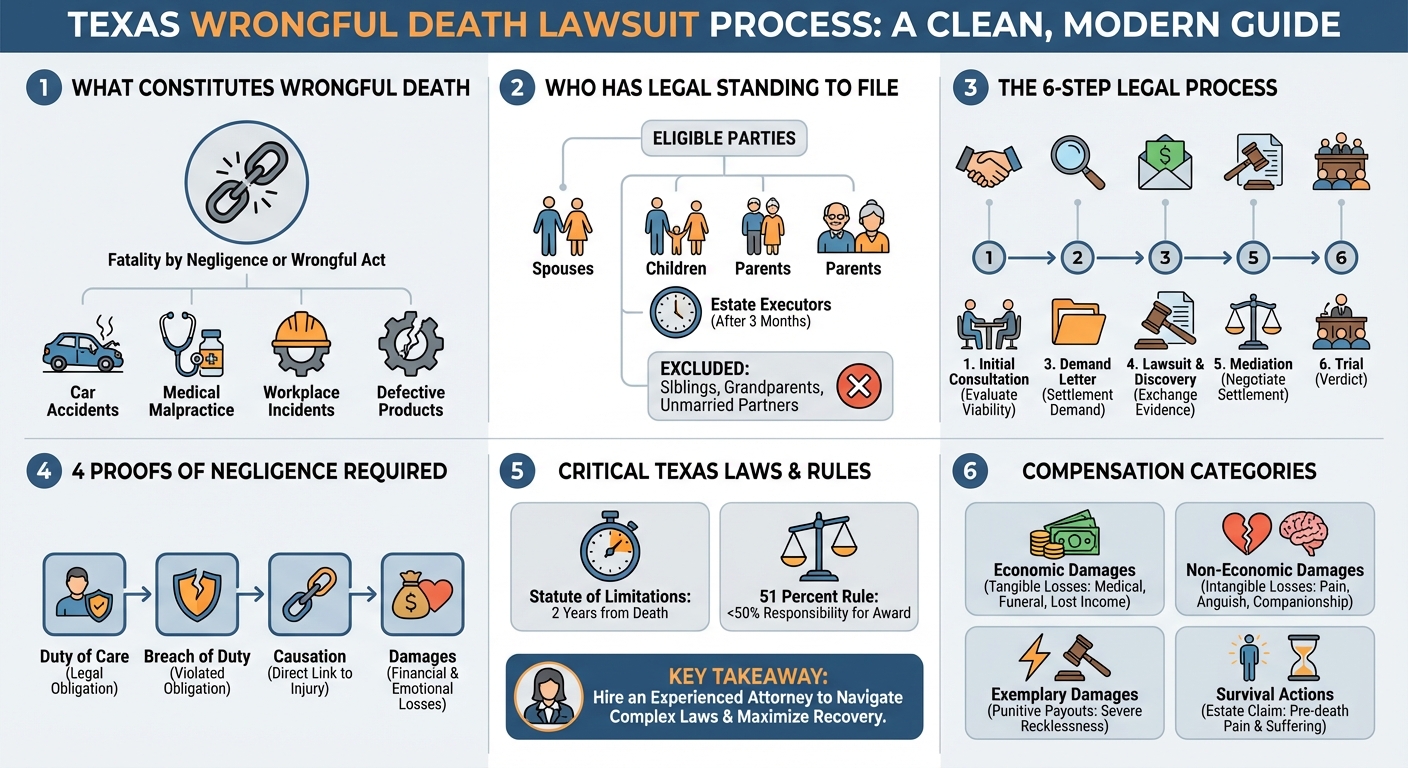
The wrongful death lawsuit process in Texas involves consulting an attorney, investigating the fatal incident, sending a demand letter, filing a formal complaint, entering discovery, and negotiating a settlement or going to trial. Eligible family members must file within the two-year statute of limitations to seek compensation.
Understanding the Wrongful Death Lawsuit Process in Texas
Losing a loved one is a devastating experience, especially when their death could have been prevented. While no amount of money can replace a family member, the wrongful death lawsuit process in Texas provides a legal pathway to hold negligent parties accountable and secure your family’s financial future. Navigating the Texas legal system requires a clear understanding of state-specific statutes, strict deadlines, and complex evidentiary rules. This guide breaks down exactly how these claims work from start to finish.
What is considered wrongful death in Texas?
Under Texas law, a wrongful death is considered any fatality caused by the wrongful act, neglect, carelessness, unskillfulness, or default of another person or corporation. This allows surviving family members to seek compensation when the deceased would have been entitled to file a personal injury claim had they survived.
Definition under the Texas Civil Practice and Remedies Code
Chapter 71 of the Texas Civil Practice and Remedies Code officially defines the parameters of a wrongful death claim. The statute dictates that liability applies whether the at-fault party is an individual or a corporation. The core principle is that the defendant’s failure to act reasonably directly resulted in a fatal injury.
Common causes (car accidents, medical malpractice, workplace incidents)
Wrongful death claims in Texas frequently stem from several common scenarios:
- Car and Truck Accidents: Fatalities caused by drunk, distracted, or reckless drivers.
- Medical Malpractice: Surgical errors, misdiagnoses, or medication mistakes by healthcare providers.
- Workplace Incidents: Construction site falls, oil rig explosions, or industrial accidents, particularly when third-party negligence is involved.
- Defective Products: Fatalities resulting from dangerous consumer goods or unsafe medications.
Who Can File a Wrongful Death Lawsuit in Texas?
Texas law strictly limits who has the legal standing to initiate a wrongful death claim. Not every relative is eligible to sue.
Immediate family members: Spouses, children, and parents
The right to file a wrongful death lawsuit is reserved exclusively for the deceased person’s surviving spouse, children (including legally adopted children), and parents. These individuals can choose to file a claim individually or jointly as a group.
The role of the estate executor or administrator
If the surviving spouse, children, or parents do not file a wrongful death claim within three calendar months of the death, the executor or administrator of the deceased’s estate may file the claim on their behalf. The only exception is if all eligible family members explicitly request that the claim not be filed.
Who is excluded from filing (siblings, grandparents)
Unlike some other states, Texas law explicitly excludes certain family members from filing a wrongful death lawsuit. Siblings (both biological and adopted), grandparents, aunts, uncles, and unmarried romantic partners do not have legal standing to pursue a wrongful death claim in Texas.
The Step-by-Step Wrongful Death Lawsuit Process
Filing a wrongful death claim involves a structured legal process. Knowing what to expect can help alleviate stress during an already difficult time.
Step 1: Initial Consultation and Case Evaluation
The process begins with a free consultation with a Texas wrongful death attorney. During this meeting, the lawyer will review the basic facts of the fatality, assess legal standing, and determine if there is a viable claim against a negligent party.
Step 2: Investigation and Gathering Evidence
Once retained, your legal team will launch a comprehensive investigation. This involves collecting police reports, medical records, eyewitness testimonies, and surveillance footage. Attorneys often collaborate with accident reconstruction specialists and medical experts to build a robust foundation for the case.
Step 3: Sending the Demand Letter
Before formally filing a lawsuit, your attorney may send a demand letter to the at-fault party’s insurance company. This document outlines the facts of the case, the evidence of negligence, and a specific financial demand to settle the claim out of court.
Step 4: Filing the Lawsuit and the Discovery Phase
If the insurance company refuses to offer a fair settlement, your attorney will file a formal complaint in a Texas civil court. This initiates the “discovery” phase, where both sides exchange evidence, take sworn depositions from witnesses, and request internal documents.
Step 5: Mediation and Settlement Negotiations
Texas courts frequently require parties to attempt mediation before going to trial. A neutral third-party mediator will help facilitate settlement negotiations between your legal team and the defense. The majority of wrongful death cases are successfully resolved at this stage.
Step 6: Trial and Verdict
If mediation fails, the case proceeds to trial. Both sides will present their evidence and call witnesses before a judge or jury. The jury will then deliberate and deliver a verdict, determining whether the defendant is liable and, if so, the amount of damages to be awarded.
Proving Liability: What are the 4 proofs of negligence?
To win a wrongful death claim, the four proofs of negligence you must establish are: a legal duty of care owed by the defendant, a breach of that duty, direct causation linking the breach to the fatal injury, and actual damages resulting from the death.
Duty of Care
You must prove that the defendant had a legal obligation to act reasonably to avoid harming others. For example, a driver has a duty to obey traffic laws, and a doctor has a duty to provide a standard level of medical care.
Breach of Duty
Next, you must demonstrate that the defendant violated this duty through action or inaction. Driving under the influence or failing to order a necessary medical test are examples of breaching a duty of care.
Causation
It is not enough to show the defendant made a mistake; you must prove that their specific breach of duty was the direct and proximate cause of your loved one’s death.
Damages
Finally, you must show that the death resulted in quantifiable damages, such as medical bills, funeral expenses, lost income, and emotional suffering.
Critical Texas Laws Impacting Your Claim
Texas has specific statutes that govern how and when a wrongful death claim can be pursued. Missing a deadline or misunderstanding fault rules can destroy your case.
The Texas Statute of Limitations (2-Year Deadline)
In Texas, the statute of limitations for a wrongful death lawsuit is generally two years from the date of the deceased person’s death. If you fail to file a lawsuit within this two-year window, the court will almost certainly dismiss your case, barring you from recovering any compensation.
Exceptions to the Statute of Limitations
While the two-year rule is strict, a few rare exceptions exist. These may include situations where the plaintiff is a minor (the clock may pause until they turn 18), or if the defendant’s negligence was fraudulently concealed and could not have been reasonably discovered right away.
What is the 51 percent rule in Texas? (Modified Comparative Fault)
The 51 percent rule in Texas is a modified comparative fault law stating that you can only recover damages if the deceased was 50 percent or less responsible for the fatal incident. If they are found to be 51 percent or more at fault, you cannot recover any compensation.
Damages and Compensation in Texas Wrongful Death Cases
The goal of a wrongful death lawsuit is to provide financial stability for the surviving family members and compensate them for their profound loss.
Compensatory Damages (Economic and Non-Economic)
Compensatory damages are split into two categories. Economic damages cover tangible financial losses, such as funeral costs, medical bills incurred prior to death, and the loss of the deceased’s expected lifetime earning capacity. Non-economic damages compensate for intangible losses, including mental anguish, loss of companionship, and loss of consortium.
Exemplary (Punitive) Damages in Cases of Gross Negligence
In cases where the defendant’s actions were exceptionally reckless or intentional, Texas law allows juries to award exemplary (punitive) damages. These are not meant to compensate the family, but rather to punish the wrongdoer and deter similar behavior in the future.
What is the average settlement for wrongful death in Texas?
There is no true average settlement for wrongful death in Texas, as payouts vary drastically based on the deceased’s earning capacity, medical bills, and the defendant’s insurance limits. Settlements can range from hundreds of thousands to multi-million dollar verdicts depending on the specific facts of the case.
Wrongful Death vs. Survival Action Claims
While a wrongful death claim compensates the surviving family for their losses, a “survival action” compensates the deceased’s estate for the pain and suffering the victim endured between the time of the injury and the time of death. Both claims are often filed simultaneously.
Why You Need an Experienced Texas Wrongful Death Attorney
Wrongful death cases are high-stakes, complex legal battles. Attempting to handle one without professional legal representation puts your family’s financial recovery at risk.
Navigating complex legal procedures and insurance tactics
Insurance companies aggressively defend against wrongful death claims to protect their profit margins. They may try to shift blame onto the deceased or offer lowball settlements before you understand the true value of your case. An experienced attorney knows how to counter these tactics and navigate the strict procedural rules of Texas courts.
Maximizing your family’s compensation
A skilled lawyer will accurately calculate both current and future losses, ensuring that no money is left on the table. They work with economists and life-care planners to project the full financial impact of your loved one’s passing.
How to schedule a free consultation
If you have lost a family member due to someone else’s negligence, time is of the essence. Contact our legal team today to schedule a free, confidential consultation. We will listen to your story, evaluate your case, and help you understand your legal options with zero upfront costs.
 Call (713) 747-7777