
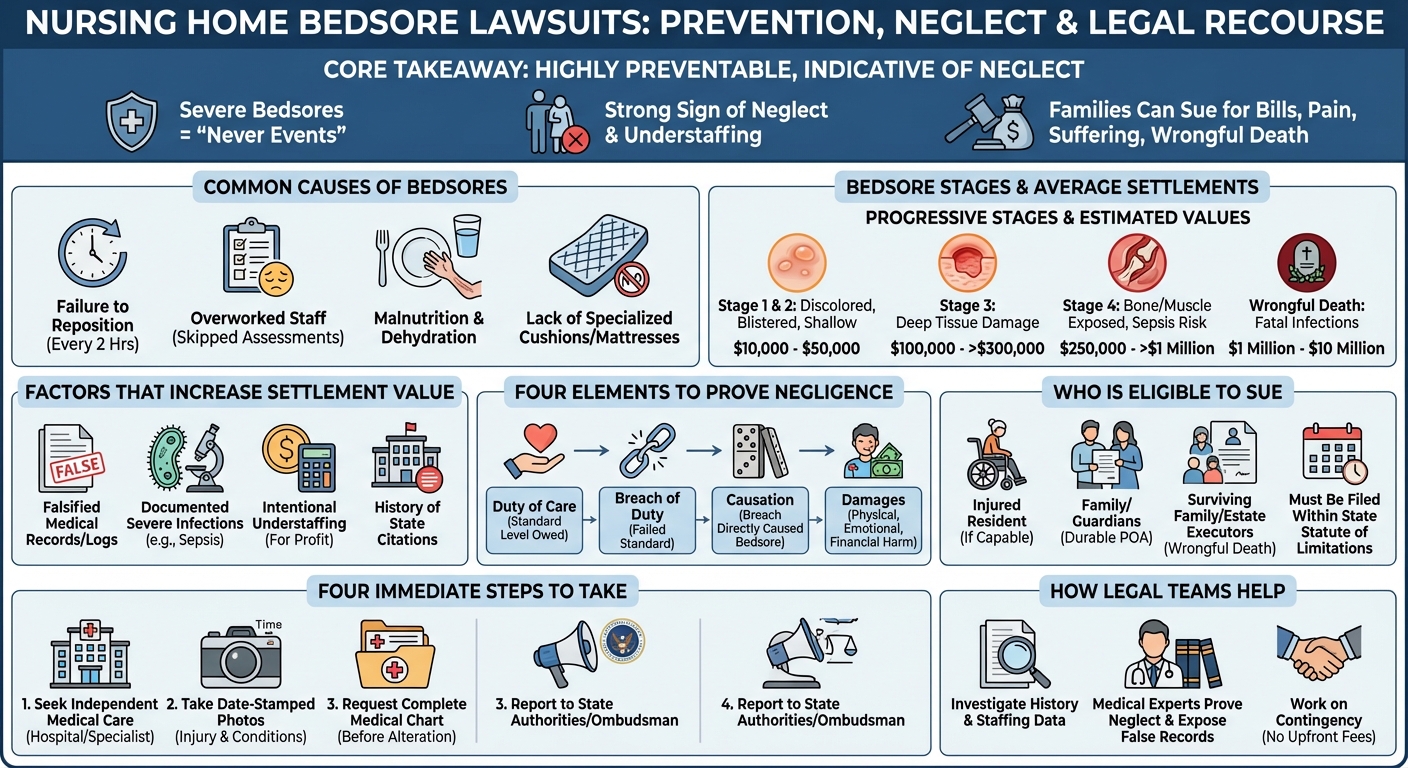
Yes, you can sue a nursing home for bedsores if the injury resulted from negligence or inadequate care. Because severe bedsores are highly preventable, their presence often indicates staff failed to properly reposition, monitor, or hydrate the resident. Families can seek compensation for medical bills, pain, and suffering.
Can You Sue a Nursing Home for Bedsores?
Yes, you can sue a nursing home or assisted living facility for bedsores if the injuries resulted from negligence, understaffing, or inadequate medical care. Bedsores—also known as pressure ulcers or decubitus ulcers—are highly preventable when proper medical protocols are followed. When they occur in a clinical setting, they are a primary indicator of elder neglect.
Why Bedsores Are Considered a ‘Never Event’
In the medical community, severe bedsores (Stage 3 and Stage 4) are classified as a “never event.” This means they are adverse events that are unambiguous, serious, and usually preventable. Because the standard of care requires staff to assess skin integrity and implement prevention plans, the development of a severe pressure ulcer is strong evidence that the facility failed in its fundamental duties.
Proving Negligence in a Care Facility
To win a bedsore lawsuit, your legal team must prove four elements:
- Duty of Care: The facility accepted the resident and owed them a standard level of care.
- Breach of Duty: The staff failed to meet this standard (e.g., failing to turn the patient every two hours).
- Causation: The breach directly caused the bedsore to develop or worsen.
- Damages: The resident suffered harm, requiring medical treatment, experiencing pain, or resulting in wrongful death.
Statute of Limitations for Nursing Home Lawsuits
You have a limited window to file a claim. The statute of limitations for nursing home abuse and medical malpractice varies by state, typically ranging from one to three years from the date the injury was discovered or the date of death. Failing to file within this deadline permanently forfeits your right to compensation.
Bedsore Lawsuit Settlement Amounts and Verdicts
Compensation in nursing home neglect cases depends heavily on the severity of the injury, the extent of the facility’s negligence, and the resulting medical expenses.
Average Settlement Ranges by Bedsore Stage
| Bedsore Severity | Typical Settlement Range | Key Factors |
|---|---|---|
| Stage 1 & 2 | $10,000 – $50,000 | Usually resolved without extensive litigation unless part of a broader neglect pattern. |
| Stage 3 | $100,000 – $300,000+ | Requires significant medical intervention, pain management, and extended recovery. |
| Stage 4 | $250,000 – $1,000,000+ | Involves bone/muscle exposure, surgical debridement, and high risk of fatal complications. |
Stage 3 and Stage 4 Bedsore Payouts
Because Stage 3 and Stage 4 bedsores cause excruciating pain and require intensive treatments like surgical debridement (removal of dead tissue) or skin grafts, settlements are significantly higher. Juries and insurance companies recognize the catastrophic physical and emotional toll these advanced wounds take on elderly residents.
Wrongful Death Settlements Involving Pressure Ulcers
If a bedsore leads to a fatal infection like sepsis or osteomyelitis (bone infection), surviving family members can file a wrongful death lawsuit. These cases frequently result in settlements or jury verdicts exceeding $1 million, and in cases of egregious institutional neglect, verdicts have reached upwards of $10 million.
Factors That Increase Your Case Value
Certain aggravating factors can drastically increase the value of a bedsore settlement:
- Falsified Medical Records: If staff altered charting logs to pretend they turned the patient.
- Severe Infection/Sepsis: Documented systemic infections directly linked to the wound.
- Chronic Understaffing: Evidence that corporate management intentionally understaffed the facility to maximize profits.
- State Citations: Prior health department violations for similar neglect issues.
The Link Between Bedsores and Nursing Home Neglect
Bedsores do not happen overnight. They are the physical manifestation of systemic failures within a care facility.
Failure to Reposition and Rotate Patients
The standard protocol for bedbound or wheelchair-bound residents is to reposition them at least once every two hours. This relieves pressure on vulnerable areas like the tailbone, heels, hips, and shoulder blades. When staff skip these rotations, blood flow is restricted, and tissue begins to die.
Understaffing and Inadequate Monitoring
Most nursing home neglect stems from corporate understaffing. When nurses and aides are overworked, time-consuming tasks like full-body skin assessments, bathing, and repositioning are the first to be neglected.
Malnutrition and Dehydration Contributing to Skin Breakdown
Proper nutrition and hydration are critical for maintaining skin elasticity and healing minor abrasions. Neglected residents who are malnourished or dehydrated are exponentially more likely to develop rapid, severe pressure ulcers.
Failure to Provide Specialized Mattresses or Cushions
High-risk patients require offloading devices, such as alternating pressure mattresses, specialized wheelchair cushions, and heel protectors. Failing to order or utilize these prescribed devices is a direct breach of the standard of care.
Understanding the Four Stages of Bedsores
Medical professionals categorize pressure ulcers into four primary stages based on tissue damage depth.
Stage 1 and 2: Early Warning Signs of Neglect
- Stage 1: The skin is intact but appears red (or discolored) and does not blanch when pressed. It may feel warm or firm.
- Stage 2: The skin breaks open, wears away, or forms an ulcer. It looks like a shallow crater or a fluid-filled blister.
Stage 3: Deep Tissue Damage
The sore worsens and extends into the tissue beneath the skin, forming a small crater. Fat may show in the sore, but not muscle, tendon, or bone. At this stage, the risk of infection increases dramatically.
Stage 4: Bone and Muscle Exposure (High Risk of Sepsis)
This is a life-threatening medical emergency. The pressure ulcer is so deep that damage reaches the muscle and bone, and sometimes tendons and joints. Stage 4 bedsores are highly susceptible to sepsis, a systemic and often fatal infection.
Unstageable Bedsores
A sore is considered unstageable when its base is covered by slough (yellow, tan, gray, green, or brown tissue) or eschar (dark scab-like dead tissue). A doctor cannot determine the true depth and stage until this dead tissue is surgically removed.
Who is Eligible to File a Nursing Home Lawsuit?
Depending on the resident’s health and mental capacity, different parties may have the legal standing to file a claim.
The Injured Resident
If the resident is mentally competent and physically able, they can file the lawsuit directly against the facility for their pain, suffering, and medical bills.
Family Members with Power of Attorney
If the resident suffers from dementia, Alzheimer’s, or is otherwise incapacitated, a family member holding a durable Power of Attorney (POA) or a court-appointed legal guardian can file the lawsuit on their behalf.
Surviving Family Members (Wrongful Death Claims)
If the resident passes away due to complications from the bedsore, the executor of their estate or eligible surviving family members (usually spouses or children) can file a wrongful death lawsuit.
What to Do If Your Loved One Develops a Bedsore
Immediate action is required to protect your loved one’s health and preserve evidence for a future legal claim.
Seek Immediate Independent Medical Attention
Do not rely solely on the nursing home’s in-house doctor. Demand that your loved one be transferred to a hospital emergency room or seen by an independent wound care specialist immediately.
Document the Injury with Photographs
If you are legally permitted, take clear, date-stamped photographs of the bedsore, the resident’s living conditions, and any soiled bedding. Visual evidence is incredibly powerful in front of a jury.
Request the Resident’s Complete Medical Chart
Request a complete copy of the resident’s medical records, care plans, and daily charting logs immediately. Do this before the facility has an opportunity to alter or “lose” critical documentation.
Report the Facility to State Authorities
File a formal complaint with your state’s Department of Health or the local Long-Term Care Ombudsman. This triggers an independent state investigation, which can yield citations that strengthen your lawsuit.
How Our Nursing Home Abuse Lawyers Can Help
Taking on a corporate nursing home chain requires resources, medical knowledge, and aggressive litigation tactics.
Investigating the Facility’s History of Citations
Our legal team will pull the facility’s historical inspection reports, staffing data, and Medicare ratings to establish a pattern of neglect and understaffing.
Working with Medical Experts to Prove Neglect
We partner with board-certified wound care specialists and nursing experts who will review the medical records, testify about the preventability of the bedsore, and expose falsified charting logs.
Free Case Evaluation and No Upfront Fees
We handle nursing home bedsore lawsuits on a contingency fee basis. This means we offer a free, confidential case evaluation, and you pay absolutely no attorney fees unless we secure a settlement or jury verdict in your favor.
 Call (713) 747-7777