
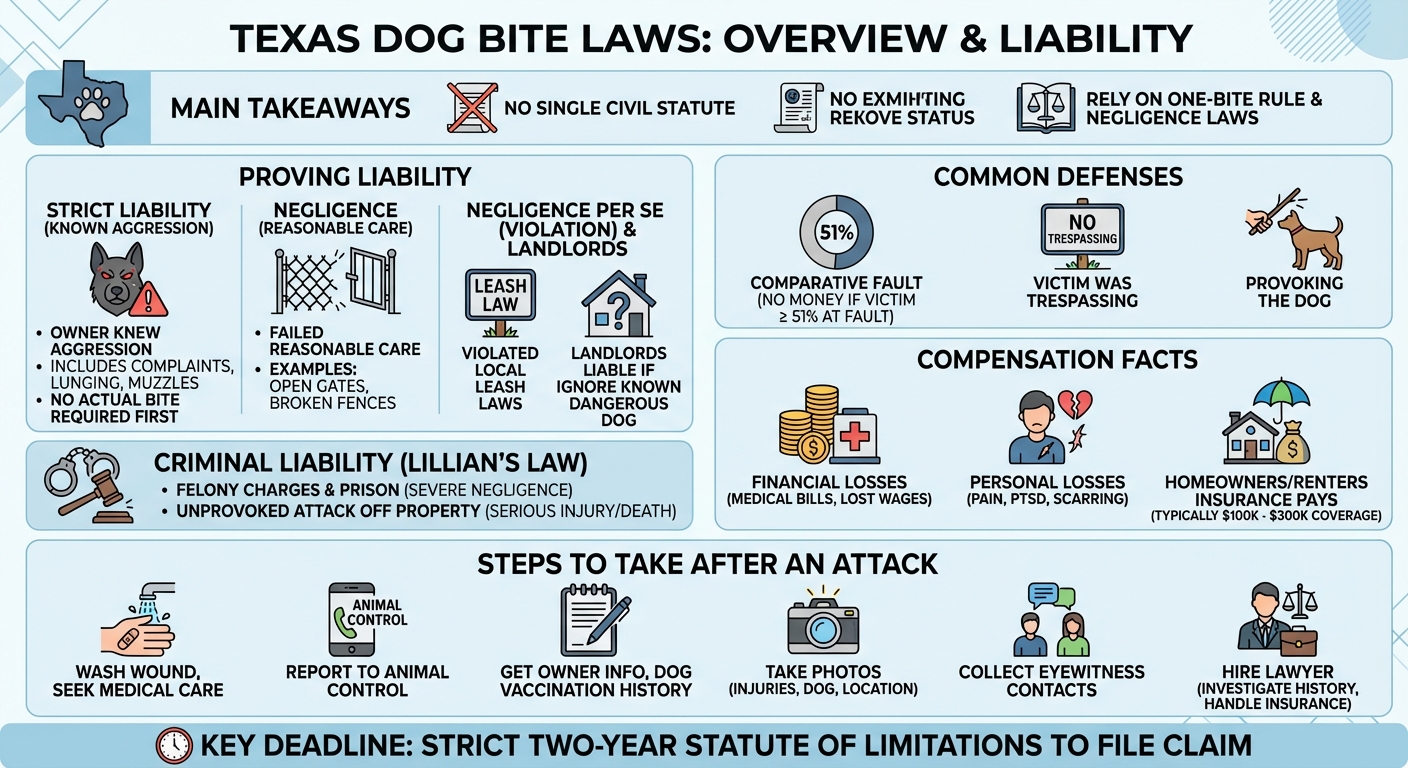
In Texas, dog bite liability is governed by the “one-bite rule” and negligence laws, as there is no specific civil dog bite statute. An owner is strictly liable if they knew the dog was previously aggressive. Otherwise, victims can recover damages by proving the owner was negligent, such as violating local leash laws.
Understanding Texas Dog Bite Laws and Liability
If you or a loved one has been injured by a dog in Texas, navigating the legal landscape can be confusing. Unlike many other states, Texas handles dog bite claims through a combination of common law precedents and negligence principles rather than a single, unified civil code.
Does Texas Have a Specific Dog Bite Statute?
No, Texas does not have a specific civil statute that automatically holds a dog owner liable for damages when their dog bites someone. Instead, Texas is considered a “one-bite rule” and “negligence” state. To recover compensation, a victim must prove that the owner knew the dog was dangerous or that the owner failed to exercise reasonable care in controlling the animal.
The Difference Between Civil and Criminal Liability
It is important to distinguish between civil and criminal liability following a dog attack:
- Civil Liability: Involves the victim filing a personal injury claim or lawsuit against the dog owner (or their insurance company) to recover financial compensation for medical bills, lost wages, and pain and suffering.
- Criminal Liability: Involves the State of Texas prosecuting the dog owner for severe negligence that led to serious bodily injury or death, which can result in fines and prison time.
The Texas ‘One-Bite Rule’ Explained
The “one-bite rule” is a common law doctrine that holds dog owners strictly liable for injuries if they knew, or should have known, that their dog had aggressive tendencies.
What Constitutes ‘Prior Knowledge’ of Aggression?
Prior knowledge does not strictly mean the owner knew the dog bit someone before. Evidence of prior knowledge can include:
- Previous complaints from neighbors about the dog’s behavior.
- The dog frequently lunging, snapping, or growling at strangers.
- The owner keeping “Beware of Dog” signs on their property.
- The dog having to be muzzled during vet visits or walks.
Strict Liability Under the One-Bite Rule
If you can prove the owner had prior knowledge of the dog’s dangerous nature, strict liability applies. This means you do not have to prove that the owner was negligent on the day of the attack. The mere fact that they owned a known dangerous dog and it injured you is enough to establish liability.
Does the Dog Actually Have to Bite Someone First?
No. The term “one-bite rule” is slightly misleading. A dog does not get one “free” bite. If the dog has exhibited clear aggressive behaviors that put the owner on notice, the owner can be held strictly liable even if this is the dog’s very first time biting someone.
Other Ways to Prove Liability in Texas
If the dog has no history of aggression, you can still recover compensation by proving the owner was negligent.
Proving Owner Negligence (Lack of Reasonable Care)
To win a negligence claim, you must show that the dog owner failed to exercise ordinary care to prevent the dog from injuring someone. Examples of negligence include:
- Leaving a gate open or unsecured.
- Failing to repair a broken fence where the dog frequently escapes.
- Allowing a dog to roam freely in a neighborhood.
Negligence Per Se (Violations of Local Leash Laws)
Texas does not have a statewide leash law, but most cities and counties do. If a dog owner violates a local leash ordinance and their unrestrained dog bites you, they can be held liable under the doctrine of negligence per se. Because they broke a safety law, the court presumes they were negligent, making your path to compensation much easier.
Premises Liability and Landlord Responsibility
In some cases, a landlord or property manager can be held liable for a dog bite. This typically occurs if the landlord knew a tenant harbored a dangerous dog but failed to take action to remove the dog or protect other tenants and guests from the hazard.
Criminal Liability: What is Lillian’s Law?
In 2007, Texas enacted “Lillian’s Law” (named after Lillian Stiles, who was tragically killed by a pack of loose dogs). This law establishes criminal penalties for irresponsible dog owners.
When a Dog Attack Becomes a Felony
Under Lillian’s Law, a dog owner can be charged with a third-degree felony if their dog causes serious bodily injury, and a second-degree felony if the attack results in death. A conviction can lead to up to 20 years in prison.
Requirements for Criminal Charges Under Texas Law
For criminal charges to apply, the following must be true:
- The attack was unprovoked.
- The attack occurred at a location other than the owner’s property.
- The owner failed to secure the dog with criminal negligence.
Common Defenses Used by Dog Owners
Dog owners and their insurance companies will often try to avoid paying claims by shifting the blame to the victim.
Texas Comparative Negligence (Proportionate Responsibility)
Texas follows a “modified comparative fault” rule with a 51% bar. If the court finds you were partially at fault for the incident (e.g., you ignored a warning sign), your compensation will be reduced by your percentage of fault. If you are found to be 51% or more responsible, you cannot recover any damages.
The Trespassing Defense
Dog owners owe a very limited duty of care to trespassers. If you were unlawfully on private property when the dog bit you, it is highly unlikely you will be able to recover compensation, as the law generally protects property owners in these scenarios.
Provocation of the Animal
If the victim provoked the dog—such as by hitting, teasing, pulling its tail, or cornering it—the owner can use this as a strong defense against liability. Provocation is a common defense, especially in cases involving young children who may not understand how to interact safely with animals.
Compensation for Dog Bite Injuries in Texas
Victims of dog attacks often face severe physical and emotional trauma. Texas law allows victims to seek comprehensive compensation.
Economic vs. Non-Economic Damages
| Economic Damages (Financial Losses) | Non-Economic Damages (Personal Losses) |
|---|---|
| Emergency room bills and surgeries | Physical pain and suffering |
| Physical therapy and rehabilitation | Emotional distress and PTSD |
| Lost wages from missed work | Permanent scarring and disfigurement |
| Future medical care (e.g., plastic surgery) | Loss of enjoyment of life |
The Role of Homeowner’s and Renter’s Insurance
In most civil dog bite cases, the compensation is paid by the dog owner’s homeowner’s or renter’s insurance policy, not out of the owner’s personal bank account. These policies typically provide between $100,000 and $300,000 in liability coverage. However, some insurance companies exclude specific “dangerous breeds” from coverage.
What is the Average Settlement for a Dog Bite?
There is no fixed “average” settlement, as the value of a claim depends entirely on the severity of the injuries, the amount of medical bills, the extent of permanent scarring, and the policy limits of the owner’s insurance. Minor bites may settle for a few thousand dollars, while severe attacks requiring reconstructive surgery can result in six-figure settlements.
What to Do Immediately After a Dog Attack
Taking the right steps immediately after a dog bite is crucial for your health and your potential legal claim.
Seek Medical Attention and Report to Animal Control
Your health is the top priority. Wash the wound immediately and go to urgent care or the ER. Dog bites have a high risk of infection, and you may need a rabies or tetanus shot. Additionally, report the bite to your local animal control agency. They will investigate, quarantine the dog if necessary, and create an official report that serves as vital evidence.
Gather Evidence and Identify the Owner
If you are physically able, gather as much information at the scene as possible:
- Get the name, address, and contact info of the dog owner.
- Ask for the dog’s vaccination records.
- Take clear photos of your injuries, the dog, and the location of the attack.
- Collect contact information from any eyewitnesses.
Texas Statute of Limitations for Dog Bite Claims
In Texas, the statute of limitations for personal injury claims, including dog bites, is two years from the date of the injury. If you fail to file a lawsuit within this two-year window, you will permanently lose your right to seek compensation.
How a Texas Dog Bite Lawyer Can Help Your Case
Dog bite cases in Texas can be legally complex due to the lack of a specific civil statute. An experienced personal injury attorney can level the playing field.
Investigating the Dog’s History
To win under the one-bite rule, your lawyer will conduct a thorough investigation to uncover the dog’s history. This includes interviewing neighbors, requesting animal control records, and finding proof that the owner knew the dog was a danger.
Negotiating with Aggressive Insurance Companies
Insurance adjusters are trained to minimize payouts. They may try to pressure you into a lowball settlement or claim that you provoked the dog. A skilled Texas dog bite lawyer will handle all communications with the insurance company, build a robust case demonstrating the owner’s liability, and fight to secure the maximum compensation you deserve.
 Call (713) 747-7777