

Table of contents
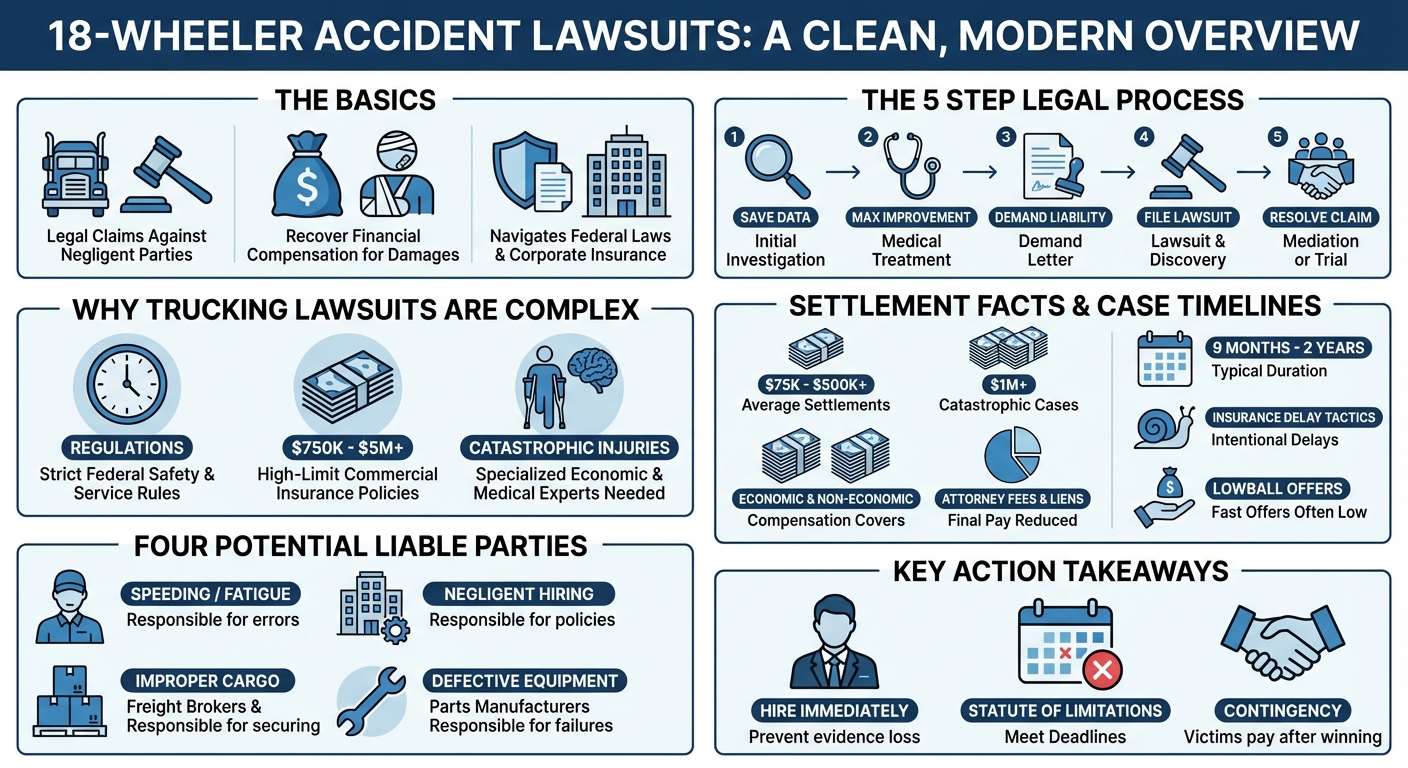
An 18-wheeler accident lawsuit is a legal claim filed against a trucking company or driver to recover compensation for injuries. The process involves sending a spoliation letter to preserve evidence, investigating federal safety violations, determining liability, and negotiating a settlement that covers medical bills, lost wages, and pain and suffering.
18-Wheeler Accident Lawsuits: Process, Settlements, and Timelines
A collision with a commercial truck can alter your life in seconds. Because of the massive size and weight disparity between a passenger vehicle and a semi-truck, victims often face catastrophic injuries, mounting medical bills, and lost income. Filing an 18-wheeler accident lawsuit is the primary legal mechanism for holding negligent trucking companies accountable and securing the financial compensation you need to rebuild your life.
However, suing a commercial motor carrier is not like handling a standard fender-bender. It requires navigating federal regulations, fighting aggressive corporate insurance defense teams, and carefully calculating long-term damages.
Why 18-Wheeler Lawsuits Are More Complex Than Car Accidents
Commercial truck accidents involve unique legal and logistical challenges that require specialized legal strategy.
Federal Motor Carrier Safety Administration (FMCSA) Regulations
Unlike standard drivers, commercial truck drivers and their employers must adhere to strict FMCSA regulations. These federal laws govern hours of service (how long a driver can be on the road), mandatory drug and alcohol testing, vehicle maintenance schedules, and cargo weight limits. Proving a violation of these rules is often the key to winning a lawsuit.
Higher Commercial Insurance Policy Limits
Federal law requires commercial trucks to carry minimum liability insurance ranging from $750,000 to $5,000,000, depending on the cargo. Because the financial stakes are so high, commercial insurance companies deploy rapid-response teams to accident scenes immediately to mitigate their liability and protect their bottom line.
Severe and Catastrophic Injury Profiles
The sheer force of an 18-wheeler crash frequently results in traumatic brain injuries (TBIs), spinal cord damage, amputations, or wrongful death. These catastrophic injury profiles mean that plaintiffs require life care plans, economic experts, and medical specialists to accurately project future medical costs and lost earning capacity.
Who Can Be Held Liable in a Commercial Truck Crash?
In a standard car accident, liability usually falls on the other driver. In a commercial truck lawsuit, multiple corporate entities may share the blame.
| Liable Party | Reason for Liability |
|---|---|
| The Truck Driver | Fatigue, distracted driving, speeding, or driving under the influence. |
| The Trucking Company | Negligent hiring, failing to train drivers, or pressuring drivers to violate hours-of-service rules. |
| Freight Brokers & Cargo Loaders | Overloading the trailer or improperly securing cargo, leading to rollovers or jackknife accidents. |
| Manufacturers | Defective truck parts, such as failing brakes or blown tires. |
The Step-by-Step 18-Wheeler Accident Lawsuit Process
Understanding the legal timeline can help alleviate the stress of pursuing a claim. Here is how a typical commercial truck lawsuit unfolds.
1. Initial Investigation and Evidence Preservation (Spoliation Letters)
Evidence in trucking cases disappears quickly. Your attorney will immediately send a spoliation letter to the trucking company, legally requiring them to preserve critical evidence. This includes the truck’s black box (ECM data), dashcam footage, driver logbooks, and maintenance records.
2. Medical Treatment and Reaching MMI
Before demanding a settlement, you must reach Maximum Medical Improvement (MMI). This is the point where your doctors determine your condition is stable and they can accurately predict your future medical needs. Settling before reaching MMI can result in leaving money on the table.
3. Sending the Demand Letter
Once your damages are fully calculated, your lawyer will send a comprehensive demand letter to the trucking company’s insurance provider. This document outlines liability, details your injuries, and demands a specific financial payout.
4. Filing the Lawsuit and the Discovery Phase
If the insurance company refuses to offer a fair settlement, your attorney will officially file a lawsuit. This initiates the discovery phase, where both sides exchange evidence, take sworn depositions from witnesses and experts, and build their respective cases.
5. Mediation, Negotiation, and Potential Trial
Most commercial truck lawsuits are resolved during mediation—a formal negotiation facilitated by a neutral third party. If a settlement cannot be reached, the case proceeds to trial, where a judge or jury will determine the final verdict.
18-Wheeler Accident Settlement Amounts and Averages
Victims naturally want to know the potential value of their case. While every crash is unique, understanding how damages are calculated provides a clearer picture.
How much are most truck accident settlements?
Most 18-wheeler accident settlements range from $75,000 to over $500,000, depending heavily on the severity of the injuries. Cases involving catastrophic injuries, wrongful death, or gross negligence by the trucking company frequently settle for $1 million or more due to high commercial insurance policy limits.
Economic vs. Non-Economic Damages
Your total settlement is a combination of two types of damages:
- Economic Damages: Quantifiable financial losses, including past and future medical bills, lost wages, loss of earning capacity, and property damage.
- Non-Economic Damages: Subjective losses, such as physical pain and suffering, emotional distress, PTSD, and loss of enjoyment of life.
Examples of High-Tier Truck Accident Verdicts
When trucking companies are found guilty of gross negligence—such as knowingly employing drivers with multiple DUIs or ignoring severe mechanical failures—juries often award massive verdicts. It is not uncommon to see multi-million dollar verdicts (sometimes exceeding $10 million to $100 million) in cases involving wrongful death or permanent paralysis.
Breaking Down Settlement Payouts: What You Actually Keep
A settlement offer is a gross amount. Before you receive your check, several deductions are legally required.
How much will I get from a $50,000 settlement?
If you receive a $50,000 settlement, you can typically expect to take home between $16,000 and $25,000. This is because standard attorney contingency fees take around 33% ($16,500), and the remaining funds must cover your outstanding medical liens, court costs, and expert witness fees before you receive the net payout.
Is $100,000 a good settlement?
A $100,000 settlement is good if your injuries are relatively minor, you have fully recovered, and your medical bills are low. However, if you suffered permanent disabilities, require ongoing medical care, or cannot return to work, $100,000 is likely insufficient to cover your long-term economic and non-economic damages.
Timeline: How long does 18 wheeler settlement take?
An 18-wheeler settlement typically takes between 9 months and 2 years to resolve. Straightforward cases with clear liability might settle in a few months, but complex commercial truck accidents involving severe injuries, multiple liable parties, or disputed facts often require extensive litigation and discovery, extending the timeline.
Fast Settlements vs. Litigated Cases
Insurance companies may offer a fast settlement within weeks of the crash. Beware of these early offers. They are almost always lowball tactics designed to close the case before you realize the full extent of your injuries. Litigated cases take longer but generally yield significantly higher compensation.
Why Trucking Companies Delay Payouts
Commercial insurers use delay tactics to wear plaintiffs down. They may dispute the severity of your injuries, argue that you were partially at fault for the crash, or drag out the discovery process. An experienced trucking lawyer knows how to counter these tactics and force the case forward.
When to Hire a Truck Accident Lawyer
Because evidence degrades rapidly, you should contact an attorney immediately after seeking medical attention. The sooner a lawyer can secure the truck’s black box data and dispatch accident reconstructionists, the stronger your case will be.
Statute of Limitations for Truck Accidents
Every state has a strict deadline—known as the statute of limitations—for filing a personal injury lawsuit. This typically ranges from one to three years from the date of the accident. If you miss this deadline, you permanently lose your right to seek compensation.
Free Case Evaluations
Most reputable truck accident attorneys offer free, no-obligation case evaluations and operate on a contingency fee basis. This means you pay nothing upfront, and the law firm only gets paid if they successfully win a settlement or verdict on your behalf.