
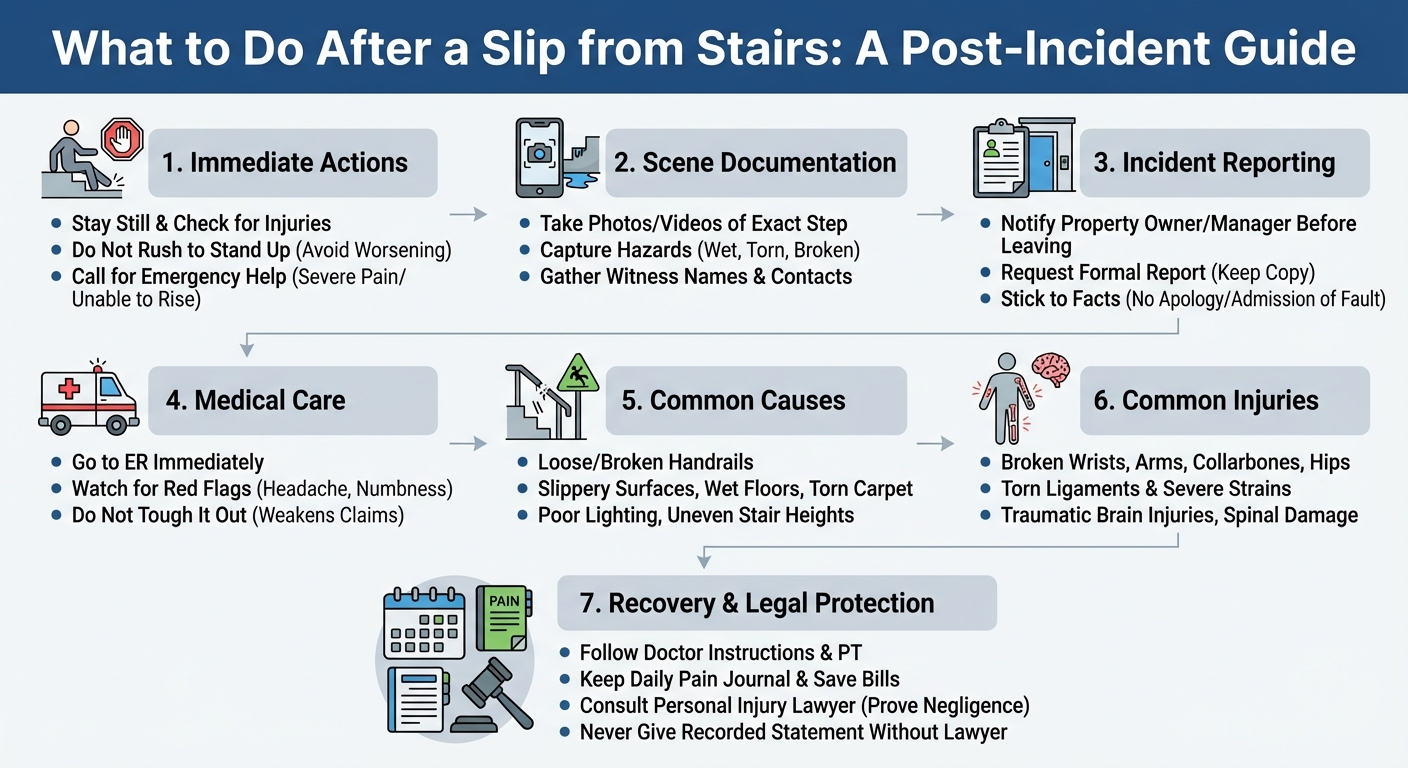
If you slip from stairs, remain still and assess your injuries before moving. Seek immediate medical attention, especially if you experience red flag symptoms like severe head pain or numbness. Document the scene by taking photos of the hazard, report the fall to the property manager, and consult a personal injury lawyer.
What to Do After a Slip from Stairs: A Complete Guide
A slip from stairs can happen in the blink of an eye, transforming a routine walk into a life-altering emergency. Whether caused by a missing handrail, poor lighting, or a wet surface, falling down a staircase often results in severe trauma. Because gravity accelerates the fall and stairs present hard, uneven edges, the resulting injuries are frequently more complex than a standard trip-and-fall on a flat surface. Knowing exactly how to respond protects both your physical well-being and your legal rights.
What to do if you slip on the stairs?
If you slip on the stairs, stay calm and assess your body for injuries before attempting to move. Call 911 if you experience severe pain, bleeding, or cannot get up. If you can safely move, take photos of the stairs, report the incident to the property manager, and seek medical attention immediately.
What is the immediate action after a fall?
The immediate action after a fall is to remain still and perform a quick mental check of your body. Do not rush to stand up, as this can worsen spinal or bone injuries. If you feel sharp pain, numbness, or dizziness, call for emergency medical help right away.
Documenting the scene and gathering evidence
If you are physically able to do so without risking further injury, start gathering evidence immediately. The conditions that caused your fall—such as a spilled liquid or a loose carpet—can be cleaned up or repaired within minutes. Use your smartphone to take clear photos and videos of the exact step where you slipped. Capture wide angles showing the entire staircase, lighting conditions, and any missing or broken handrails. If anyone witnessed the fall, ask for their names and contact information.
Reporting the incident to property owners or managers
Notify the property owner, landlord, or store manager about the accident before you leave the premises. Request that they file a formal incident report and ask for a copy for your records. Stick to the facts of what happened, and avoid apologizing or making statements that could be interpreted as admitting fault. Your goal is simply to create an official record that the fall occurred on their property.
What are red flag symptoms after a fall?
Red flag symptoms after a fall include loss of consciousness, severe headache, persistent nausea or vomiting, numbness or tingling in your extremities, and uncontrollable bleeding. If you experience any of these signs, or severe back and neck pain, go to the nearest emergency room immediately.
Head trauma and concussion signs
Striking your head on a stair tread or handrail can cause a traumatic brain injury (TBI). Symptoms of a concussion or more severe head trauma might not appear immediately. Watch closely for confusion, dizziness, blurred vision, ringing in the ears, or changes in mood and sleep patterns over the days following the accident.
Spinal injury indicators and severe back pain
The impact of bouncing down hard stairs can severely damage your spinal cord or vertebrae. Indicators of a dangerous spinal injury include shooting pains down your legs or arms, loss of bowel or bladder control, weakness in your limbs, and localized tenderness along your spine. These symptoms require immediate immobilization and emergency medical care.
When to visit the emergency room immediately
Never try to “tough out” a staircase fall. You should visit the emergency room immediately if you cannot bear weight on a limb, if a bone looks deformed, or if you hit your head. Delaying medical treatment can exacerbate internal bleeding or fractures, and it can also weaken a future personal injury claim by creating a gap in your medical records.
Common Injuries from Falling Down Stairs
Staircase falls are notoriously dangerous due to the momentum and the sharp angles of the steps. Victims often suffer multiple types of injuries simultaneously.
Fractures and broken bones
As people fall, their natural instinct is to reach out to catch themselves. This frequently results in broken wrists, arms, and collarbones. Additionally, tumbling down steps can cause severe fractures to the hips, ribs, ankles, and tailbone.
Soft tissue damage and torn ligaments
Even if you do not break a bone, the twisting motion of a slip from stairs can cause devastating soft tissue injuries. Sprained ankles, torn ACLs or meniscus cartilage in the knees, and severe muscle strains in the back are incredibly common and often require months of rehabilitation.
Traumatic brain injuries and neck trauma
The violent jerking motion of a fall can cause severe neck trauma, similar to the mechanics of a car accident. Furthermore, direct impacts to the skull can result in concussions, contusions, or intracranial hemorrhages. These injuries require specialized neurological evaluation.
Common Causes of Stairway Slips and Falls
Most stairway accidents are entirely preventable and stem from property owner negligence or poor maintenance.
Missing or broken handrails
Building codes require sturdy, accessible handrails on staircases. When handrails are loose, broken, or entirely missing, individuals lose their primary mechanism for regaining balance after a minor slip, turning a small misstep into a catastrophic fall.
Torn carpet, wet floors, and slippery surfaces
Worn-out treads, bunched or torn carpeting, and lack of anti-slip grips on wooden or tiled stairs are major hazards. In commercial buildings or apartment complexes, freshly mopped stairs without proper warning signs or spilled liquids left uncleaned are frequent culprits.
Poor lighting and building code violations
If a stairwell is dimly lit, pedestrians cannot accurately judge the depth or edge of the steps. Other common code violations include uneven riser heights (where one step is slightly taller than the others) and steps that are too shallow to safely accommodate an adult foot.
How to recover from a slip and fall?
To recover from a slip and fall, strictly follow your doctor’s treatment plan, attend all prescribed physical therapy sessions, and get adequate rest. Keep a detailed journal of your symptoms and securely organize all medical bills and records to ensure a smooth physical and financial recovery.
Following your doctors treatment plan
Consistency is key to healing. Take all prescribed medications, wear any recommended braces or casts, and do not return to strenuous work or physical activities until you are officially cleared by your healthcare provider. Non-compliance can hinder your recovery and be used against you by insurance adjusters.
Physical therapy and adequate rest
Rebuilding strength and mobility after a stairway fall often requires professional physical therapy. Commit to your PT sessions and perform your at-home exercises. Pair this active recovery with plenty of sleep, as your body does most of its tissue repair while you rest.
Managing medical bills and documenting your recovery journey
Keep a dedicated folder for all medical invoices, insurance explanations of benefits, and pharmacy receipts. Additionally, maintain a daily “pain journal.” Document your pain levels, how the injuries impact your daily life, and any activities you are forced to miss. This documentation is vital for calculating pain and suffering damages.
When to Consult a Slip and Fall Lawyer
If your fall was caused by a hazardous condition on someone else’s property, you shouldn’t have to bear the financial burden of recovery alone.
Proving negligence in stairway accidents
Premises liability claims require proving that the property owner knew, or reasonably should have known, about the dangerous condition on the stairs and failed to fix it. An experienced attorney can subpoena maintenance logs, secure surveillance footage, and hire building code experts to build a compelling case.
Protecting your rights against insurance companies
Property insurance companies are notorious for offering lowball settlements or trying to blame the victim for being “clumsy.” Before providing a recorded statement or accepting a quick settlement check, consult with a personal injury lawyer. They will handle all communications, accurately value your current and future medical needs, and fight to secure the maximum compensation you deserve.
 Call (713) 747-7777