Table of contents
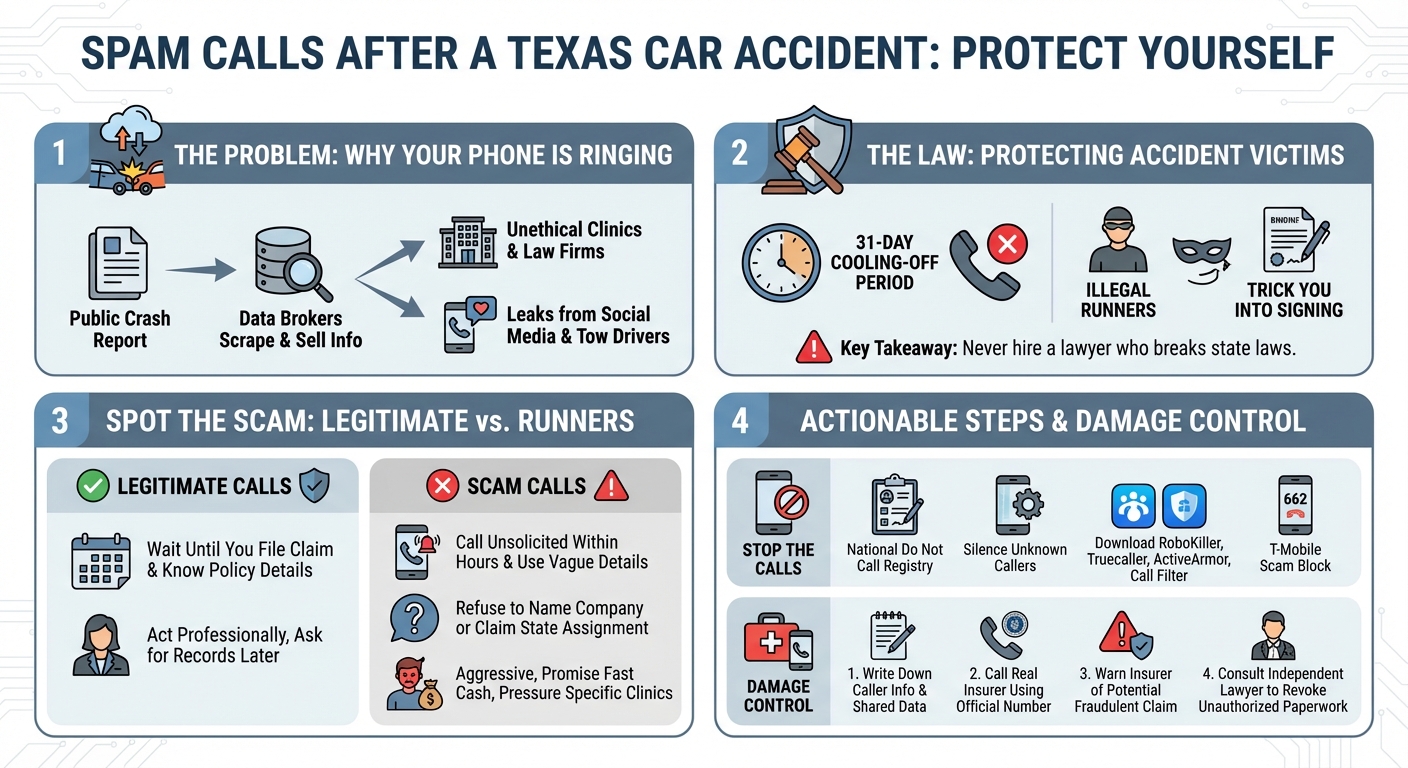
You are getting spam calls after a Texas car accident because your crash report (CR-3) becomes public record. Data brokers, unethical clinics, and illegal legal “runners” scrape these reports for your phone number. They use this data to illegally solicit you for medical treatments or personal injury lawsuits.
Why Am I Getting Spam Calls After a Car Accident in Texas?
Dealing with the aftermath of a car crash is stressful enough without your phone ringing off the hook. If you were recently involved in a collision in Texas, you might be experiencing a sudden, overwhelming influx of post-accident spam calls from unrecognized numbers.
Your phone number is no longer private because accident data moves quickly. While you might assume these callers are trying to help, many are predatory operations looking to profit off your vulnerability. It is critical to understand the difference between legitimate insurance follow-ups and illegal solicitation schemes.
Why am I getting so many spam calls after a car accident?
You are getting spam calls because your Texas Crash Report (CR-3) becomes a public record. Data brokers scrape these reports for your phone number and sell it to unethical clinics, tow truck companies, and illegal legal “runners” who use the information to solicit you for services.
- Texas Crash Reports (CR-3) and Public Record Loopholes: Once law enforcement files your accident report, it enters a database. While Texas law restricts who can access full reports, loopholes allow third parties to obtain basic contact information.
- Data Brokers Scraping Databases: Companies specialize in scraping police scanners, dispatch logs, and public accident databases. They package this data and sell it as “leads” to aggressive marketers.
- Information Leaks: Unscrupulous tow truck drivers, auto body shops, and even unethical medical clinics sometimes sell customer lists to third-party solicitors.
- Social Media Oversharing: Posting about your accident publicly on Facebook or Instagram, especially with geo-tags, allows data miners to cross-reference your identity and find your phone number.
Why are lawyers calling me after a car accident?
Lawyers are calling you because they are illegally soliciting your business. Under Texas barratry laws, it is a crime for attorneys or their representatives to contact accident victims for legal representation within 31 days of a crash unless you contact them first.
- Understanding Barratry (Ambulance Chasing) Laws: Texas strictly prohibits “barratry.” Lawyers cannot cold-call, text, or show up at your hospital room uninvited to pitch their services.
- The 31-Day Rule: Texas law mandates a 31-day cooling-off period. During this time, direct legal solicitation is strictly forbidden, protecting victims from high-pressure sales tactics while they heal.
- Unethical Law Firms and “Runners”: To bypass these laws, shady law firms hire “runners”—third parties who pretend to be from “accident support clinics” or “victim advocacy groups.” They trick you into signing paperwork that signs away your rights to a specific lawyer or chiropractor.
- Why You Should Never Hire Them: If a lawyer is willing to break state barratry laws to get your case, they will likely cut corners when handling your claim. Always hang up and choose an attorney on your own terms.
How to Tell the Difference Between Legitimate Calls and Scams
Not every call after an accident is a scam. You need to communicate with certain parties to process your claim. Here is how to tell who is on the other end of the line.
- Calls from Your Own Auto Insurance Company: Your insurer will call to take your statement, arrange a rental car, or discuss property damage. They will know your policy number and the specific details you reported to them.
- Calls from the At-Fault Driver’s Adjuster: The other driver’s insurance may contact you. While legitimate, remember that their goal is to minimize your payout. You are not obligated to give them a recorded statement without your own lawyer present.
- Red Flags of a Scam Call: Scammers will often refuse to name their specific company, demand immediate action, promise guaranteed settlement amounts, or claim they were “assigned” to your case by the state.
Legitimate Callers vs. Accident Scammers
| Characteristic | Legitimate Insurance Adjuster | Accident Scammer / Runner |
|---|---|---|
| Initial Contact | Usually after you file a claim | Unsolicited, often within hours of the crash |
| Knowledge of Details | Knows your policy or claim number | Uses vague terms like “your recent accident” |
| Demeanor | Professional, focused on facts | Aggressive, pushy, promises fast cash |
| Medical Demands | Asks for medical records later | Pressures you to visit a specific “clinic” today |
How to stop all insurance spam calls?
To stop insurance spam calls, register your number on the National Do Not Call Registry and enable “Silence Unknown Callers” on your smartphone. You can also download reputable call-blocking apps and report illegal solicitation directly to the Texas Attorney General.
- National Do Not Call Registry: Add your number to donotcall.gov. While it won’t stop illegal scammers, it filters out legally compliant telemarketers.
- Smartphone Built-In Features: Both iOS and Android have features to silence unknown callers. This sends numbers not in your contacts directly to voicemail, allowing you to screen for legitimate insurance adjusters.
- Third-Party Call Blocking Apps: Apps like RoboKiller, Truecaller, or Nomorobo use vast databases to identify and block known scam numbers automatically.
- Reporting Illegal Solicitation: If you receive a call from a “runner” or an unethical lawyer, document the number and report them to the State Bar of Texas and the Texas Attorney General’s Consumer Protection Division.
Does 662 really block spam calls?
Yes, dialing #662# activates Scam Block for T-Mobile and Sprint users. It stops “Scam Likely” calls from ringing your phone. However, it does not block all spam, especially if scammers use local number spoofing to disguise their caller ID.
- How #662# Works: This shortcode turns on T-Mobile’s free Scam Shield network-level blocking. It intercepts known scam numbers before they ever reach your device.
- Alternative Carrier Codes and Apps: If you are not on T-Mobile, #662# won’t work. AT&T users should download the ActiveArmor app, while Verizon users can activate the Call Filter app to achieve similar network-level protection.
- Limitations Against Spoofed Numbers: Scammers often “spoof” their numbers to look like local Texas area codes (e.g., 713, 281, 512). Carrier blocks struggle to catch these because the numbers appear legitimate.
What to Do If You Accidentally Gave Information to a Scammer
In the chaotic days following a crash, it is easy to mistake a scammer for a legitimate insurance representative. If you accidentally shared personal details, take immediate action to protect your claim and your identity.
- Document the Call Details: Write down the phone number, the name the caller used, the company they claimed to represent, and exactly what information you provided.
- Notify Your Actual Insurance Company: Call your insurer using the official number on your insurance card. Inform them that a third party may try to file a fraudulent claim or access your policy using your details.
- Consult a Vetted, Independent Texas Personal Injury Lawyer: If you signed paperwork with a “runner” or gave away sensitive medical information, contact an independent, reputable attorney immediately. A qualified lawyer can help you revoke unauthorized medical releases and protect your legitimate injury claim from being hijacked by bad actors.