
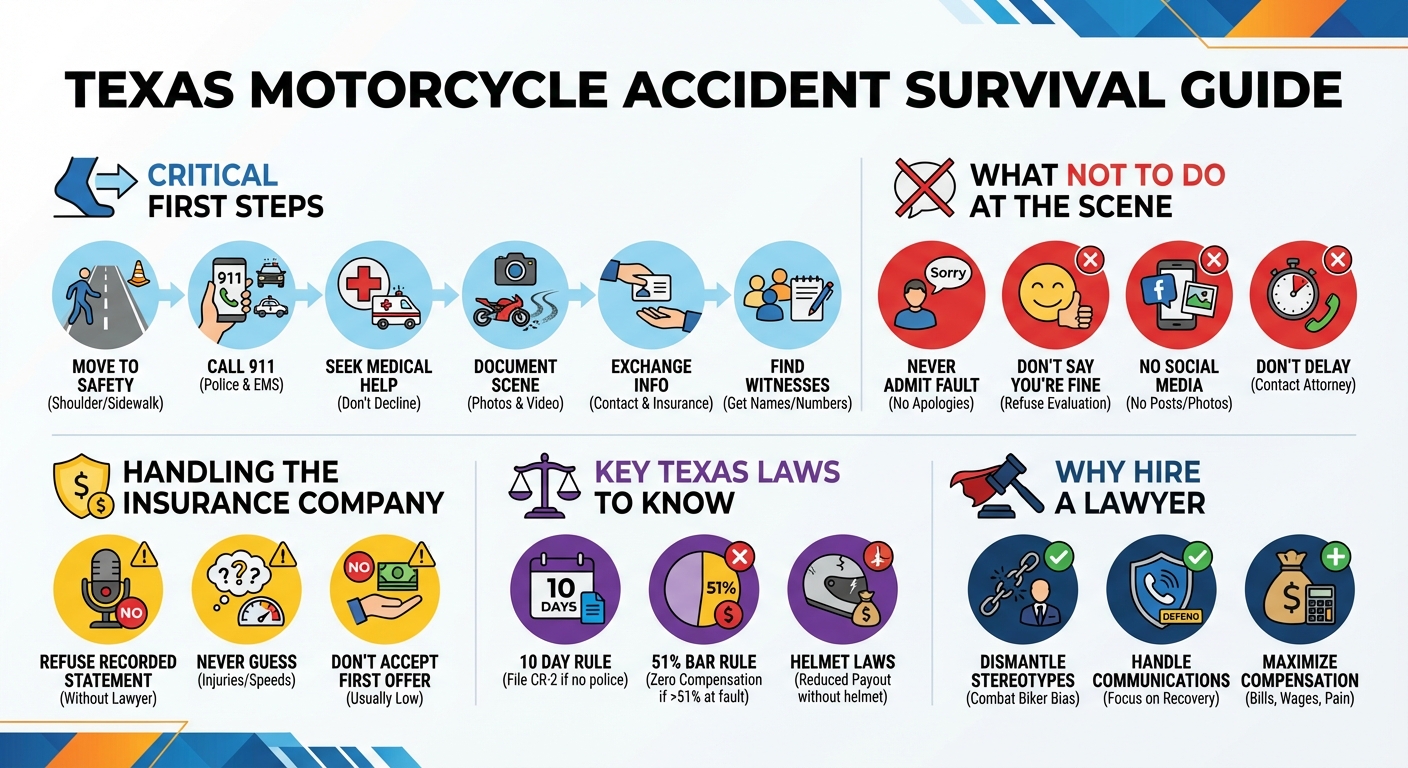
After a motorcycle accident in Texas, immediately call 911 to report the crash and request medical help. Move to safety if possible, exchange contact and insurance information with the other driver, and document the scene with photos. Never admit fault or apologize at the scene.
What to Do After a Motorcycle Accident in Texas: A Step-by-Step Guide
The Critical First Minutes After a Crash
The moments immediately following a motorcycle crash are chaotic and overwhelming. Adrenaline floods your system, often masking the pain of severe injuries. What you do in these critical first minutes can dictate your physical recovery and the success of your personal injury claim. Taking decisive, documented action protects you from aggressive insurance adjusters who will look for any reason to deny your claim.
Why Texas Motorcycle Crashes Require Specific Actions
Texas is an at-fault state, meaning the person responsible for the crash is liable for the damages. However, motorcyclists face an uphill battle. Bias against riders is common, and insurance companies often try to shift blame onto the biker. Documenting evidence at the scene and strictly following legal protocols is your best defense against these tactics.
What should I do immediately after a motorcycle accident?
Immediately after a motorcycle accident, prioritize safety by moving out of traffic if possible. Call 911 to request police and emergency medical services. Document the crash scene with photos, exchange insurance information with the other driver, and gather witness contacts. Never admit fault or apologize at the scene.
1. Move to Safety (If Possible)
If you are physically able and your motorcycle is in a hazardous position, move to the shoulder or sidewalk. Do not risk further injury by standing in the middle of a busy Texas highway. If you cannot move, stay as still as possible and wait for emergency responders.
2. Call 911 and Request Police and EMS
Always call 911. Texas law requires you to report any accident resulting in injury, death, or significant property damage. Having a police officer at the scene ensures an official crash report is generated, which is a vital piece of evidence for your insurance claim.
3. Get Medical Help Immediately
Never decline an ambulance ride if you feel pain. Even if you think you only have minor scrapes, let the paramedics evaluate you. Internal bleeding, concussions, and soft tissue injuries often take hours or days to manifest. Immediate medical records link your injuries directly to the crash.
4. Document the Scene (Photos and Video)
If you are physically able, use your smartphone to take wide-angle and close-up photos of the scene. Capture vehicle damage, skid marks, road conditions, traffic signs, and your injuries. Video footage panning across the entire intersection or roadway is also highly effective.
5. Exchange Information with the Other Driver
Collect the other driver’s name, phone number, address, driver’s license number, license plate number, and insurance policy details. Keep the conversation brief and strictly factual. Do not discuss how the accident happened.
6. Gather Witness Contact Information
Independent witnesses can make or break a motorcycle accident claim. Ask bystanders who saw the crash for their names and phone numbers. Their objective testimony can counter a negligent driver who later changes their story.
How late can you file a police report after an accident in Texas?
In Texas, if law enforcement does not investigate the crash, you must file a CR-2 form (Blue Form) within 10 days of the accident. However, it is always best to call the police immediately so an official crash report is created at the scene to support your claim.
The 10-Day Rule for Texas CR-2 (Blue Form) Reports
If the police do not respond to your accident (which sometimes happens in minor collisions during severe weather or high call volumes), the burden falls on you. You have exactly 10 days from the date of the crash to submit the CR-2 form to the Texas Department of Transportation if the accident caused injury, death, or more than $1,000 in property damage.
Why an Official Police Report is Crucial for Your Claim
Insurance adjusters rely heavily on the police report to determine fault. The report contains the officer’s objective narrative, diagrams of the crash, and citations issued to the at-fault driver. Without it, your claim becomes a frustrating word-against-word dispute.
What not to do after a motorcycle accident?
After a motorcycle accident, do not admit fault, apologize, or say you are fine. Do not refuse medical treatment, as adrenaline often masks serious injuries. Additionally, avoid posting about the crash on social media and do not delay contacting a personal injury attorney to protect your legal rights.
Do Not Admit Fault or Apologize at the Scene
Saying “I’m sorry” or “I didn’t see you” can be legally construed as an admission of guilt. Stick to the facts when speaking to the police, and let the physical evidence determine who was at fault.
Do Not Refuse Medical Treatment or Say ‘I’m Fine’
Insurance companies love it when victims say they feel fine at the scene. If you later discover you have a herniated disc or a closed head injury, the adjuster will argue that your injuries are unrelated to the crash because you initially declined treatment.
Do Not Post About the Crash on Social Media
Go dark on social media. Do not post photos of your damaged bike, updates about your health, or rants about the other driver. Defense attorneys will scour your profiles for anything they can use to minimize your injuries or shift blame.
Do Not Delay Contacting a Personal Injury Attorney
Evidence disappears quickly. Skid marks fade, witnesses forget details, and security camera footage gets overwritten. Contacting a lawyer early ensures crucial evidence is preserved and your rights are protected from day one.
What not to tell your insurance company?
When speaking to your insurance company, do not provide a recorded statement without your lawyer present. Never speculate about your injuries, guess the extent of the vehicle damage, or accept their initial settlement offer. Stick to the basic facts of the crash, such as the date, time, and location.
Never Give a Recorded Statement Without a Lawyer
Insurance adjusters are trained interrogators. They will ask leading questions designed to make you admit partial fault or downplay your injuries. You are not legally obligated to give a recorded statement to the at-fault driver’s insurance company.
Do Not Speculate About Your Injuries or the Damage
If an adjuster asks how you are feeling, do not say “I’m okay.” Tell them you are receiving medical treatment and your doctors are evaluating your condition. Never guess about the speed you were traveling or the distance at which you saw the other car.
Do Not Accept the First Settlement Offer
Initial settlement offers are notoriously low. They are designed to close your case before you realize the full extent of your future medical bills and lost wages. Once you sign a release, you cannot ask for more money later.
How Adjusters Use Your Words Against You
Adjusters will take innocent comments out of context to devalue your claim. To understand exactly how these tactics work and how to protect yourself, read our detailed guide on The Recorded Statement Trap.
Understanding Texas Motorcycle Laws and Your Injury Claim
Texas Modified Comparative Fault (The 51% Bar Rule)
Texas follows a modified comparative fault rule. You can recover damages as long as you are 50% or less at fault for the crash. If you are found to be 51% or more responsible, you get nothing. Your compensation is reduced by your percentage of fault.
| Your Fault Percentage | Impact on Your Compensation |
|---|---|
| 0% Fault | You receive 100% of your damages. |
| 20% Fault | Your total compensation is reduced by 20%. |
| 51% or More Fault | You are barred from recovering any money ($0). |
How Texas Helmet Laws Impact Your Compensation
In Texas, riders over 21 who have completed a safety course or carry appropriate health insurance are not legally required to wear a helmet. However, if you suffer a head injury while riding helmetless, the defense may argue you failed to mitigate your damages, potentially reducing your compensation.
Overcoming the ‘Reckless Biker’ Bias in Texas Courts
Insurance companies often rely on the stereotype that all motorcyclists are reckless speeders. Overcoming this bias requires hard evidence: accident reconstruction experts, witness testimony, and a pristine driving record. A skilled attorney knows how to dismantle these unfair stereotypes.
Why You Need a Texas Motorcycle Accident Lawyer
Protecting Your Rights Against Aggressive Insurance Companies
You should focus on healing, not fighting with insurance adjusters. A dedicated motorcycle accident attorney will handle all communications, investigate the crash, and build an airtight case proving the other driver’s negligence.
Maximizing Your Settlement for Medical Bills, Lost Wages, and Pain
Motorcycle crashes often result in catastrophic injuries requiring surgeries, physical therapy, and extended time off work. Your lawyer will calculate the true lifetime cost of your injuries, ensuring your settlement covers past, present, and future damages, including pain and suffering.
How to Get Started with a Free Case Evaluation
Do not wait until the insurance company denies your claim. Reach out for a free, no-obligation case evaluation. We will review the facts of your crash, explain your legal options, and outline the exact steps needed to secure the compensation you deserve.
 Call (713) 747-7777