

Table of contents
Seeing a Doctor After a Car Accident: Why It Matters for Your Health and Claim
After a collision, your first instinct might be to exchange insurance information, assess the visible damage to your vehicle, and simply go home to rest. However, delaying a medical evaluation is one of the biggest mistakes accident victims make. Understanding why seeing a doctor after a car accident matters is essential for safeguarding both your physical recovery and your legal rights.
The Crucial Link Between Medical Attention and Accident Claims
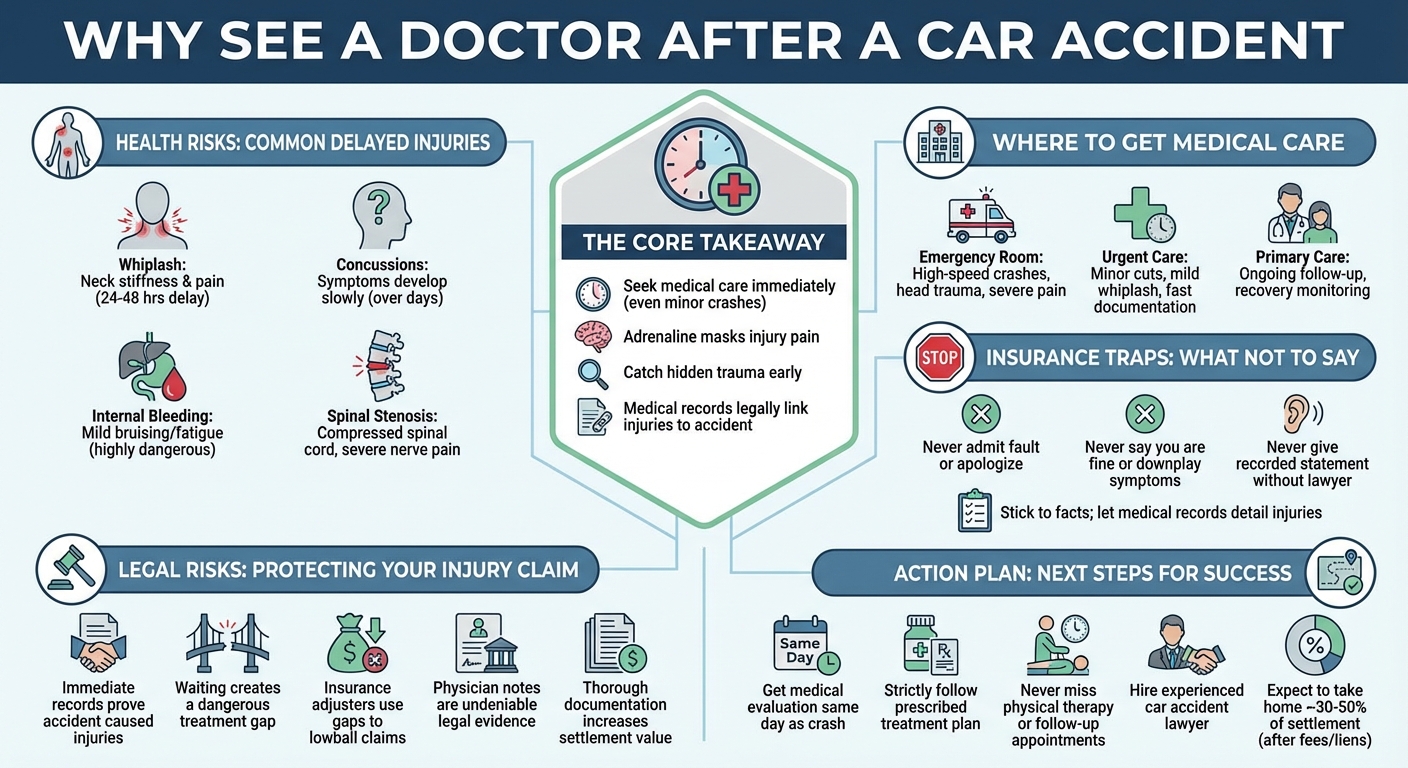
Seeing a doctor immediately after a car accident is critical for two reasons: it identifies hidden injuries before they worsen, and it creates an official medical record. This documentation legally links your injuries directly to the crash, preventing insurance companies from denying your claim.
Without this immediate medical evidence, insurance adjusters will quickly argue that your injuries were caused by an unrelated event or a pre-existing condition, severely undermining your ability to recover fair compensation.
Should you always see a doctor after a car accident?
Yes, you should always see a doctor after a car accident, even following a minor fender bender. The trauma of a crash triggers a massive surge of adrenaline and endorphins, which can temporarily mask the pain of severe injuries. A prompt medical evaluation ensures hidden trauma is diagnosed immediately.
The Medical Reasons: Protecting Your Physical Well-Being
Your health is your top priority. Many severe injuries do not show immediate symptoms, making early medical intervention a literal lifesaver.
Common Delayed-Onset Injuries
- Whiplash: Neck stiffness and pain may not appear for 24 to 48 hours.
- Concussions and Traumatic Brain Injuries (TBIs): Headaches, dizziness, or cognitive issues can develop slowly over days.
- Internal Bleeding: A highly dangerous condition that may initially only present as mild abdominal bruising or fatigue.
Can a car accident cause spinal stenosis?
Yes, a car accident can cause or aggravate spinal stenosis. While spinal stenosis is often a degenerative condition, the severe impact of a crash can cause bone fragments, herniated discs, or inflamed tissues to suddenly compress the spinal cord, triggering immediate and severe nerve pain.
The Importance of Early Intervention and Diagnostic Imaging
Doctors use X-rays, MRIs, and CT scans to look beneath the surface. Catching a hairline fracture or a bulging disc early allows you to begin physical therapy or targeted treatment before the condition requires invasive surgery.
The Legal Reasons: Protecting Your Personal Injury Case
Beyond your health, your medical records are the foundation of your personal injury claim.
Establishing the ‘Causation’ Link
To win an injury claim, you must prove that the car accident directly caused your injuries. Immediate medical records serve as objective, third-party proof of this causation, leaving little room for insurance adjusters to dispute the origin of your pain.
The Danger of ‘Gaps in Treatment’
If you wait weeks to see a doctor, insurance companies will cite a “gap in treatment.” They will argue that if you were truly hurt, you would have sought immediate care. This gap is the most common justification used to deny or lowball settlement offers.
Medical Records as Your Strongest Evidence
Your physician’s notes detailing your pain levels, restricted mobility, and prescribed treatments translate your subjective experience into hard, undeniable evidence.
Navigating Insurance Companies After Seeking Treatment
Insurance adjusters are trained to minimize payouts. How you communicate with them after your medical visits can make or break your case.
What not to tell your insurance company?
When speaking to an insurance company, do not admit fault, apologize, or downplay your injuries. Never say “I am fine” or provide a recorded statement without an attorney present. Stick only to the basic facts of the crash and let your official medical records detail your injuries.
Understanding Compensation and Settlements
The cost of your medical care directly influences the value of your personal injury settlement.
How Medical Bills Impact Your Case Value
Settlements are largely calculated based on your economic damages (hospital bills, physical therapy, lost wages) and non-economic damages (pain and suffering). Comprehensive medical documentation ensures every dollar of your treatment is accounted for.
How much of a $100K settlement will I get?
From a $100,000 settlement, you will typically receive the remaining balance after deducting attorney fees (usually 33% to 40%), case expenses, and outstanding medical liens. Depending on your specific medical bills and legal costs, a client often takes home roughly 30% to 50% of the total gross settlement.
Where to Go: ER, Urgent Care, or Primary Care?
Choosing the right facility depends on the severity of the crash and your symptoms.
- Emergency Room (ER): Best for high-speed collisions, head trauma, suspected fractures, or severe pain. ERs have comprehensive imaging equipment on hand.
- Urgent Care: Suitable for minor cuts, mild whiplash, or low-speed fender benders when the ER is unnecessary but you still need immediate documentation.
- Primary Care Physician (PCP): Ideal for follow-up care, though some PCPs refuse to treat car accident victims due to auto insurance billing complexities.
For a deeper dive into why immediate, high-level care is vital, read our guide on Why You Should Never Skip the Emergency Room After a Texas Car Accident.
Next Steps: Securing Your Medical and Legal Rights
Seeing a doctor is only the first step. To protect your claim, you must strictly follow your doctor’s treatment plan. Attend all physical therapy sessions, fill your prescriptions, and do not miss follow-up appointments.
Finally, navigating the aftermath of a crash shouldn’t be done alone. Consulting an experienced Houston car accident lawyer ensures that while your doctors focus on healing your body, your legal team focuses on securing the compensation you deserve.