

Table of contents
If you are injured in a Houston boat accident, your claim falls under either Texas state personal injury law or federal maritime law. Maritime law applies if the collision occurred on navigable waters like the Houston Ship Channel or the Gulf of Mexico, offering specific protections like the Jones Act for injured seamen.
Houston Boat Accident & Maritime Law Attorney: Navigating Your Injury Claim
Houston’s proximity to the Gulf of Mexico, Galveston Bay, and the bustling Houston Ship Channel makes it a hub for both commercial maritime activity and recreational boating. Unfortunately, this heavy water traffic also leads to severe accidents. When a collision or injury occurs on the water, victims quickly discover that standard personal injury laws do not always apply.
Watercraft injuries are governed by a complex intersection of Texas state law and federal maritime law (admiralty law). Knowing which legal framework applies to your case is the difference between securing maximum compensation and having your claim dismissed. If you have been injured offshore or on local waterways, you need a legal strategy tailored to the specific jurisdiction of your accident.
Does Texas State Law or Federal Maritime Law Apply to Your Boat Accident?
The most critical question following a watercraft accident is determining jurisdiction. The location of the accident and the status of the victim (civilian vs. maritime worker) dictate whether state or federal laws apply.
The Difference Between Recreational and Commercial Watercraft Claims
Recreational boating accidents typically involve pleasure crafts, jet skis, or pontoon boats on inland lakes. These cases often fall under Texas state negligence laws. Conversely, commercial watercraft claims involve cargo ships, tugboats, barges, or offshore oil rigs. Because these vessels operate in federal waters and engage in interstate or international commerce, injuries sustained on them are strictly governed by federal maritime law.
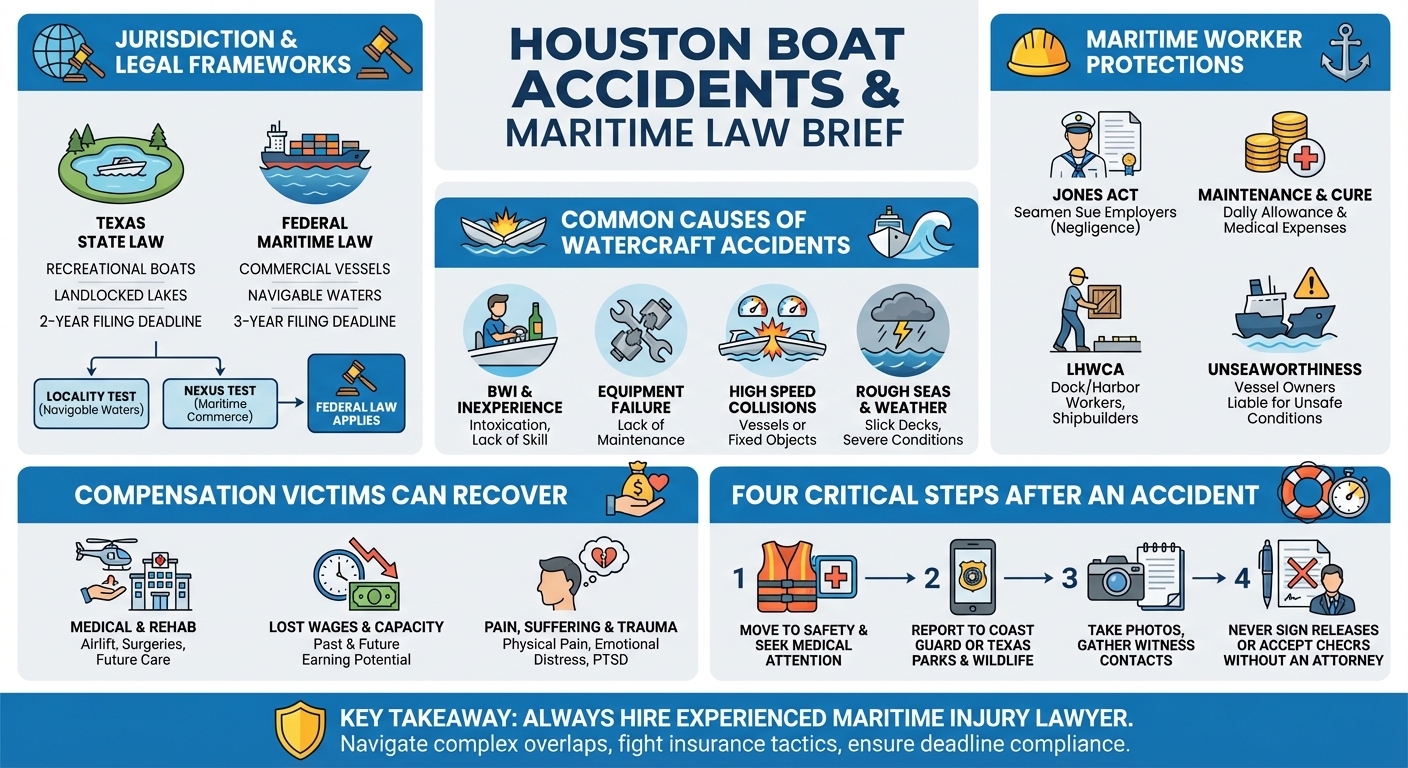
Comparison: Texas Personal Injury Law vs. General Maritime Law
| Feature | Texas State Personal Injury Law | Federal Maritime Law |
|---|---|---|
| Primary Location | Landlocked lakes, private ponds, rivers not used for commerce. | Navigable waters (Gulf of Mexico, Ship Channel, Galveston Bay). |
| Statute of Limitations | Typically 2 years from the date of injury. | Typically 3 years from the date of injury. |
| Worker Protections | Texas Workers’ Compensation (if subscribed). | The Jones Act, LHWCA, Maintenance & Cure. |
Understanding the Rules of Admiralty: When Maritime Law Takes Over
For federal maritime law to apply to an injury claim, the incident must satisfy two specific legal criteria: the Locality Test and the Nexus Test.
The ‘Navigable Waters’ Locality Test (Gulf of Mexico, Houston Ship Channel)
The accident must occur on “navigable waters.” These are bodies of water that can be used for interstate or foreign commerce. In the Houston area, the Gulf of Mexico, the Houston Ship Channel, and Galveston Bay all easily meet this definition.
The ‘Nexus’ Test: Does the Accident Impact Maritime Commerce?
Even if an accident happens on navigable waters, it must have a “nexus” (connection) to traditional maritime activity. The courts will ask: Does the nature of the incident have the potential to disrupt maritime commerce? For example, a fire on a marina dock or a collision that blocks a shipping lane satisfies this requirement.
How Inland Lakes (Like Lake Conroe) Are Treated Under the Law
Accidents on landlocked, man-made lakes like Lake Conroe or Lake Livingston generally do not fall under federal maritime law because they do not support interstate maritime commerce. Injuries on these waters are typically pursued under standard Texas personal injury and negligence laws.
Legal Protections for Injured Maritime Workers and Seamen
Maritime workers face some of the most dangerous working conditions in the world. Because standard state workers’ compensation does not apply on navigable waters, federal law provides specific protections.
The Jones Act: Suing an Employer for Negligence
The Jones Act is a federal statute that allows qualifying “seamen” (workers who spend a significant amount of their time on a vessel in navigation) to sue their employers for negligence. Unlike standard workers’ comp, which is no-fault, a Jones Act claim requires proving that the employer’s negligence—even a minor unsafe condition—contributed to the injury.
Maintenance and Cure Benefits Explained
Regardless of who is at fault for the injury, an injured seaman is entitled to “Maintenance and Cure.”
- Maintenance: A daily living allowance to cover room and board while recovering.
- Cure: Full coverage of reasonable and necessary medical expenses until the worker reaches maximum medical improvement (MMI).
The Longshore and Harbor Workers’ Compensation Act (LHWCA)
Not all maritime workers qualify as seamen. Dockworkers, shipbuilders, harbor construction workers, and stevedores are protected under the LHWCA. This federal law provides compensation for lost wages and medical care for injuries occurring on navigable waters or adjoining areas like piers and terminals.
Claims of ‘Unseaworthiness’ Against Vessel Owners
Under general maritime law, vessel owners owe an absolute duty to provide a “seaworthy” vessel. This does not mean the ship must be perfect, but it must be reasonably fit for its intended purpose. If a worker is injured due to defective gear, an undertrained crew, or unsafe conditions, they can file an unseaworthiness claim against the vessel owner.
Common Causes of Houston Boating and Offshore Accidents
Whether on a recreational speedboat or a commercial barge, accidents on the water happen rapidly and often with catastrophic results.
Boating While Intoxicated (BWI) and Operator Inexperience
Alcohol consumption is a leading cause of recreational boating accidents. Combined with operator inexperience and a lack of understanding of navigational rules, BWI frequently leads to high-speed collisions and drownings.
Equipment Failure and Lack of Proper Maintenance
Vessels require rigorous maintenance. Steering failures, engine fires, and electrical shorts can leave a boat stranded or cause sudden, unpredictable movements that throw passengers overboard.
Collisions with Other Vessels or Fixed Objects
Crowded waterways like Galveston Bay increase the risk of collisions. Boats striking submerged rocks, docks, or other watercraft often cause severe blunt force trauma and whiplash injuries to passengers.
Rough Seas and Severe Weather Conditions
The Gulf Coast is notorious for sudden weather shifts. Failing to monitor weather advisories can result in vessels capsizing or crew members suffering slip and fall injuries on slick decks.
What Compensation Can You Recover in a Maritime Injury Case?
Victims of maritime and boating accidents can pursue comprehensive damages to restore their financial and physical well-being.
Medical Expenses and Future Rehabilitation
This includes emergency airlift evacuations, surgeries, hospital stays, physical therapy, and any future medical care required for permanent disabilities.
Lost Wages and Loss of Earning Capacity
If your injury prevents you from returning to your maritime career or requires you to take a lower-paying job, you can recover both past lost wages and future loss of earning capacity.
Pain, Suffering, and Mental Anguish
Victims can be compensated for physical pain, emotional trauma (such as PTSD from a near-drowning experience), and diminished quality of life.
Critical Steps to Take After a Houston Watercraft Collision
The actions you take immediately following a boat accident heavily influence the success of your future legal claim.
1. Ensure Safety and Seek Immediate Medical Attention
Move away from sinking vessels or fuel leaks. Call for emergency medical help immediately. Even if you feel fine, adrenaline can mask severe internal injuries or concussions.
2. Report the Accident to the Coast Guard or Texas Parks & Wildlife
Federal and state laws require operators to report boating accidents that result in injury, death, or significant property damage. An official report serves as vital evidence.
3. Document the Scene, Vessel Damage, and Witness Info
If you are physically able, take photos of the damage to all vessels involved, the weather conditions, and your injuries. Collect names and contact information from all passengers and eyewitnesses.
4. Do Not Sign Any Insurance Releases Without Legal Counsel
Maritime insurance companies are notoriously aggressive. They may offer a fast, lowball settlement or ask for a recorded statement to use against you later. Never sign a release or accept a check without consulting an attorney.
Why You Need an Experienced Houston Maritime Injury Lawyer
Handling a watercraft injury claim without specialized legal representation is incredibly risky due to the overlapping laws and aggressive defense tactics involved.
Navigating Complex Jurisdictional Overlaps
A standard personal injury lawyer may not know how to file a Jones Act claim or invoke admiralty jurisdiction. An experienced maritime attorney will identify exactly which laws apply to maximize your recovery.
Fighting Back Against Aggressive Maritime Insurance Companies
Vessel owners and their corporate insurers have teams of lawyers ready to minimize their liability. They may attempt to blame you for the accident or claim your injuries are pre-existing. A skilled lawyer will protect your rights and handle all negotiations.
Understanding Strict Statutes of Limitations in Admiralty Law
Missing a deadline will permanently bar you from recovering compensation. While general maritime law typically allows three years to file a claim, Texas state law only allows two years. An attorney ensures all filings are executed well within the correct deadlines.
Frequently Asked Questions About Houston Boat Accidents and Maritime Law
Below are answers to common questions regarding watercraft injuries and legal rights in Texas.