

Table of contents
Yes, you can sue the Catholic Church for sexual abuse and institutional negligence. Survivors can file civil lawsuits against individual perpetrators and the institutional entities—like the local diocese or archdiocese—that enabled or covered up the abuse, often recovering compensation for medical care and emotional trauma.
Suing the Catholic Church: Legal Rights for Abuse Survivors
For decades, systemic cover-ups within the Catholic Church shielded abusive priests and left survivors without a voice. Today, the legal landscape has shifted dramatically. A combination of changing laws, reduced social stigma, and relentless advocacy has empowered survivors to hold one of the world’s most powerful institutions accountable.
Survivors are coming forward now more than ever because many states have temporarily lifted the legal deadlines that previously barred older claims. While our firm handles general clergy abuse claims across various denominations, lawsuits against the Catholic Church involve unique structural complexities, such as diocesan bankruptcies and complex institutional hierarchies, which require specialized legal strategies.
Can the Catholic Church be sued?
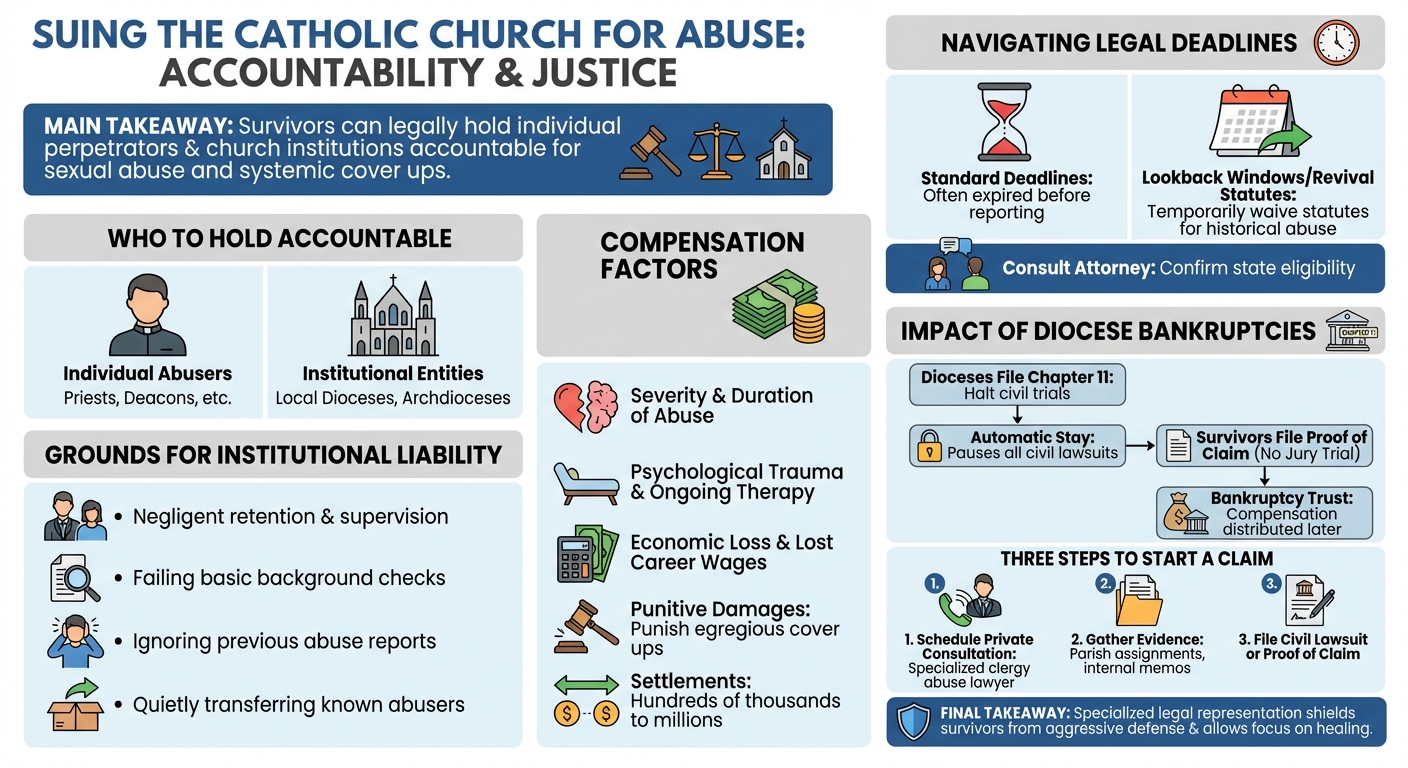
Yes, the Catholic Church can be sued. Survivors can file civil lawsuits against both the individual perpetrators, such as priests or deacons, and the institutional entities, such as the local diocese or archdiocese, that enabled or covered up the abuse. Holding the institution accountable is a primary focus of these claims.
When pursuing a lawsuit, it is crucial to understand the difference between individual and institutional liability. While the individual abuser committed the act, the institution is often held liable for negligence. This includes failing to conduct background checks, ignoring reports of abuse, or actively transferring known abusers to new parishes where they had access to more vulnerable individuals.
Eligibility Criteria for a Catholic Church Lawsuit
To file a successful lawsuit against a Catholic diocese, plaintiffs must generally prove institutional negligence. This often falls under legal concepts like negligent retention, negligent supervision, or failure to warn the congregation about a known threat.
One of the biggest hurdles in historical abuse cases has been the statute of limitations. Because trauma often prevents survivors from coming forward for years or decades, standard legal deadlines frequently expired before victims could file a claim. To remedy this, several states have enacted “Lookback Windows” or Revival Statutes. These laws create a temporary period where survivors of historical abuse can file civil lawsuits, regardless of how long ago the abuse occurred.
| State | Lookback Window Status | Impact on Survivors |
|---|---|---|
| California | AB 218 (Window Closed Dec 2022) | Allowed thousands of historical claims; ongoing litigation continues for filed cases. |
| New York | Child Victims Act (Window Closed Aug 2021) | Resulted in over 10,000 lawsuits against various institutions, heavily impacting NY dioceses. |
| Pennsylvania | Legislative Reforms Ongoing | Eliminated criminal statutes of limitations for future cases; civil windows remain a heavily debated legislative priority. |
Even if a specific lookback window has closed, exceptions may apply depending on when the survivor discovered the psychological impact of the abuse or if the abuser was convicted criminally. Consulting a lawyer is the only way to confirm current eligibility.
How much compensation for historical abuse?
Compensation for historical abuse varies widely, but settlements often range from hundreds of thousands to over a million dollars per victim. For example, a landmark Los Angeles settlement awarded $660 million to 508 victims, averaging over $1.2 million per survivor. Final amounts depend on the specific damages proven.
- Severity and Duration of Abuse: Prolonged abuse generally results in higher compensation.
- Psychological Impact: Damages cover past and future therapy, emotional distress, PTSD, and loss of enjoyment of life.
- Economic Loss: Compensation can include lost wages if the trauma impacted the survivor’s career trajectory.
- Punitive Damages: In cases of egregious institutional cover-ups, courts may award punitive damages designed to punish the diocese.
The Impact of Diocese Bankruptcies on Claims
As civil lawsuits have mounted, dozens of Catholic dioceses across the United States have filed for Chapter 11 bankruptcy reorganization. Dioceses use this legal maneuver to consolidate claims, halt ongoing civil jury trials, and protect their broader assets from massive judgments.
When a diocese files for bankruptcy, an “automatic stay” is issued, which pauses all civil lawsuits against that specific entity. Instead of going to a jury trial, survivors must file a “Proof of Claim” in bankruptcy court before a strict deadline (the bar date). A bankruptcy trust is eventually formed, and compensation is distributed from this trust based on a matrix of abuse severity. Navigating bankruptcy court requires an attorney who understands both personal injury law and complex creditor rights.
What does the Catholic Church say about suing?
Publicly, the Catholic Church has apologized for historical abuse and established independent compensation programs in some dioceses. However, in civil litigation, Church lawyers frequently use aggressive defense tactics, such as citing expired statutes of limitations or filing for bankruptcy to limit financial payouts to survivors.
There is often a stark contrast between the Church’s internal Canon law and secular civil litigation. While the Vatican has updated Canon law to mandate the reporting of abuse internally, civil defense attorneys representing local dioceses still vigorously defend the institution’s assets, often arguing that the diocese is not legally responsible for the independent actions of rogue priests.
What was his biggest complaint against the Catholic Church?
In the context of legal action, the biggest complaint against the Catholic Church by whistleblowers and lead plaintiffs is the systemic cover-up of abuse. Specifically, plaintiffs condemn the practice of quietly transferring accused priests to new parishes without warning the congregation, thereby enabling further abuse.
This practice of shuffling abusers was the catalyst for the 2002 “Dallas Charter,” where U.S. bishops pledged a zero-tolerance policy for abuse. While modern reforms have improved reporting and background checks, historical lawsuits continue to expose the devastating consequences of the pre-2002 cover-up culture.
How to Start a Civil Claim Against a Diocese
Taking legal action against a powerful institution can feel overwhelming, but the process begins with a single, confidential step.
- Schedule a Confidential Legal Consultation: Speak with a specialized clergy abuse lawyer. These consultations are entirely private and usually free.
- Gather Evidence and Records: Your legal team will help obtain parish assignments, personnel files, and internal diocesan memos that corroborate the timeline of the abuser.
- File the Claim: Depending on the state laws and whether the diocese is in bankruptcy, your attorney will either file a civil lawsuit or submit a Proof of Claim to a bankruptcy trust.
Hiring a specialized clergy abuse lawyer is critical. These cases require deep knowledge of diocesan corporate structures, historical insurance policies, and state-specific revival statutes. Legal representation ensures that survivors are protected from aggressive defense tactics and can focus on their healing journey.