
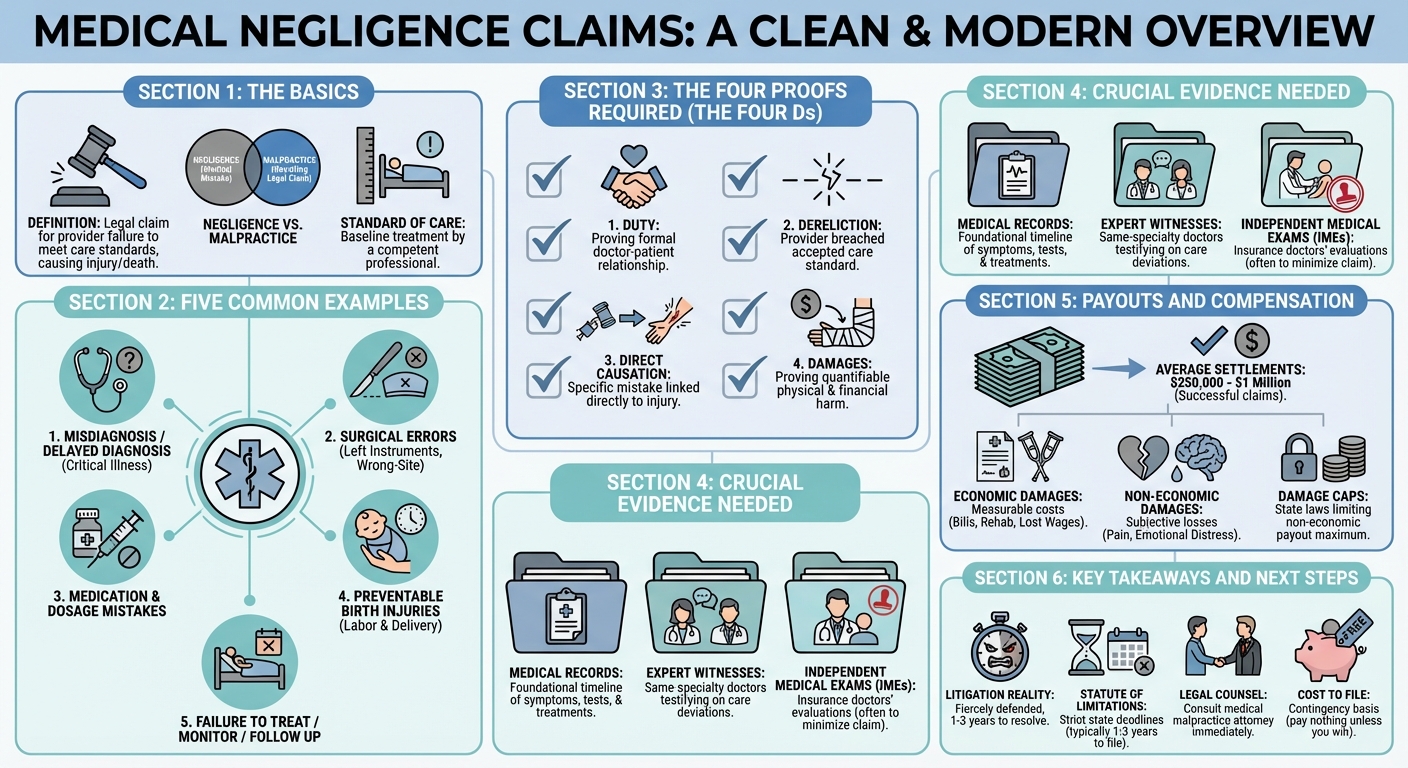
A medical negligence claim is a legal lawsuit filed when a healthcare provider fails to meet the accepted standard of care, resulting in patient injury or death. To win, plaintiffs must prove four elements: a duty of care, a breach of that duty, direct causation, and quantifiable damages.
What Is a Medical Negligence Claim?
A medical negligence claim is a formal legal action taken by a patient (or their family) against a healthcare provider whose failure to meet accepted medical standards resulted in injury, worsened illness, or death. These claims seek financial compensation for the physical, emotional, and financial damages caused by the provider’s error.
Medical Negligence vs. Medical Malpractice
While often used interchangeably, there is a subtle legal distinction between these two terms. Medical negligence refers to the actual mistake—an unintentional failure to provide the standard of care. Medical malpractice occurs when that negligence directly causes harm to the patient, giving rise to a viable lawsuit. In short, negligence is the action (or inaction), and malpractice is the resulting legal claim.
Understanding the Medical Standard of Care
The foundation of any claim is the “medical standard of care.” This is defined as the level and type of care that a reasonably competent and skilled healthcare professional, with a similar background and in the same medical community, would have provided under the same circumstances. If a doctor deviates from this baseline, they may be held liable.
What are 5 examples of medical negligence?
Five common examples of medical negligence include misdiagnosis or delayed diagnosis, surgical errors such as wrong-site surgery, medication and prescription dosage mistakes, preventable birth injuries, and the failure to properly treat or monitor a patient’s condition.
1. Misdiagnosis or Delayed Diagnosis
When a doctor fails to recognize a condition, diagnoses the wrong illness, or delays a critical diagnosis (like cancer or a heart attack), the patient loses valuable treatment time, often leading to severe disease progression or death.
2. Surgical Errors and Wrong-Site Surgery
Surgical negligence includes leaving medical instruments inside the body, operating on the wrong body part, performing the wrong procedure, or causing preventable nerve and organ damage during an operation.
3. Medication and Prescription Dosage Mistakes
Administering the wrong medication, prescribing an incorrect dosage, or failing to check for dangerous drug interactions can cause catastrophic allergic reactions, overdoses, or toxic shock.
4. Preventable Birth Injuries
Negligence during labor and delivery—such as failing to monitor fetal distress, improper use of forceps, or delaying a necessary C-section—can result in lifelong conditions like cerebral palsy or Erb’s palsy.
5. Failure to Treat or Properly Monitor a Patient
Discharging a patient prematurely, ignoring reported symptoms, or failing to order necessary follow-up tests can cause a treatable condition to escalate into a life-threatening medical emergency.
What are the 4 proofs of negligence?
To win a medical negligence claim, you must establish the four proofs of negligence, often called the ‘Four Ds’: Duty (a doctor-patient relationship existed), Dereliction (breach of the standard of care), Direct Causation (the breach caused your injury), and Damages (quantifiable harm resulted).
Duty: Establishing the Doctor-Patient Relationship
You must first prove that a formal doctor-patient relationship existed. This establishes that the healthcare provider owed you a legal duty of care to act competently.
Dereliction: Proving a Breach of the Standard of Care
Also known as a breach of duty, dereliction requires demonstrating that the provider failed to meet the accepted medical standard of care. This is typically proven through the testimony of medical experts in the same field.
Direct Causation: Linking the Breach to Your Injury
It is not enough to show that a doctor made a mistake; you must prove that this specific mistake directly caused your injury or worsened your condition, rather than an underlying illness.
Damages: Quantifying the Physical and Financial Harm
Finally, you must show that you suffered actual, quantifiable damages as a result of the injury. This includes medical bills, lost wages, diminished earning capacity, and pain and suffering.
Crucial Evidence Needed to Support Your Claim
Medical malpractice cases are highly complex and fiercely defended by hospital insurance teams. Success depends entirely on the strength of your evidence.
Why Your Medical Records Are the Foundation of Your Case
Your medical records provide the timeline of your care. They detail what symptoms were reported, what tests were ordered (or ignored), and what treatments were administered. Securing an unaltered copy of your records immediately is the most critical step in preserving your claim.
The Role of Medical Expert Witnesses
Because judges and juries lack specialized medical knowledge, expert witnesses are required. An expert—usually a doctor in the same specialty as the defendant—will review your records, establish what the standard of care should have been, and testify exactly how the defendant deviated from it.
Navigating Independent Medical Examinations (IMEs)
During litigation, the defense will likely require you to undergo an Independent Medical Examination (IME). Despite the name, these doctors are hired by the insurance company to minimize your injuries or attribute them to pre-existing conditions. Knowing how to handle an IME is crucial to protecting your claim’s value.
What is the average medical negligence payout?
There is no single average medical negligence payout, as settlements vary widely based on case severity. However, many successful claims settle between $250,000 and $1 million. The final amount depends heavily on your economic losses, the severity of your injuries, and specific state damage caps.
Factors That Influence Settlement Amounts
Payouts are driven by the extent of the patient’s injuries, the clarity of the provider’s negligence, the patient’s age and earning capacity, and the cost of future medical care required to treat the malpractice-induced injury.
Economic vs. Non-Economic Damages Explained
- Economic Damages: Reimbursable, out-of-pocket costs such as hospital bills, rehabilitation, lost wages, and loss of future earning capacity.
- Non-Economic Damages: Subjective losses, including physical pain, emotional distress, loss of consortium, and diminished quality of life.
State Damage Caps in Medical Malpractice Cases
Many U.S. states have enacted tort reform laws that place strict limits (caps) on the amount of non-economic damages a plaintiff can recover. For example, some states cap pain and suffering damages at $250,000 or $500,000, regardless of how severe the injury is. Economic damages typically remain uncapped.
Is it worth suing for medical negligence?
Yes, it is often worth suing for medical negligence if you suffered severe, permanent injuries or significant financial loss. A successful claim provides crucial compensation for medical bills and lost wages. However, because these cases are expensive and time-consuming, consulting an attorney is essential to evaluate your case’s viability.
Weighing the Time, Cost, and Emotional Toll of Litigation
Medical malpractice lawsuits can take anywhere from one to three years (or more) to resolve. They require extensive depositions, expert reviews, and aggressive negotiations. While the financial recovery can be life-changing, plaintiffs must be prepared for a rigorous legal process.
Statute of Limitations: How Long Do You Have to File?
Every state has a strict statute of limitations for medical malpractice, typically ranging from one to three years from the date the injury occurred (or the date it was reasonably discovered). Missing this deadline permanently bars you from seeking compensation.
When to Consult a Medical Malpractice Attorney
If you suspect a medical error caused significant harm to you or a loved one, you should consult an attorney immediately. Most malpractice lawyers operate on a contingency fee basis, meaning they offer free case evaluations and only get paid if they successfully recover a settlement or verdict on your behalf.
 Call (713) 747-7777