
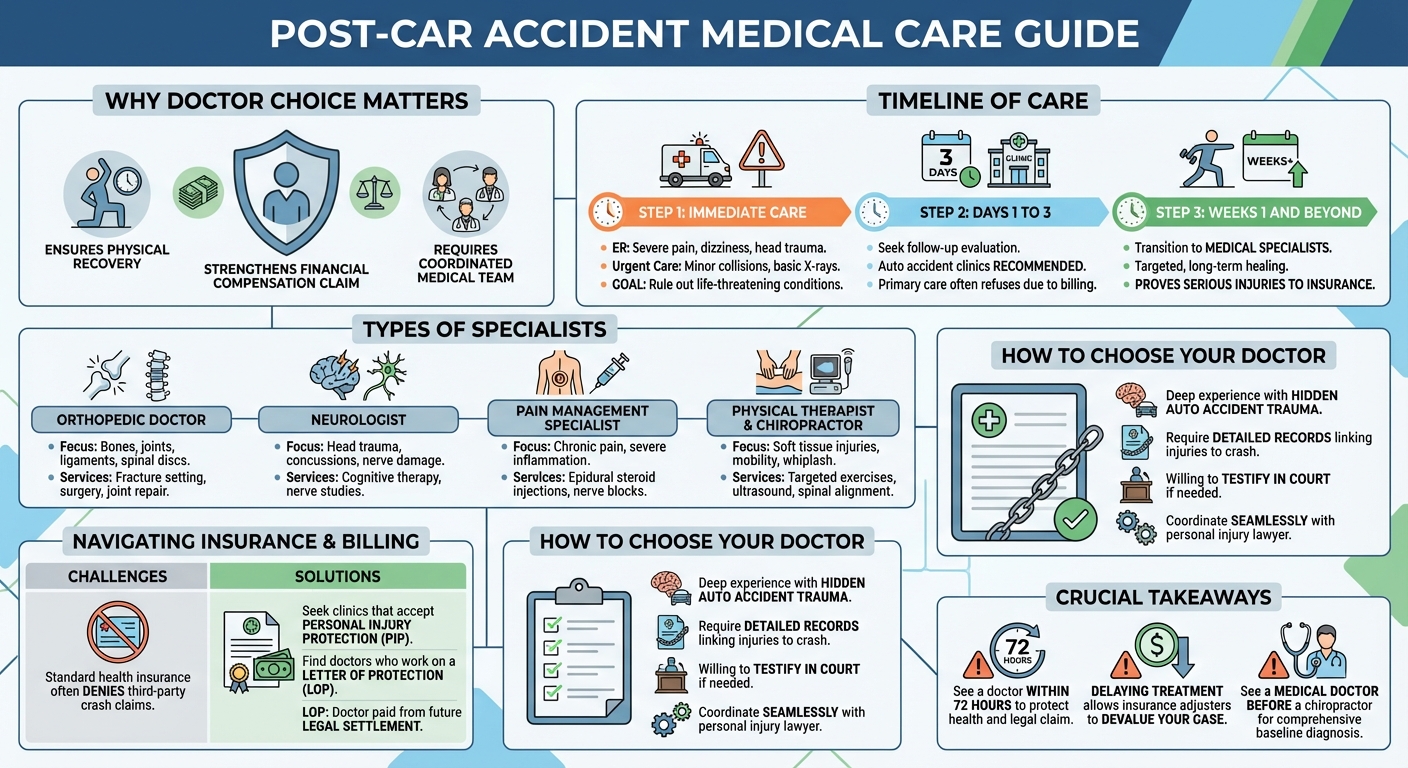
After a car accident, you should first see an Emergency Room (ER) or Urgent Care doctor for immediate trauma. Following initial treatment, you may need to visit an auto accident clinic, an orthopedic specialist for bone and joint injuries, a neurologist for head trauma, or a physical therapist for rehabilitation.
What Type of Doctor Should You See After a Car Accident?
Choosing the right doctor for a car accident injury is critical for both your physical recovery and your financial compensation. Because auto collisions cause unique types of trauma—such as whiplash, blunt force impact, and sudden deceleration injuries—you need medical professionals who specialize in identifying and treating these specific conditions. Furthermore, the doctors you choose will play a pivotal role in your personal injury claim. Their medical records, diagnostic tests, and willingness to bill auto insurance directly impact the success of your case. Rather than relying on a single physician, most accident victims require a coordinated team of medical providers, starting with emergency responders and transitioning to specialized rehabilitation experts.
The Timeline of Post-Accident Medical Care: Who to See and When
Medical care after a crash follows a specific progression. Knowing who to see at each stage ensures you get the right treatment without jeopardizing your legal claim.
Step 1: Emergency Room or Urgent Care (Immediate Care)
In the immediate aftermath of a crash, your priority is ruling out life-threatening conditions, internal bleeding, and fractures. If you experience severe pain, dizziness, or loss of consciousness, go directly to the Emergency Room. ER doctors are equipped with advanced imaging (CT scans, MRIs) to diagnose acute trauma. For minor collisions with mild discomfort, an Urgent Care center can provide a faster, more cost-effective alternative for initial X-rays and pain management.
Step 2: Primary Care Physician or Auto Accident Clinic (Days 1-3)
Within the first few days, you should seek a follow-up evaluation. While many people instinctively call their Primary Care Physician (PCP), you may find that your regular doctor refuses to see you for an auto-related injury due to billing complications. In these cases, an auto accident clinic is an excellent alternative. These facilities are staffed by medical doctors (MDs) who specialize in crash trauma and are fully equipped to handle third-party insurance billing and coordinate your ongoing care.
Step 3: Medical Specialists (Weeks 1 and Beyond)
Once your immediate injuries are stabilized, your primary care or auto accident doctor will likely refer you to specialists. These providers focus on the long-term healing of specific body parts, such as your spine, nervous system, or soft tissues. Seeing specialists is crucial because it demonstrates to insurance companies that your injuries require targeted, professional intervention.
Types of Specialists That Treat Car Accident Injuries
Depending on your diagnosis, your recovery team may include several different types of medical experts.
| Type of Specialist | Best For | Typical Treatments |
|---|---|---|
| Orthopedic Doctor | Bones, joints, ligaments, and spinal discs | Fracture setting, surgery, joint repair |
| Neurologist | Head trauma, concussions, nerve damage | Cognitive therapy, nerve conduction studies |
| Pain Management | Chronic pain, severe inflammation | Epidural steroid injections, nerve blocks |
| Physical Therapist | Soft tissue injuries, whiplash, mobility | Targeted exercises, massage, ultrasound therapy |
Orthopedic Doctors (Bones, Joints, and Spinal Discs)
Orthopedic specialists are the most common doctors treating car accident victims. They handle everything from broken bones and torn rotator cuffs to herniated discs and severe whiplash. If your injury requires surgery or advanced joint rehabilitation, an orthopedic surgeon will lead your treatment plan.
Neurologists (Concussions and Closed Head Injuries)
The violent motion of a car crash often causes the brain to strike the inside of the skull, leading to concussions or traumatic brain injuries (TBIs). Neurologists specialize in diagnosing and treating these closed head injuries, as well as peripheral nerve damage (like numbness or tingling in your arms and legs caused by spinal compression).
Pain Management Specialists (Chronic Pain and Injections)
When over-the-counter medication isn’t enough, pain management specialists step in. They focus on alleviating severe, chronic pain without relying solely on heavy narcotics. Treatments often include targeted epidural steroid injections, facet joint injections, or radiofrequency ablation to block nerve pain signals.
Physical Therapists and Chiropractors (Rehabilitation)
Recovery requires restoring strength and mobility. Physical therapists use guided exercises and modalities to heal soft tissue injuries. Chiropractors focus on spinal alignment and joint manipulation. Both are vital for long-term recovery, but they are most effective when working in conjunction with a medical doctor’s overarching treatment plan.
Why Your Regular Doctor Might Refuse to Treat You After a Crash
It can be shocking to call your trusted family doctor only to be told they cannot see you because you were in a car accident. This is rarely a medical decision; it is an administrative one.
The Complications of Auto Insurance Billing
Standard health insurance policies often refuse to pay for injuries caused by a third party (the at-fault driver). Because primary care physicians are set up to bill standard health insurance—not auto insurance or personal injury protection (PIP)—they often decline auto accident patients to avoid denied claims and unpaid bills.
Understanding Letters of Protection (LOP) and PIP
Doctors who specialize in car accidents understand how to navigate auto insurance. They frequently accept Personal Injury Protection (PIP) or work on a Letter of Protection (LOP). An LOP is a legally binding agreement between your lawyer and the doctor, guaranteeing that the medical provider will be paid directly out of your future settlement. This allows you to receive necessary care immediately, even if you cannot afford out-of-pocket costs.
How to Choose the Right Car Accident Doctor for Your Claim
Not all doctors are equipped to handle the legal and medical complexities of a personal injury claim. When selecting a provider, look for these three critical traits:
Experience with Auto Accident Trauma
Crash injuries, like delayed-onset whiplash or micro-tears in ligaments, can be difficult to diagnose. You need a doctor who routinely treats auto accident victims and knows exactly what diagnostic imaging (like an MRI rather than just an X-ray) is required to uncover hidden damage.
Willingness to Provide Detailed Medical Records and Testify
Your medical records are the foundation of your personal injury claim. A good car accident doctor takes meticulous notes, clearly linking your injuries directly to the crash. Furthermore, they must be willing to provide expert testimony or sit for a deposition if your case goes to trial.
Coordination with Your Personal Injury Lawyer
The best accident doctors maintain open lines of communication with your legal team. They ensure that all medical bills, treatment plans, and prognosis reports are promptly shared with your lawyer, preventing gaps in documentation that insurance adjusters could use to devalue your claim.
Frequently Asked Questions About Car Accident Doctors
How long do I have to see a doctor after a car accident?
You should see a doctor within 72 hours of a car accident. Delaying medical care not only risks your health by allowing hidden injuries to worsen, but it also gives insurance companies a reason to argue that your injuries were not caused by the crash, potentially devaluing your claim.
Who pays for my medical bills after a crash?
Initially, your medical bills may be covered by your Personal Injury Protection (PIP), MedPay coverage, or standard health insurance. If you lack coverage, many accident doctors will treat you under a Letter of Protection (LOP). Ultimately, the at-fault driver’s liability insurance is responsible for reimbursing these costs through your final settlement.
Can I just go to a chiropractor instead of a medical doctor?
While chiropractors are excellent for treating soft tissue injuries and whiplash, it is highly recommended to see a medical doctor (MD) first. An MD can order comprehensive imaging, prescribe necessary medications, and provide a foundational medical diagnosis that significantly strengthens your personal injury claim.
 Call (713) 747-7777