

Table of contents
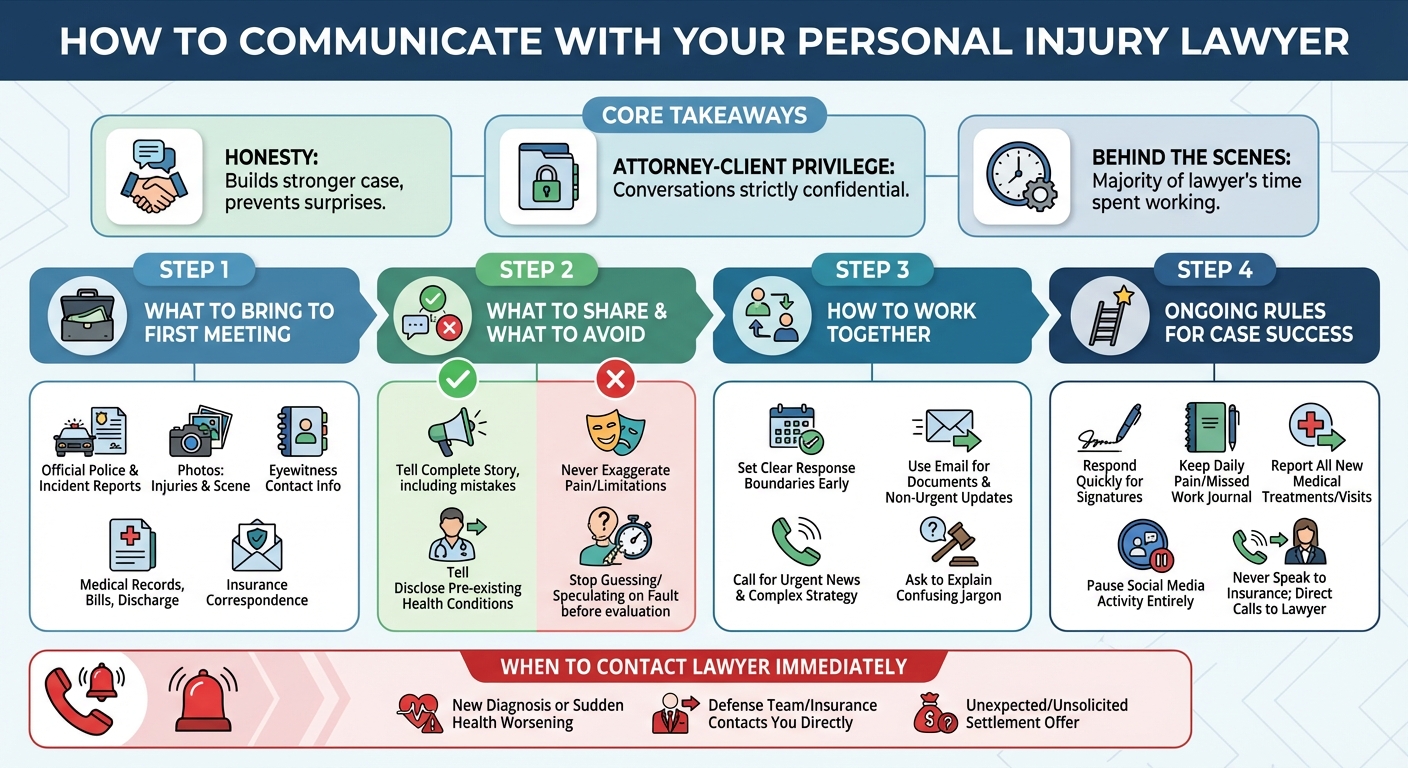
To communicate effectively with your personal injury lawyer, always be completely honest and share every detail of your accident, even if it seems unflattering. Provide all requested medical documents promptly, establish preferred communication methods early, and never hide pre-existing conditions or speak to insurance adjusters without your attorney present.
How to Communicate with Your Personal Injury Lawyer: A Complete Guide
Hiring a personal injury attorney is the first step toward securing the compensation you deserve. However, the success of your case heavily depends on what happens next: how well you communicate with your legal team. A strong attorney-client relationship is built on transparency, promptness, and clear expectations.
This guide breaks down exactly how to communicate with your personal injury lawyer, what to share, what to avoid saying, and how to ensure your case moves forward smoothly.
Why Effective Communication with Your Attorney Matters
Your lawyer is your advocate, but they can only protect you if they have all the facts. Open communication ensures there are no surprises during negotiations or litigation.
The Role of Attorney-Client Privilege
Attorney-client privilege means that, with very few exceptions, your lawyer cannot disclose what you tell them in confidence. This legal protection exists so you can be completely honest without fear of your words being used against you by the defense or insurance companies.
How Transparency Builds a Stronger Injury Claim
When you are transparent about the details of your accident, your lawyer can anticipate the defense’s arguments. If you share potential weaknesses in your case early on, your legal team can build a strategy to mitigate them. Hiding facts only gives the insurance company ammunition to devalue your claim later.
Preparing for Your First Meeting: What to Bring and Say
Your initial consultation sets the tone for your entire case. Being prepared saves time and allows your attorney to evaluate your claim accurately.
Organizing Your Medical Records and Accident Reports
Come to your first meeting with all relevant documentation. Create a folder containing:
- The official police or incident report
- Photographs of the accident scene and your injuries
- Contact information for any eyewitnesses
- All medical records, discharge papers, and bills
- Correspondence from any insurance companies
Telling the Whole Story (Even the Unflattering Parts)
Share the events exactly as they happened. If you were speeding, texting, or had consumed alcohol before the accident, tell your lawyer. Defense attorneys will uncover these facts during the discovery process. If your lawyer knows about them in advance, they can prepare a defense; if they are blindsided, it could ruin your case.
What not to say to a personal injury lawyer?
When speaking to your personal injury lawyer, do not lie, exaggerate your injuries, or hide pre-existing medical conditions. Avoid speculating about who was at fault if you aren’t certain of the facts, and never say you are “completely fine” before a doctor has fully evaluated you.
Never Exaggerate Your Injuries
Insurance adjusters use surveillance and social media to verify injury claims. If you tell your lawyer you cannot walk, but are caught on camera playing golf, your credibility is destroyed. Always describe your pain and limitations accurately.
Do Not Hide Pre-Existing Conditions
A pre-existing condition does not disqualify you from receiving compensation if a new accident aggravated it. However, lying about past injuries gives the defense a reason to deny your claim entirely. Be upfront about your medical history.
Avoid Speculating About Fault or the Accident’s Cause
Stick to the facts. Do not guess how fast the other driver was going or assume you might have been partially at fault. Let the evidence and accident reconstruction experts determine the exact cause.
Establishing Communication Expectations (Phone vs. Email)
Frustration often arises when clients and lawyers have different expectations regarding communication. Address this in your very first meeting.
Setting Boundaries and Response Times
Ask your lawyer how they prefer to communicate. Generally, email is best for sending documents, medical updates, and non-urgent questions, as it creates a written record. Phone calls are better for urgent updates or complex strategic discussions. Ask your attorney for their standard response time (e.g., 24 to 48 hours) so you know when to expect a reply.
What is the 80 20 rule for lawyers?
In the legal field, the 80/20 rule often means that 80% of a lawyer’s results come from 20% of their efforts. For clients, it also suggests that attorneys spend 80% of their time working behind the scenes on legal strategy, and 20% directly communicating updates.
Understanding Your Case: Key Legal Concepts to Discuss
Personal injury law is filled with complex jargon. Do not be afraid to ask your lawyer to explain terms you do not understand.
Bridging the Communication Gap with Your Legal Team
If your attorney uses terms like “maximum medical improvement (MMI),” “discovery,” or “depositions,” ask for clarification. Understanding the timeline and phases of your lawsuit helps manage your expectations and reduces anxiety.
What are the 4 proofs of negligence?
To win an injury claim, you must establish the four proofs of negligence: duty of care (the defendant owed you safety), breach of duty (they failed to provide it), causation (their failure directly caused the accident), and damages (you suffered actual physical or financial harm).
How hard is it to win a personal injury lawsuit?
Winning a personal injury lawsuit can be challenging because the burden of proof rests on the plaintiff. You must provide clear evidence of negligence and damages while countering insurance company tactics designed to minimize payouts. However, having an experienced attorney significantly increases your chances of success.
5 Essential Tips for Ongoing Communication During Your Case
Your case could take months or even years to resolve. Here is how to maintain a productive relationship with your legal team during that time.
1. Respond Promptly to Requests for Information
If your lawyer asks for a signature, a missing medical bill, or an update on your treatment, reply as quickly as possible. Delays on your end will delay your settlement.
2. Keep a Written Journal of Your Recovery
Document your daily pain levels, missed work days, and how the injury impacts your daily life. Share this journal with your lawyer periodically. It provides powerful evidence for non-economic damages like pain and suffering.
3. Notify Your Lawyer of Any New Medical Treatments
If you are referred to a new specialist, undergo surgery, or start physical therapy, inform your attorney immediately. They need to request these new medical records to accurately calculate your case value.
4. Stay Off Social Media (And Tell Your Lawyer if You Posted)
Defense attorneys will scour your social media accounts for anything that contradicts your injury claims. The best practice is to pause your social media activity entirely. If you have already posted about the accident, tell your lawyer so they can manage the situation.
5. Coordinate Communication if Insurance Adjusters Call
Once you hire an attorney, you should not speak to the at-fault party’s insurance company. If an adjuster calls you, simply state, “I have retained an attorney, please direct all communication to them,” and hang up. Then, notify your lawyer.
When to Contact Your Lawyer Immediately
While you don’t need to call your lawyer every day, certain situations require immediate communication.
Sudden Changes in Medical Condition
If your doctor diagnoses a new injury related to the accident, or if your condition suddenly worsens, your lawyer needs to know. This could significantly change the value of your settlement demand.
Unsolicited Contact from the Defense or Insurance Companies
If the defendant, their legal team, or their insurance adjusters attempt to contact you directly, bypass your lawyer, or offer a quick settlement check, do not engage. Report the contact to your attorney immediately so they can intervene and protect your rights.