

Table of contents
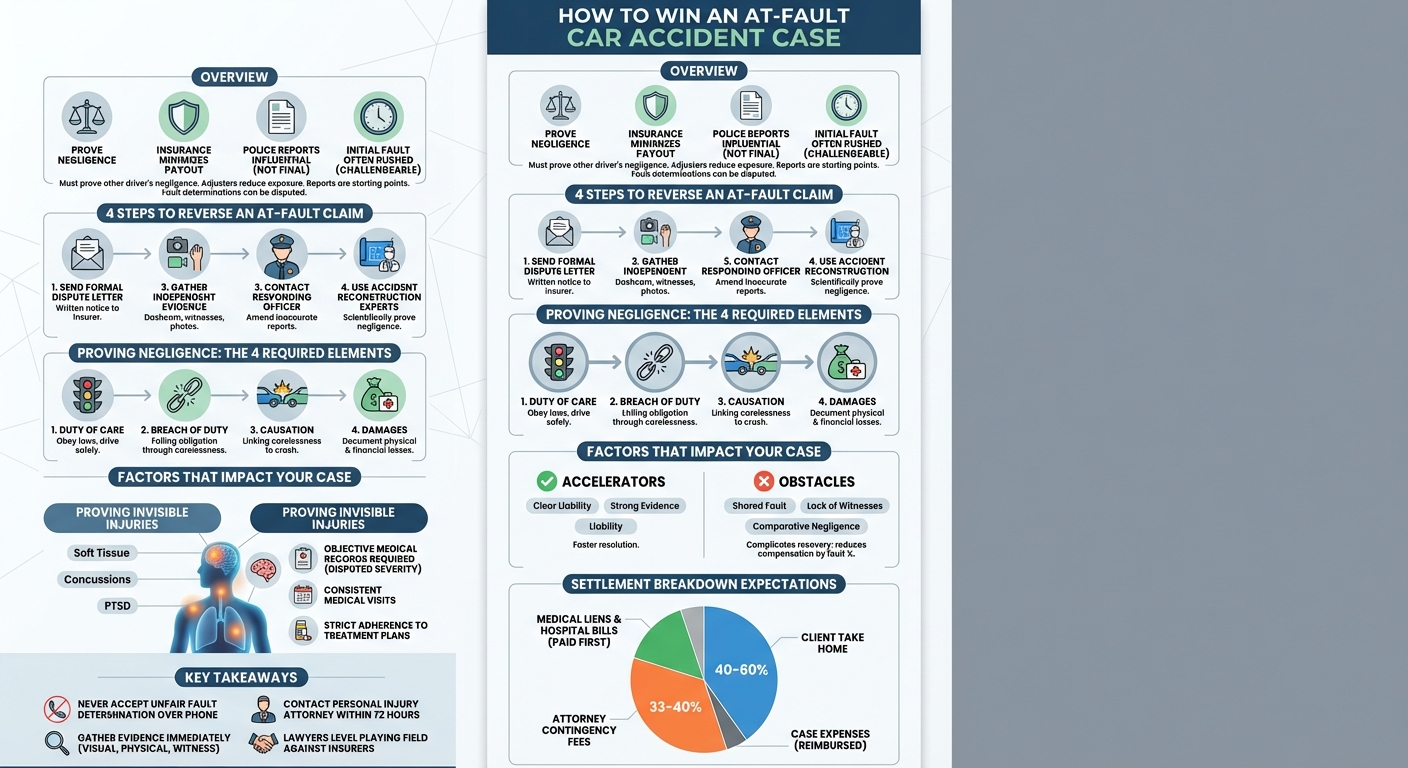
To win an at-fault car accident case, you must prove the other driver’s negligence by establishing duty, breach, causation, and damages. Start by formally disputing the insurance company’s fault determination in writing. Then, gather independent evidence like dashcam footage, witness statements, and amended police reports to build a winning claim.
Understanding Fault: How Insurance Companies Decide Who is to Blame
Winning a car accident case starts with understanding how fault is assigned. Insurance companies do not simply take your word for what happened; they rely on a specific set of criteria to determine liability and minimize their financial exposure.
The Role of the Police Report in Fault Determination
The police report is often the first piece of evidence an insurance adjuster reviews. Responding officers document the scene, interview drivers, and may issue citations. While highly influential, a police report is not the final legal word on fault. Officers can make mistakes or base their conclusions on incomplete information from the other driver.
How Insurance Adjusters Investigate the Crash
Insurance adjusters are trained to protect the company’s bottom line. They investigate crashes by reviewing property damage, analyzing skid marks, taking recorded statements, and searching for inconsistencies in your story. Their goal is often to find a reason to shift at least a percentage of the blame onto you.
Why Initial At-Fault Determinations Are Often Wrong
Initial fault determinations are frequently rushed. Adjusters may rely solely on a biased police report or the other driver’s fabricated statement before all the evidence is available. If you are incorrectly blamed, you have the right to challenge their findings.
How to beat an at-fault accident?
To beat an at-fault accident determination, you must formally dispute the claim in writing with the insurance company. Provide independent evidence like dashcam footage, witness statements, and photos of the scene. If the police report contains factual errors, request an amendment from the responding officer.
Step 1: Formally Dispute the Claim in Writing
Never accept an unfair fault determination over the phone. Send a formal dispute letter to the insurance adjuster detailing why their conclusion is incorrect. Keep your tone professional, stick to the facts, and state clearly that you are contesting liability.
Step 2: Gather Independent Evidence (Photos, Video, Witnesses)
Evidence is the only way to overturn an adjuster’s decision. Gather objective proof that supports your version of events:
- Visuals: Dashcam footage, traffic camera recordings, and scene photos.
- Witnesses: Written statements and contact information from unbiased third parties.
- Physical Evidence: Debris patterns and vehicle damage locations.
Step 3: Amend Inaccurate Police Reports
If the police report contains a factual error—such as the wrong direction of travel or an incorrect intersection—contact the responding officer immediately. Provide your evidence and politely request a supplemental report or an amendment to correct the official record.
Step 4: Utilize Accident Reconstruction Experts
For complex crashes, your attorney may hire an accident reconstructionist. These experts use physics, vehicle data recorders (black boxes), and forensic analysis to recreate the crash and scientifically prove the other driver’s negligence.
Proving the Other Driver’s Negligence: The 4 Elements of a Winning Case
To win your case, you must legally prove that the other driver was negligent. This requires establishing four specific elements.
| Element | Definition | Example |
|---|---|---|
| Duty of Care | The legal obligation to follow traffic laws and drive safely. | Stopping at a red light. |
| Breach of Duty | Failing to uphold that obligation through carelessness. | Texting while driving. |
| Causation | Directly linking the breach to the accident. | The texting driver rear-ends you. |
| Damages | The physical and financial losses you suffered as a result. | Medical bills and lost wages. |
Duty of Care: Establishing the Rules of the Road
Every driver owes a duty of care to others on the road. This means operating their vehicle reasonably and obeying all traffic laws.
Breach of Duty: Proving the Traffic Violation or Carelessness
You must prove the other driver breached this duty. This could be speeding, running a stop sign, driving under the influence, or simply failing to pay attention.
Causation: Linking the Breach to the Crash
It is not enough to prove the other driver was careless; you must prove their specific carelessness caused the crash. If they were speeding but you pulled out illegally, causation becomes contested.
Damages: Documenting Your Financial and Physical Losses
A winning case requires documented damages. Without medical bills, repair estimates, or proof of lost income, there is no financial claim to win.
Is it hard to win a car accident case?
It is not inherently hard to win a car accident case if you have clear liability and strong evidence. However, cases become difficult when fault is shared, witnesses are unavailable, or injuries lack objective medical documentation. State comparative negligence laws can also complicate your financial recovery.
Factors That Make a Case Easier to Win (Clear Liability, Strong Evidence)
Cases resolve faster and more favorably when the evidence is undeniable. Rear-end collisions with a police citation issued to the other driver, backed by dashcam footage and immediate medical treatment, are generally straightforward to win.
Factors That Complicate a Case (Shared Fault, Lack of Witnesses)
Cases become battles when it is a “he-said, she-said” scenario with no witnesses. Pre-existing medical conditions, delayed medical treatment, and missing evidence give insurance companies ammunition to deny your claim.
The Impact of State Comparative Negligence Laws
Most states follow comparative negligence rules, meaning your compensation is reduced by your percentage of fault. If you are awarded $100,000 but found 20% at fault, you only receive $80,000. Fighting for 0% fault is crucial to maximizing your payout.
Medical Evidence: What is the hardest injury to prove?
The hardest injuries to prove in a car accident case are “invisible” conditions like soft tissue injuries (whiplash), mild traumatic brain injuries (concussions), and emotional distress (PTSD). Because these injuries do not show up on standard X-rays, insurance companies frequently dispute their severity and causation.
Soft Tissue Injuries (Whiplash, Sprains, and Strains)
Insurance adjusters are highly skeptical of soft tissue injuries. Winning compensation for these requires consistent medical treatment, physical therapy records, and sometimes MRI results to prove the damage is real.
Traumatic Brain Injuries (TBIs) and Concussions
Mild TBIs can cause severe cognitive issues without showing up on a CT scan. Proving a concussion often requires testimony from neurologists and statements from family members detailing changes in your behavior and memory.
Emotional Distress and PTSD
Psychological trauma is notoriously difficult to quantify. Winning damages for PTSD requires official diagnoses from mental health professionals and a clear, documented history of therapy following the crash.
How Objective Medical Records Win the Case
Your medical records are the foundation of your injury claim. Consistent visits, detailed doctor’s notes, and strict adherence to your treatment plan prevent the insurance company from arguing that you are exaggerating your pain.
Settlement Breakdown: How much of a $100K settlement will I get?
From a $100K settlement, you will typically take home between $40,000 and $60,000. This net amount is calculated after deducting attorney contingency fees (usually 33% to 40%), reimbursing case expenses like expert witness fees, and paying off outstanding medical liens and hospital bills.
Deducting Attorney Contingency Fees (Typically 33% to 40%)
Most personal injury lawyers work on contingency, meaning they take a percentage of the final settlement. This is typically 33% if settled out of court, and up to 40% if a lawsuit is filed.
Paying Off Medical Liens and Outstanding Bills
Before you receive your check, your attorney must legally pay off any medical providers or health insurance companies that placed a lien on your settlement for care provided after the crash.
Reimbursing Case Expenses (Filing Fees, Expert Witnesses)
Building a winning case costs money. Your settlement will reimburse your attorney for upfront costs like court filing fees, obtaining police reports, and hiring accident reconstruction experts.
Calculating Your Final Take-Home Compensation
Once fees, liens, and expenses are paid, the remaining balance is your tax-free compensation for pain, suffering, and personal recovery.
Why You Need a Personal Injury Lawyer to Dispute Fault
Disputing an at-fault determination on your own is an uphill battle against professionals who deny claims for a living. Hiring an attorney changes the dynamic entirely.
Leveling the Playing Field Against Insurance Defense Teams
Insurance companies have teams of adjusters and defense lawyers. A skilled personal injury attorney knows their tactics, understands the law, and forces the insurance company to take your dispute seriously.
Maximizing Your Settlement Value
Attorneys know how to accurately calculate the full lifetime value of your claim, ensuring you do not settle for a lowball offer that fails to cover future medical needs.
When to Contact an Attorney (The 72-Hour Rule)
Time is critical. Contacting an attorney within the first 72 hours ensures evidence is preserved, witness memories are fresh, and you avoid making recorded statements that the insurance company can use against you.