

Table of contents
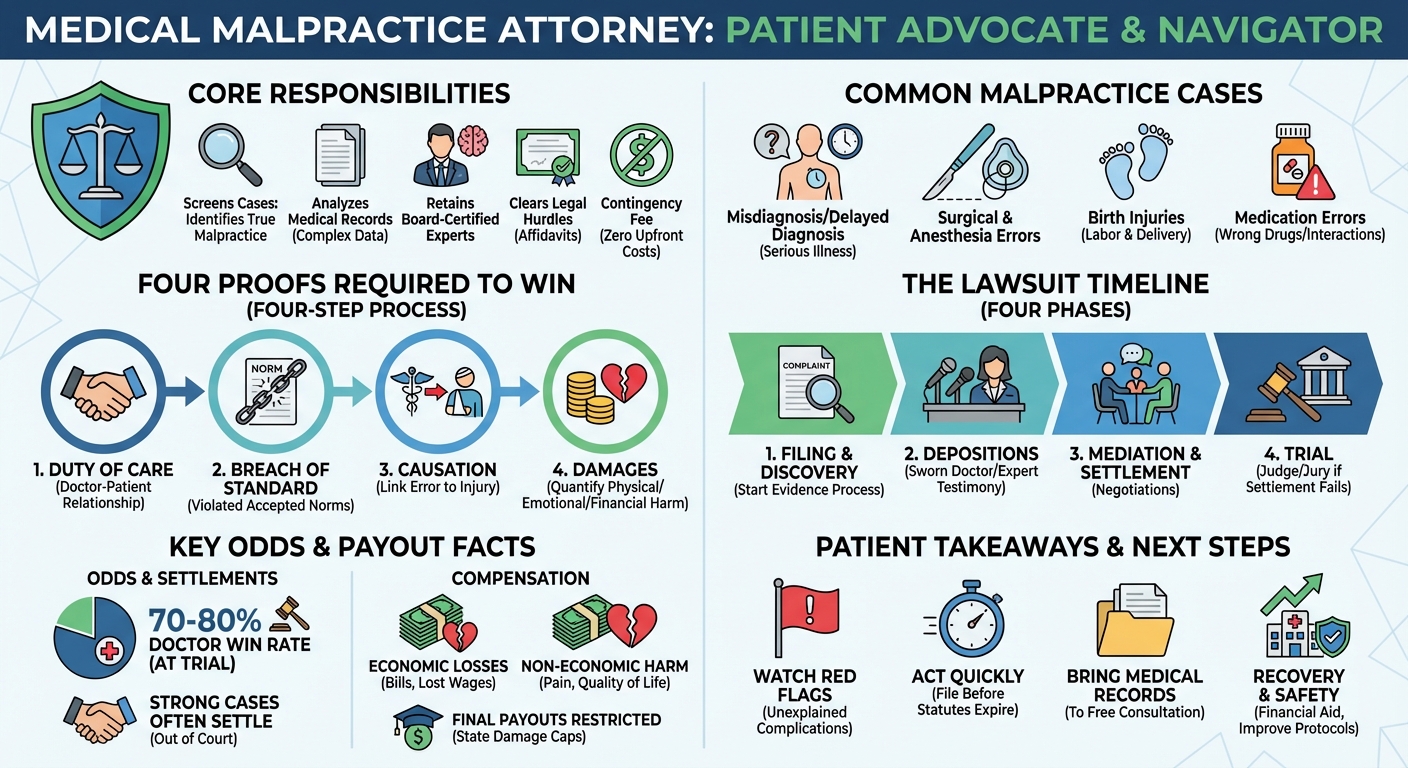
A medical malpractice attorney is a specialized personal injury lawyer who helps patients seek compensation after being harmed by a healthcare provider’s negligence. Their primary duties include investigating medical records, hiring expert witnesses, proving the standard of care was breached, and negotiating settlements or litigating in court.
What Does a Medical Malpractice Attorney Do?
A medical malpractice attorney is a specialized legal professional who advocates for patients injured by the negligence of doctors, nurses, hospitals, or other healthcare providers. When a medical professional fails to provide the accepted standard of care, these attorneys step in to hold them accountable and secure financial compensation for the victim.
Defining Medical Malpractice Law
Medical malpractice law is a highly complex subset of personal injury law. It governs situations where a patient is harmed because a healthcare provider deviated from the accepted medical standard of care. This area of law requires not only a deep understanding of legal procedures but also a strong grasp of medical terminology, procedures, and healthcare regulations.
The Difference Between a General Personal Injury Lawyer and a Medical Malpractice Specialist
While a general personal injury lawyer might handle car accidents or slip-and-fall cases, a medical malpractice specialist focuses almost exclusively on clinical negligence. Medical malpractice cases are notoriously expensive and difficult to litigate. They require specialized resources, established networks of medical experts, and a thorough understanding of state-specific healthcare laws, such as damage caps and pre-suit notification requirements.
The Core Responsibilities of a Medical Malpractice Lawyer
Building a successful medical negligence claim requires meticulous preparation. A medical malpractice attorney manages the entire lifecycle of the case, allowing the injured patient to focus on recovery.
Initial Case Evaluation and Screening
Not every bad medical outcome is malpractice. Attorneys rigorously screen potential cases during the initial consultation. They evaluate whether the injury was a known risk of the procedure or a direct result of preventable negligence.
Gathering and Analyzing Complex Medical Records
Your medical records are the foundation of your case. Attorneys request, organize, and analyze thousands of pages of hospital charts, surgical notes, lab results, and imaging reports to pinpoint exactly where the error occurred.
Finding and Retaining Medical Expert Witnesses
You cannot win a medical malpractice case without expert testimony. Attorneys leverage their networks to hire board-certified medical specialists who can testify about what the standard of care should have been and how the defendant breached it.
Navigating Pre-Suit Requirements and Affidavits of Merit
Many states require an “Affidavit of Merit” or a certificate of review before a lawsuit can even be filed. This is a sworn statement from a qualified medical expert confirming that your case has legal and medical validity. Your attorney ensures all these strict procedural hurdles are cleared.
What are the four things that must be proven to win a medical malpractice suit?
To win a medical malpractice suit, you must prove four legal elements: a doctor-patient relationship existed (Duty of Care), the provider was negligent (Breach of Standard of Care), the negligence directly caused the injury (Causation), and the injury resulted in specific damages (Damages).
1. Duty of Care (The Doctor-Patient Relationship)
You must first establish that a formal doctor-patient relationship existed. This proves that the healthcare provider owed you a legal duty to act competently and follow accepted medical standards.
2. Breach of Standard of Care (Medical Negligence)
You must prove that the provider violated the standard of care. This means showing that another reasonably competent healthcare professional in the same specialty would have acted differently under similar circumstances.
3. Causation (Linking the Breach to the Injury)
It is not enough to show the doctor made a mistake; you must prove that this specific mistake directly caused your injury or worsened your condition, rather than an underlying illness.
4. Damages (Quantifying the Harm Suffered)
Finally, you must prove that the injury resulted in quantifiable harm. This includes economic losses like additional medical bills and lost wages, as well as non-economic losses like pain and suffering.
Common Types of Cases Medical Malpractice Attorneys Handle
Medical errors can occur in any healthcare setting. Attorneys typically handle cases involving severe, life-altering mistakes.
Misdiagnosis and Delayed Diagnosis
When a doctor fails to diagnose a serious condition like cancer, stroke, or heart attack, the patient loses valuable treatment time. This can lead to a worsened prognosis or preventable death.
Surgical and Anesthesia Errors
These cases involve “never events” such as operating on the wrong body part, leaving surgical instruments inside the patient, or administering the wrong dose of anesthesia, leading to brain damage or waking up during surgery.
Birth Injuries (Cerebral Palsy, Hypoxia)
Negligence during labor and delivery can cause catastrophic harm to a newborn. Failure to monitor fetal distress or improper use of delivery instruments can result in lifelong conditions like cerebral palsy or Erb’s palsy.
Medication and Prescription Errors
Administering the wrong medication, prescribing an incorrect dosage, or failing to check for dangerous drug interactions can cause severe allergic reactions, organ failure, or fatal overdoses.
Is it worth suing for medical malpractice?
Yes, suing for medical malpractice is often worth it if you have suffered severe, permanent injuries or significant financial losses. A successful lawsuit provides essential compensation for ongoing medical care, replaces lost income, and holds negligent healthcare providers accountable to prevent future harm to others.
Weighing the Financial Recovery Against the Time Commitment
Medical malpractice lawsuits can take years to resolve. However, if you are facing millions of dollars in lifetime medical care or have lost your ability to work, the financial recovery is critical for your family’s survival and well-being.
Understanding Contingency Fees (No Upfront Costs)
Most medical malpractice attorneys work on a contingency fee basis. This means you pay nothing upfront. The attorney covers all the expensive costs of litigation, including hiring experts, and only gets paid a percentage of your settlement or verdict if you win.
Holding Negligent Healthcare Providers Accountable
Beyond financial compensation, filing a lawsuit forces hospitals and doctors to review their safety protocols. Your case could lead to institutional changes that protect future patients from suffering the same fate.
What are the odds of winning a medical malpractice suit?
The odds of winning a medical malpractice suit at trial are historically low, with doctors winning roughly 70% to 80% of cases that go to a jury. However, a significant portion of strong medical malpractice claims are settled out of court before a trial ever occurs.
Settlement Rates vs. Trial Verdict Statistics
Because trials are risky and expensive, insurance companies often prefer to settle clear-cut cases of negligence. If your attorney builds an airtight case with strong expert testimony, the odds of securing a favorable settlement are much higher than the odds of winning a jury trial.
Why Medical Malpractice Cases Are Harder to Win Than Car Accidents
Unlike a car accident where fault is often clear, medicine is an inexact science. Juries tend to sympathize with doctors, and defense attorneys will argue that your bad outcome was an unavoidable complication of your underlying illness, not negligence.
The Role of Expert Testimony in Tipping the Scales
The success of your case hinges almost entirely on the credibility of your medical experts. A skilled attorney knows how to find authoritative, articulate experts who can explain complex medical failures to a jury in plain English.
What’s the average payout for medical negligence?
There is no universal average payout for medical negligence, as settlements vary drastically based on case severity. Minor injury claims may settle for tens of thousands, while cases involving catastrophic injuries, permanent disability, or wrongful death frequently result in settlements or verdicts exceeding $1 million.
Economic Damages: Medical Bills, Rehabilitation, and Lost Wages
Economic damages reimburse you for out-of-pocket costs. This includes past and future medical expenses, physical therapy, assistive devices, and compensation for the income you lost while recovering or if you can no longer work.
Non-Economic Damages: Pain, Suffering, and Loss of Quality of Life
Non-economic damages compensate you for the physical pain, emotional distress, scarring, and loss of enjoyment of life caused by the malpractice. These damages are subjective but often make up a large portion of a settlement.
How State Damage Caps Impact Your Final Settlement
Many states, including Texas, have enacted tort reform laws that place strict caps on non-economic damages in medical malpractice cases. Your attorney will explain how these statutory limits affect the maximum potential value of your claim.
The Medical Malpractice Lawsuit Timeline: What to Expect
Understanding the legal process can help alleviate the stress of litigation. Here is how a typical case unfolds.
Filing the Complaint and the Discovery Phase
After the initial investigation, your attorney files a formal complaint. This triggers the discovery phase, where both sides exchange evidence, medical records, and written answers to interrogatories.
Depositions of Doctors and Experts
During discovery, attorneys will depose the defendant doctors, nurses, and expert witnesses. A deposition is sworn testimony taken outside of court. Your attorney will aggressively question the healthcare providers to uncover inconsistencies in their story.
Mediation, Settlement Negotiations, and Trial
Before going to trial, most courts require mediation. A neutral third party will try to help both sides reach a settlement. If the insurance company refuses to offer a fair amount, your attorney will present your case to a judge and jury.
When Should You Contact a Medical Malpractice Attorney?
Time is of the essence in medical malpractice claims. Waiting too long can destroy your chances of recovering compensation.
Recognizing the Red Flags of Medical Negligence
You should contact an attorney if you experience unexplained complications after surgery, receive a drastically different second opinion, or if a healthcare facility refuses to answer your questions or suddenly stops communicating with you after an adverse event.
Understanding the Statute of Limitations in Your State
Every state has a statute of limitations that dictates how long you have to file a lawsuit—often just one to three years from the date of the injury or the date you discovered the injury. If you miss this deadline, your claim will be permanently barred.
How to Prepare for Your Free Consultation
When you schedule a consultation, gather any medical records you have, a timeline of your treatment, and a list of all healthcare providers involved. This allows the attorney to quickly assess the viability of your claim and advise you on your next steps.