
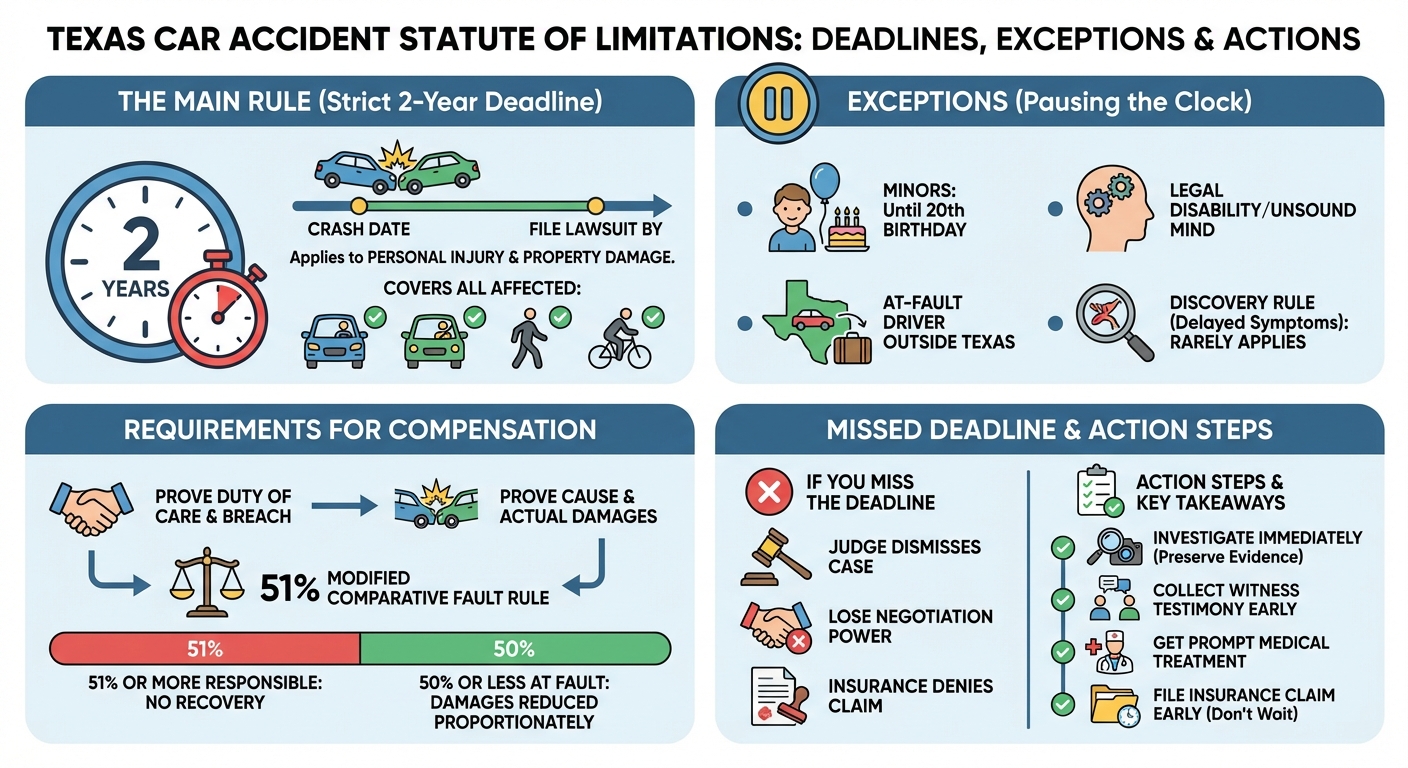
The car accident statute of limitations in Texas is generally two years from the date of the crash, according to Texas Civil Practice and Remedies Code § 16.003.
What Is the Car Accident Statute of Limitations in Texas?
After a motor vehicle collision, state law strictly limits the amount of time you have to take legal action. The car accident statute of limitations in Texas is a rigid legal deadline that dictates how long you have to file a lawsuit against the at-fault party. Missing this deadline generally means permanently losing your right to seek financial compensation for your injuries and property damage.
Texas Civil Practice and Remedies Code Section 16.003
The specific law governing these deadlines is Texas Civil Practice and Remedies Code Section 16.003. Under this statute, anyone injured in a car crash—whether a driver, passenger, pedestrian, or bicyclist—has exactly two years from the date of the accident to file a civil lawsuit. This two-year clock begins ticking on the day the collision occurs, not the day you realize the full extent of your injuries or the day you finish medical treatment.
How long after an car accident can you file a claim in Texas?
In Texas, you have exactly two years from the date of the car accident to file a personal injury or property damage lawsuit. While you should file an initial insurance claim much sooner, this two-year legal deadline is the absolute cutoff to initiate formal litigation against the at-fault driver.
Exceptions That Can Extend the Filing Deadline (Tolling)
While the two-year rule is strict, Texas law recognizes a few specific scenarios where the statute of limitations can be paused, or “tolled.” When the clock is tolled, the countdown to the deadline is temporarily suspended.
Minors and Legal Disability
If the victim of a car accident is under the age of 18, the two-year statute of limitations does not begin until they reach their 18th birthday. This means a minor effectively has until they turn 20 to file a lawsuit. Similarly, if an individual is deemed to be of “unsound mind” at the time of the crash, the clock is paused until their legal disability is lifted.
When the At-Fault Driver Leaves the State
If the driver responsible for the crash leaves Texas before a lawsuit can be filed, the period of their absence is not counted toward the two-year limit. The statute of limitations pauses while they are out of state and resumes only when they return to Texas, preventing at-fault drivers from simply hiding across state lines to run out the clock.
The Discovery Rule and Delayed Car Accident Injuries
In some areas of law, the “discovery rule” pauses the statute of limitations until a victim discovers their injury. However, Texas courts rarely apply the discovery rule to car accidents. The law assumes that a car crash is a sudden, traumatic event, and victims should immediately know they have been involved in an incident that could cause harm, even if specific symptoms take weeks to appear.
Can a car accident cause spinal stenosis?
Yes, the severe trauma of a car accident can cause or accelerate spinal stenosis. The impact can rupture discs, fracture vertebrae, or cause bone spurs that narrow the spinal canal and compress nerves. Because symptoms may be delayed, immediate medical imaging is crucial to document the injury.
Building Your Injury Claim Before the Clock Runs Out
Filing a lawsuit is not something that can be done overnight. Before the two-year deadline approaches, your legal team must investigate the crash, gather evidence, and build a compelling case that proves the other driver is legally responsible for your damages.
What are the 4 proofs of negligence?
To win a car accident lawsuit in Texas, you must establish the four proofs of negligence: duty of care (the driver owed you safe driving), breach of duty (they drove recklessly), causation (their actions directly caused the crash), and damages (you suffered actual physical or financial harm).
Understanding Texas Shared Fault Laws
As you build your claim within the statute of limitations, you must also navigate Texas’s comparative fault rules. Insurance companies will often try to run out the clock while simultaneously arguing that you were partially to blame for the crash.
What is the 51 percent rule in Texas?
The 51 percent rule in Texas is a modified comparative fault law stating that you cannot recover any financial compensation if you are found to be 51 percent or more responsible for the accident. If your fault is 50 percent or less, your damages are simply reduced proportionately.
Property Damage vs. Personal Injury Deadlines
In Texas, the statute of limitations for property damage is identical to the deadline for personal injury claims. You have two years from the date of the crash to file a lawsuit for vehicle repairs, total loss replacement, or damage to personal items inside the vehicle. Often, property damage claims are resolved through insurance long before the two-year mark, but the legal deadline remains the same if litigation becomes necessary.
What Happens If You Miss the 2-Year Deadline?
Failing to file your lawsuit before the two-year anniversary of your crash has catastrophic consequences for your case. The legal system is unforgiving regarding missed deadlines.
Motions to Dismiss
If you file a lawsuit two years and one day after your accident, the defendant’s legal team will immediately file a “Motion to Dismiss.” The judge will review the dates, see that the statute of limitations has expired, and dismiss your case with prejudice. You will be permanently barred from suing the at-fault driver.
Loss of Negotiation Leverage with Insurance Companies
Insurance adjusters know exactly when your statute of limitations expires. If the deadline passes and you haven’t filed a lawsuit, you lose all your leverage. The insurance company will simply deny your claim and close their file, knowing you no longer have the power to take them to court.
Why You Should Never Wait Until the Deadline to File
Having two years to file a lawsuit does not mean you should wait two years to take action. Waiting until the last minute severely damages the value and viability of your claim.
Preserving Evidence and Witness Testimony
Evidence disappears quickly after a crash. Skid marks wash away, dashcam footage gets overwritten, and commercial businesses delete their surveillance video within days. Furthermore, witness memories fade over time. Investigating the crash immediately ensures critical evidence is preserved before it is lost forever.
Getting Immediate Medical Documentation
Insurance companies look for any excuse to deny a claim. If you delay medical treatment or wait months to pursue your case, adjusters will argue that your injuries were caused by an intervening event, not the car crash. Immediate medical documentation links your injuries directly to the accident, creating a strong foundation for your claim long before the statute of limitations expires.
 Call (713) 747-7777