
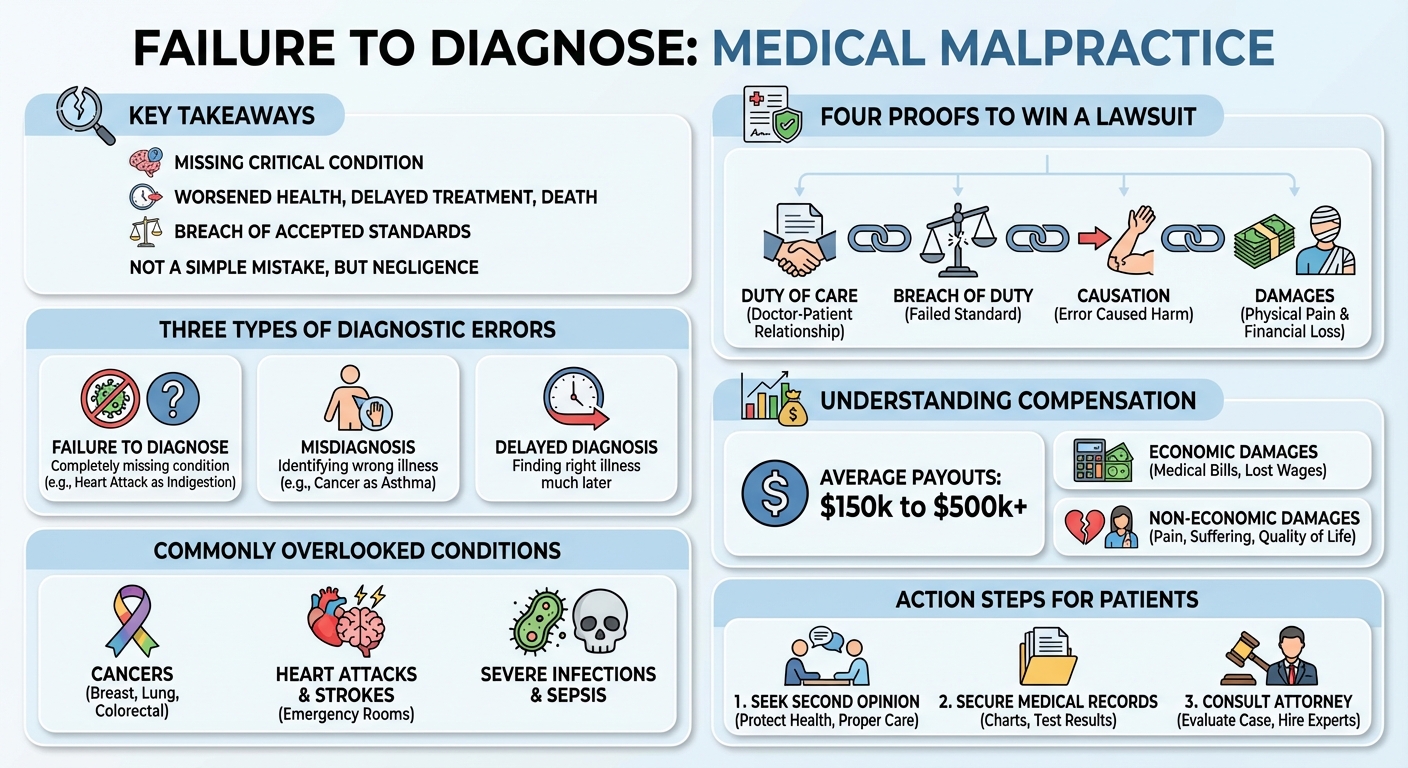
Failure to diagnose medical malpractice occurs when a healthcare provider fails to identify a patient’s illness or injury, and this negligence leads to worsened health, delayed treatment, or death. To prove malpractice, patients must show that a competent doctor would have made the correct diagnosis under similar circumstances.
Understanding Failure to Diagnose in Medical Malpractice
When you seek medical attention, you trust your healthcare provider to identify what is wrong and prescribe the right treatment. Unfortunately, doctors sometimes miss critical warning signs. When a missed illness leads to severe complications, it may constitute failure to diagnose medical malpractice.
The Difference Between a Medical Mistake and Malpractice
Medicine is not an exact science, and not every diagnostic error is grounds for a lawsuit. A simple medical mistake happens when a doctor acts reasonably but still fails to identify a rare or hidden condition. Medical malpractice, however, occurs when a doctor fails to meet the accepted medical standard of care. If another reasonably competent doctor would have ordered tests, asked different questions, or caught the illness under the same circumstances, the failure to do so is negligence.
Can you sue for failure to diagnose?
Yes, you can sue for failure to diagnose if a doctor’s negligence caused you measurable harm. To have a valid medical malpractice claim, you must prove that a competent healthcare provider under similar circumstances would have correctly identified your condition, and that the missed diagnosis directly worsened your health.
Misdiagnosis vs. Failure to Diagnose vs. Delayed Diagnosis
While often used interchangeably, these three terms represent distinct types of diagnostic errors in medical malpractice law:
| Type of Error | Definition | Example |
|---|---|---|
| Failure to Diagnose | The doctor completely misses the condition, giving the patient a clean bill of health. | Sending a patient home with “indigestion” when they are actually having a heart attack. |
| Misdiagnosis | The doctor diagnoses the wrong illness and provides incorrect treatment. | Treating a patient for asthma when they actually have lung cancer. |
| Delayed Diagnosis | The doctor eventually makes the right diagnosis, but much later than they should have. | Diagnosing Stage 4 breast cancer after ignoring a patient’s lump for two years. |
Common Conditions Missed by Healthcare Providers
Certain medical conditions are frequently overlooked in emergency rooms and primary care clinics. When these high-stakes illnesses are missed, the consequences can be fatal.
What is an example of failure to diagnose?
A common example of failure to diagnose is when a patient visits an emergency room with chest pain and shortness of breath, but the doctor dismisses it as acid reflux without ordering an EKG. If the patient subsequently suffers a severe heart attack, the doctor may be liable for malpractice.
Missed Cancer Diagnoses (Breast, Lung, Colorectal)
Cancer requires prompt treatment to prevent metastasis. Doctors may fail to diagnose cancer by ignoring patient complaints, failing to order biopsies, or misinterpreting lab results. Breast, lung, and colorectal cancers are among the most frequently missed, often robbing patients of their best window for life-saving treatment.
Overlooked Heart Attacks and Strokes in the ER
Emergency rooms are fast-paced, which can lead to rushed evaluations. Heart attacks in women or younger patients are sometimes dismissed as anxiety or heartburn. Similarly, the subtle signs of a stroke—such as slight facial drooping or dizziness—can be misattributed to migraines or vertigo, delaying the administration of crucial clot-busting drugs.
Failing to Identify Severe Infections and Sepsis
Sepsis is a life-threatening response to an infection that can cause tissue damage, organ failure, and death within hours. Healthcare providers must recognize the early signs of infection. Failing to order blood cultures or administer broad-spectrum antibiotics promptly can turn a treatable infection into a fatal event.
Building Your Case: The Legal Requirements
Winning a failure to diagnose lawsuit requires more than just showing the doctor was wrong. You must build a comprehensive case based on strict legal criteria.
What are the 4 proofs of negligence?
To win a medical malpractice lawsuit, you must establish the four proofs of negligence: duty of care (a doctor-patient relationship existed), breach of duty (the doctor failed to meet the medical standard of care), causation (the breach directly caused your injury), and damages (you suffered quantifiable financial or physical harm).
Establishing the Doctor-Patient Relationship (Duty of Care)
The first step is proving that a formal doctor-patient relationship existed. This establishes that the healthcare provider owed you a legal duty of care. This is usually straightforward and can be proven with medical bills, appointment records, or hospital admission forms.
Proving a Breach of the Medical Standard of Care
You must demonstrate that the doctor breached the standard of care. This means showing that a reasonably skilled physician in the same specialty would have acted differently. This step almost always requires testimony from independent medical experts who can review your case and point out exactly where the doctor failed.
Linking the Missed Diagnosis to Patient Harm (Causation)
Causation is often the most complex part of a failure to diagnose case. You must prove that the doctor’s error directly caused your worsened condition. If a patient had a terminal illness that would not have responded to treatment even if caught early, a malpractice claim may not hold up. You must show that the delay or failure to diagnose robbed you of a better outcome.
Calculating the Resulting Damages
Finally, the harm you suffered must be quantifiable. This includes physical pain, emotional distress, additional medical expenses, and lost income resulting from the missed diagnosis.
Compensation for a Missed Diagnosis
When a doctor’s negligence derails your health, you have the right to seek financial compensation to cover the fallout.
What is the average payout for misdiagnosis?
The average payout for a misdiagnosis or failure to diagnose lawsuit typically ranges from $150,000 to over $500,000, depending on the severity of the harm. However, there is no exact average, as settlements vary wildly based on medical bills, lost earning capacity, and state-specific caps on non-economic damages.
Economic Damages: Additional Medical Bills and Lost Wages
Economic damages reimburse you for out-of-pocket financial losses. Because your condition was allowed to worsen, you likely need more aggressive, expensive treatments. Economic damages cover hospital stays, surgeries, rehabilitation, medications, and the wages you lost while unable to work.
Non-Economic Damages: Pain, Suffering, and Reduced Quality of Life
Non-economic damages compensate you for the intangible toll the malpractice took on your life. This includes physical pain, mental anguish, loss of consortium, and a diminished quality of life. In many states, including Texas, there are statutory caps on how much you can recover in non-economic damages for medical malpractice claims.
Steps to Take If Your Doctor Missed Your Illness
If you suspect your healthcare provider failed to diagnose a serious condition, taking immediate action is vital for both your health and your legal rights.
Seek a Second Opinion Immediately
Your health is the top priority. If you feel your doctor is dismissing your symptoms, do not wait. Seek a second opinion from a different doctor or specialist immediately. Getting the correct diagnosis promptly can prevent further physical harm and establish a timeline of when the condition should have been caught.
Secure Your Medical Records (Crucial for Texas Law)
Your medical records are the foundation of your case. Request complete copies of your charts, test results, doctor’s notes, and imaging scans from the facility that missed your diagnosis. Under Texas law, having thorough, unaltered documentation is critical for proving what the doctor knew and when they knew it.
Consult a Medical Malpractice Attorney
Medical malpractice claims are heavily defended by hospital legal teams and insurance companies. Do not attempt to negotiate with them alone. Consult an experienced medical malpractice attorney who can evaluate your medical records, hire the necessary medical experts, and fight to secure the compensation you deserve.
 Call (713) 747-7777