

Table of contents
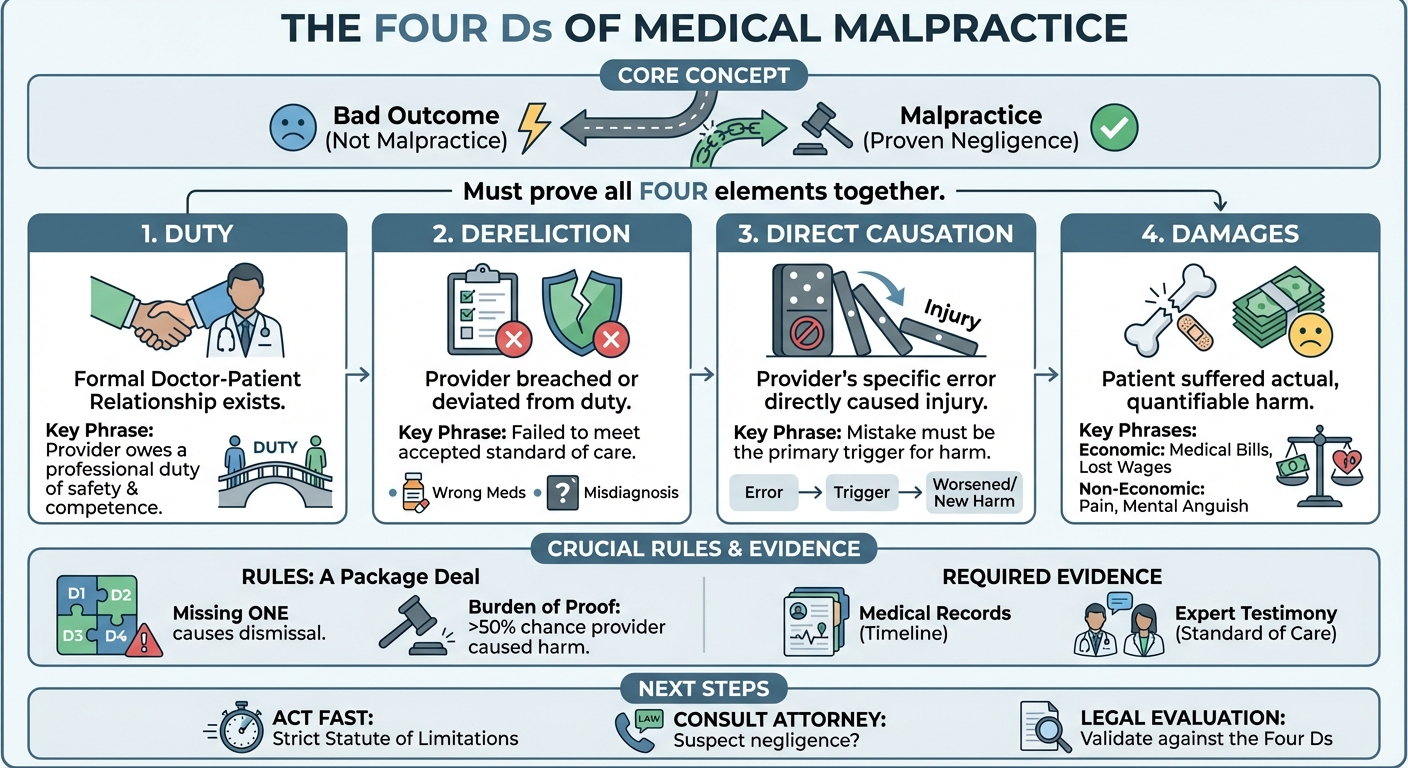
The four Ds of medical negligence are Duty, Dereliction, Direct Causation, and Damages. To win a medical malpractice claim, a patient must prove that the healthcare provider owed them a duty of care, deviated from that duty, and directly caused measurable damages or injuries as a result.
Introduction: The Legal Framework of Medical Malpractice
Experiencing a poor outcome after a medical procedure or treatment is devastating, but a negative result does not automatically mean malpractice occurred. In the eyes of the law, medical malpractice is defined by a very specific legal framework. To hold a healthcare provider legally accountable for an injury, a patient must prove that the provider’s actions fell below the accepted standard of care. This framework is universally understood in the legal and medical fields as the “four Ds.” Understanding this concept is the first step in determining whether you have a valid claim.
What are the 4 D’s of medical negligence?
The four Ds of medical negligence are Duty, Dereliction, Direct Causation, and Damages. These four elements form the foundational legal framework required to prove a medical malpractice claim. A patient must demonstrate that a healthcare provider breached their duty of care, directly causing measurable physical or financial harm.
1. Duty (Establishing the Doctor-Patient Relationship)
The first “D” stands for Duty, often referred to as the “duty of care.” Before a doctor can be sued for negligence, you must prove that a formal doctor-patient relationship existed. This relationship establishes that the healthcare provider owed you a professional duty to act competently and safely. If a doctor gives casual advice at a dinner party, a formal duty of care likely does not exist. However, once they examine you, prescribe medication, or admit you to a hospital, this legal duty is firmly established.
2. Dereliction or Deviation (Breaching the Standard of Care)
The second “D” is Dereliction, sometimes called Deviation or Breach of Duty. This means the healthcare provider failed to meet the accepted medical standard of care. The standard of care is defined as the level and type of care that a reasonably competent and skilled healthcare professional, with a similar background and in the same medical community, would have provided under the same circumstances. Dereliction occurs when a doctor makes an unreasonable error, such as misdiagnosing an obvious condition, leaving a surgical instrument inside a patient, or prescribing the wrong medication.
3. Direct Causation (Linking the Error to the Injury)
The third “D” is Direct Causation. It is not enough to prove that a doctor made a mistake; you must prove that their specific mistake directly caused your injury. This is often the most complex element to prove in a medical malpractice case. For example, if a patient is already terminally ill and a doctor makes a minor medication error that does not alter the course of the illness, direct causation may be difficult to establish. The negligence must be the primary trigger for the new or worsened harm.
4. Damages (Quantifying the Financial and Physical Harm)
The final “D” is Damages. To have a valid claim, the patient must have suffered actual, quantifiable harm as a result of the doctor’s dereliction. Damages can be economic, such as additional medical bills, lost wages, and rehabilitation costs. They can also be non-economic, encompassing physical pain, mental anguish, and a reduced quality of life. Without measurable damages, there is no legal basis for a lawsuit, regardless of how egregious the doctor’s mistake was.
What are the 4 elements of medical negligence?
The four elements of medical negligence are identical to the four Ds: Duty of care, Breach of duty (Dereliction), Causation (Direct Cause), and Damages. Courts require plaintiffs to establish all four of these legal elements with substantial evidence to successfully hold a medical professional liable for malpractice.
What are the 4 D’s for a malpractice suit to be successful?
For a malpractice suit to be successful, you must prove the four Ds: Duty, Dereliction, Direct Causation, and Damages. If a doctor makes a mistake but causes no harm, or if an injury occurs unrelated to the doctor’s error, the lawsuit will not be successful.
The Burden of Proof: Preponderance of the Evidence
In civil cases like medical malpractice, the burden of proof rests on the plaintiff (the injured patient). You must prove the four Ds by a “preponderance of the evidence.” This legal standard means you must show that it is more likely than not—greater than a 50% chance—that the doctor’s negligence caused your injuries. This is a lower threshold than “beyond a reasonable doubt” used in criminal cases, but it still requires compelling, well-documented evidence.
Why Missing Even One ‘D’ Ruins a Case
The four Ds are a package deal. If your legal team can prove Duty, Dereliction, and Causation, but you suffered no actual Damages, the case will be dismissed. Similarly, if you have severe Damages and a clear Duty of care, but the injury was an unavoidable known risk of the surgery rather than a Dereliction of duty, you do not have a case. Every single element must be present and proven.
How to Prove the Four Ds Using Medical Evidence
Proving the four Ds requires meticulous preparation and a deep understanding of both law and medicine. Evidence is the cornerstone of any successful claim.
Leveraging Your Medical Records
Your medical records are the most critical pieces of evidence in your case. They document the doctor-patient relationship (Duty), the treatments administered or omitted (Dereliction), and the resulting health complications (Causation and Damages). Thoroughly compiled medical documentation provides the factual timeline needed to build a compelling narrative of negligence.
The Role of Expert Medical Testimony
Because judges and juries are not medical professionals, the law requires expert medical testimony to establish the standard of care. An expert witness—usually a doctor in the same specialty as the defendant—must review the case and testify about what a competent doctor would have done differently. This expert testimony is essential for proving both Dereliction and Direct Causation.
Which doctor is least likely to be sued?
Psychiatrists, pediatricians, and dermatologists are generally the doctors least likely to be sued for medical negligence. These specialties typically involve fewer high-risk, acute, or invasive surgical procedures compared to high-risk fields like neurosurgery, obstetrics, or general surgery, leading to a historically lower rate of malpractice claims.
When to Consult a Medical Malpractice Attorney
Medical malpractice claims are subject to strict statutes of limitations, meaning you only have a limited window of time to file a lawsuit. If you suspect that you or a loved one has been the victim of medical negligence, it is crucial to act quickly. Consulting with an experienced medical malpractice attorney can help you evaluate your situation against the four Ds. A qualified lawyer will review your medical records, consult with medical experts, and determine if you have a viable path to recovering the compensation you deserve.