

Table of contents
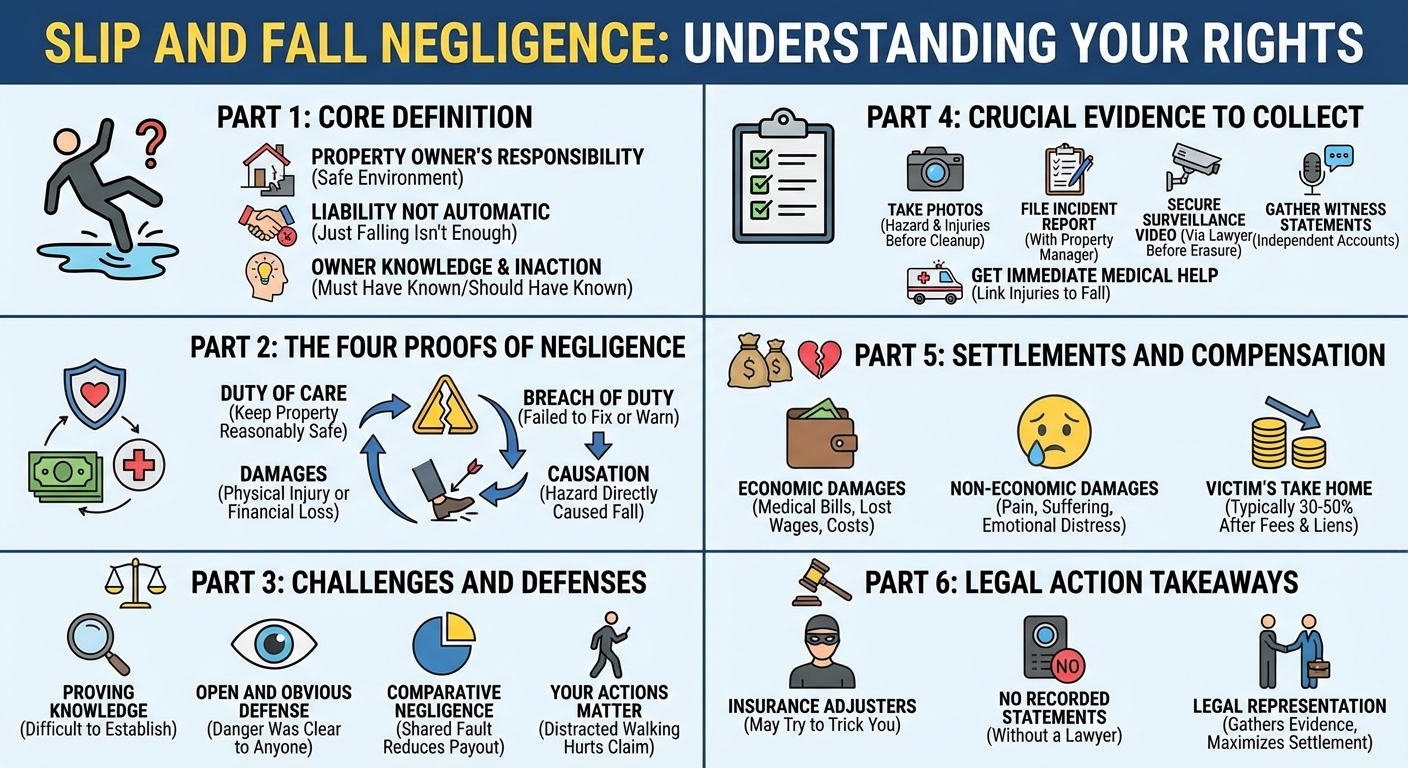
Slip and fall negligence occurs when a property owner fails to maintain safe premises, resulting in an injury. To prove negligence, you must establish four elements: the owner owed you a duty of care, they breached that duty, the breach directly caused your fall, and you suffered actual damages.
Proving Negligence in a Slip and Fall Case: Elements, Evidence, and Settlements
When you are injured on someone else’s property, securing compensation requires more than just showing that you fell. You must prove slip and fall negligence. This means demonstrating that the property owner or manager failed to maintain a safe environment, directly leading to your injuries.
What Constitutes Slip and Fall Negligence?
Slip and fall negligence occurs when a property owner ignores, creates, or fails to warn visitors about a hazardous condition. This could be a wet floor without a caution sign, broken stairs, icy walkways, or torn carpeting. The core issue is whether a reasonable person in the owner’s position would have identified and fixed the hazard.
Why Property Owners Aren’t Automatically Liable
Simply falling on another person’s property does not make them legally responsible. The law recognizes that some accidents are genuinely unavoidable. To be held liable, the property owner must have had actual or constructive knowledge of the danger and failed to act. If a customer spills a drink and you slip on it three seconds later, the owner likely isn’t liable because they didn’t have a reasonable amount of time to discover and clean the spill.
What are the 4 proofs of negligence?
To win a premises liability claim, the 4 proofs of negligence you must establish are: duty of care owed by the property owner, breach of that duty through failure to maintain safe premises, causation linking the hazard directly to your fall, and actual damages or injuries resulting from the accident.
1. Duty of Care: The Property Owner’s Legal Obligation
The first step is establishing that the defendant owed you a duty of care. In most states, property owners have a legal obligation to keep their premises reasonably safe for lawful visitors, invitees, and guests. Trespassers are generally owed a much lower duty of care.
2. Breach of Duty: Failing to Maintain Safe Premises
A breach occurs when the owner fails to meet their legal obligation. This is proven by showing they knew (or should have known) about a hazard but did nothing to fix it or warn visitors. Examples include ignoring a leaking roof or failing to clear snow from a retail entrance.
3. Causation: Linking the Hazard to Your Fall
You must prove that the specific breach of duty directly caused your injury. It is not enough that a hazard existed; the hazard must be the exact reason you slipped and fell. If you tripped over your own shoelaces near a wet spot, the wet spot didn’t cause the fall.
4. Damages: Proving Your Injuries and Financial Losses
Finally, you must have suffered legally recognized harm. This includes physical injuries, medical bills, lost wages, and pain and suffering. Without documented damages, there is no basis for a financial claim, even if the property owner was clearly negligent.
How hard is it to win a slip-and-fall lawsuit?
Winning a slip-and-fall lawsuit is notoriously hard because you must prove the property owner knew or should have known about the hazard and failed to fix it. Insurance companies aggressively defend these cases by shifting blame to the victim or claiming the danger was open and obvious.
The Challenge of Proving Constructive Knowledge
Constructive knowledge means the hazard existed long enough that a reasonable property owner should have discovered it through routine inspections. Proving this often requires circumstantial evidence, such as showing a spilled liquid was sticky and dried around the edges, indicating it had been there for hours.
Common Defenses: The Open and Obvious Doctrine
Defense attorneys frequently use the open and obvious defense. They will argue that the hazard was so apparent that any reasonable person would have noticed and avoided it. If a danger is deemed open and obvious, the property owner’s liability may be significantly reduced or completely dismissed.
Understanding Comparative Negligence in Slip and Fall Cases
Even if the property owner was negligent, your own actions leading up to the fall will be scrutinized. Most states follow a system of comparative negligence, which divides fault between the parties involved.
How Your Own Fault Impacts Your Claim
Under comparative negligence rules, your compensation is reduced by your percentage of fault. If you are awarded $100,000 but found 20% at fault for the accident, you will only receive $80,000. In modified comparative negligence states, if you are 50% or 51% at fault, you may be barred from recovering any money at all.
Examples of Plaintiff Negligence (e.g., Distracted Walking, Ignoring Signs)
Insurance adjusters will look for reasons to assign you blame. Common examples of plaintiff negligence include texting while walking, wearing inappropriate footwear for the weather, ignoring wet floor signs, or walking into areas clearly marked for employees only.
Crucial Evidence Needed to Prove Property Owner Negligence
Because slip and fall cases are difficult to win, gathering compelling evidence immediately after the accident is critical to proving your claim.
Photographs, Video Surveillance, and Incident Reports
Always take photos of the hazard, your injuries, and the surrounding area before the scene is cleaned up. Request a formal incident report from the store manager or property owner. Additionally, your attorney can send a spoliation letter to preserve video surveillance footage before it is overwritten.
Witness Statements and Expert Testimony
Independent witnesses who saw you fall or noticed the hazard beforehand are invaluable. In complex cases, your lawyer may hire accident reconstruction experts or safety engineers to testify about building code violations or the coefficient of friction on the flooring.
Medical Records and Bills
Seek medical attention immediately. Your medical records serve as the official link between the fall and your injuries. Delaying treatment gives the insurance company room to argue that your injuries were caused by a separate, unrelated event.
Slip and Fall Settlements and Compensation
Victims of negligence are entitled to compensation to make them whole again. The value of your settlement depends heavily on the severity of your injuries and the clarity of liability.
How much compensation for a slip-and-fall?
Compensation for a slip-and-fall varies widely based on injury severity, ranging from a few thousand dollars for minor sprains to hundreds of thousands for traumatic brain or spinal injuries. Settlements typically cover medical bills, lost wages, out-of-pocket expenses, and non-economic damages like pain and suffering.
How much of a $100K settlement will I get?
From a $100,000 settlement, you will typically receive between $30,000 and $50,000 after deductions. Attorney contingency fees usually take 33% to 40% ($33,000 to $40,000), and the remaining deductions go toward medical liens, case expenses, and expert witness fees before the final net payout is disbursed to you.
Calculating Economic vs. Non-Economic Damages
Damages in a slip and fall case are divided into two main categories. Understanding the difference is key to maximizing your claim.
| Damage Type | Description | Examples |
|---|---|---|
| Economic Damages | Quantifiable financial losses with a clear paper trail. | Hospital bills, physical therapy costs, lost wages, mobility aids. |
| Non-Economic Damages | Subjective losses related to your quality of life. | Pain and suffering, emotional distress, loss of enjoyment of life. |
When to Consult a Slip and Fall Accident Lawyer
Navigating premises liability law is complex, and property owners’ insurance companies are highly skilled at minimizing payouts. Consulting a legal professional is the best way to protect your rights.
Why You Shouldn’t Speak to Insurance Adjusters Alone
Insurance adjusters often use friendly tactics to get you to provide a recorded statement. Their goal is to trick you into admitting partial fault or downplaying your injuries. Never provide a recorded statement or sign a medical release without consulting an attorney first.
How Legal Representation Maximizes Your Settlement
An experienced personal injury lawyer knows how to investigate the accident, gather hard-to-get evidence like maintenance logs, and negotiate aggressively with insurers. They understand the true value of your claim and can file a formal lawsuit if the insurance company refuses to offer a fair settlement, ensuring you get the compensation you deserve.