
Table of contents
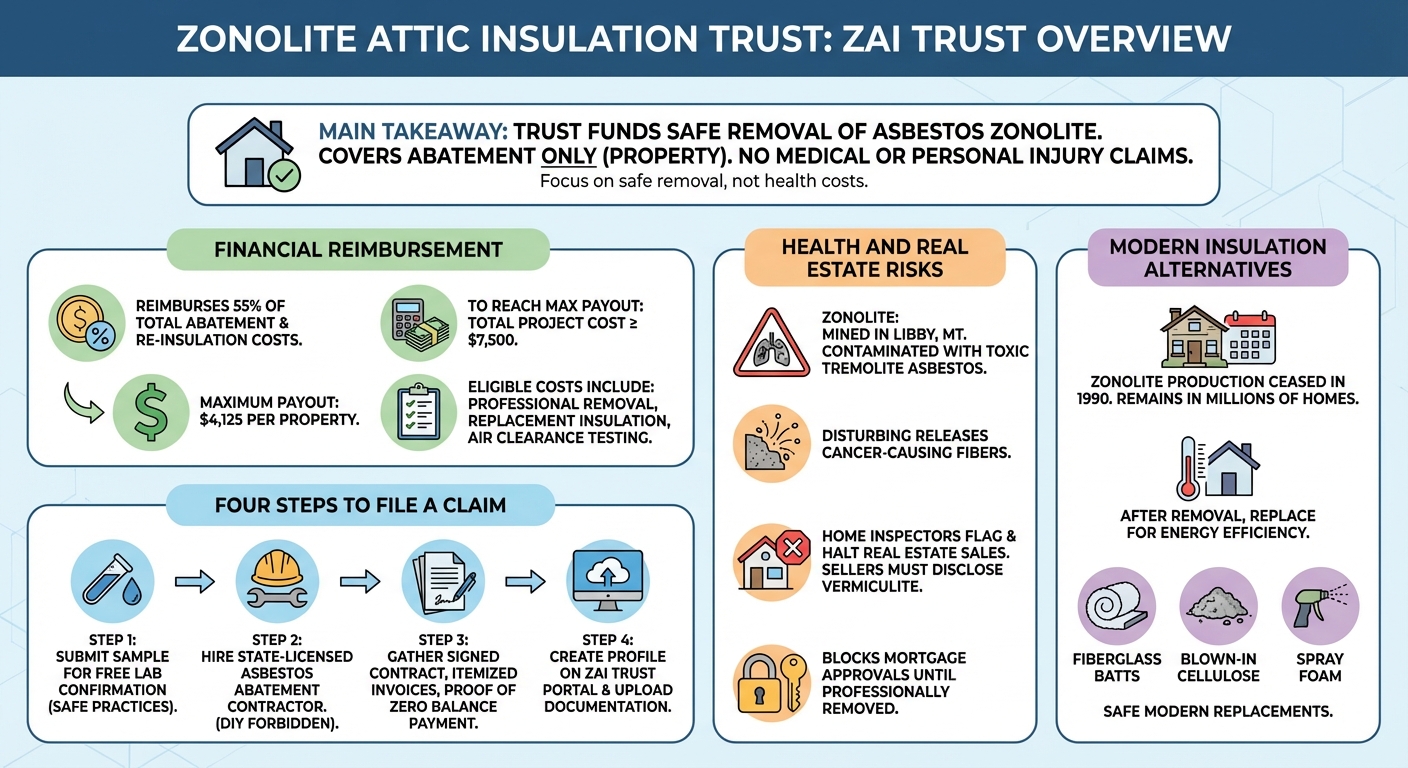
The Zonolite Attic Insulation Trust (ZAI Trust) is a fund established to help homeowners cover the cost of removing asbestos-containing vermiculite insulation. If your insulation is confirmed as the Zonolite brand, the trust reimburses 55% of your abatement and replacement costs, up to a maximum payout of $4,125.
What is the Zonolite Attic Insulation Trust (ZAI Trust)?
The Zonolite Attic Insulation Trust (ZAI Trust) is an independent fund created to help homeowners offset the high costs of removing asbestos-contaminated vermiculite insulation.
History of W.R. Grace and the Libby, Montana Mine
For decades, the W.R. Grace Company operated a vermiculite mine in Libby, Montana. This single mine produced over 70% of all vermiculite sold in the United States from 1919 to 1990. Unfortunately, the Libby deposit was naturally contaminated with tremolite asbestos, a highly toxic mineral. The resulting product, sold under the brand name Zonolite, was installed in millions of American homes.
Property Abatement Claims vs. Personal Injury Claims
It is crucial to distinguish between the types of asbestos trusts. The ZAI Trust is strictly for property abatement claims. It reimburses homeowners for the physical removal and replacement of Zonolite insulation. It does not cover medical bills or damages related to asbestos exposure. Individuals suffering from mesothelioma or other asbestos-related diseases must file through a separate personal injury trust, such as the WRG Asbestos PI Trust.
Who Manages the Trust Fund?
The ZAI Trust operates independently of W.R. Grace. It was established in 2014 following the company’s bankruptcy settlement. The trust is managed by appointed trustees who review lab results, process contractor invoices, and distribute settlement funds directly to eligible property owners.
How much does Zai Trust reimburse?
The ZAI Trust reimburses eligible homeowners for 55% of their total asbestos abatement and re-insulation costs, up to a maximum payout of $4,125 per property. To receive this maximum reimbursement cap, your total project cost for removal and replacement must be at least $7,500.
The 55% Reimbursement Rule and the $4,125 Maximum Cap
The trust calculates your payout based on eligible invoices. If your total cost is below $7,500, you simply receive 55% of that amount. If your costs exceed $7,500, your reimbursement is capped at the $4,125 limit.
Real-World Cost Examples
| Total Project Cost | 55% Calculation | Trust Payout | Out-of-Pocket Cost |
|---|---|---|---|
| $4,000 | $2,200 | $2,200 | $1,800 |
| $7,500 | $4,125 | $4,125 | $3,375 |
| $12,000 | $6,600 | $4,125 (Max Cap) | $7,875 |
What Specific Costs Are Covered?
- Removal: Labor and materials for professional asbestos abatement.
- Replacement Insulation: The cost of installing modern, safe insulation (like fiberglass or cellulose) to replace the removed Zonolite.
- Testing: Fees associated with state-required air clearance testing after abatement.
Step-by-Step: How to File a Claim with the ZAI Trust
Filing a claim requires specific documentation to prove the vermiculite in your home is the Zonolite brand. Follow these steps to ensure your claim is approved.
Step 1: Safe Sampling and Certified Lab Testing
Before removing the insulation, you must submit a sample to the ZAI Trust. The trust provides printable sampling instructions on their website. You must wear a respirator, collect a small sample without stirring up dust, and mail it to the trust. They will have it analyzed by a certified lab at no cost to you to confirm it matches the Zonolite chemical signature.
Step 2: Hiring a Licensed Asbestos Abatement Contractor
Do not attempt a DIY removal. The ZAI Trust requires the work to be completed by a licensed asbestos abatement professional. Obtain multiple quotes and ensure the contractor is certified in your state to handle hazardous materials.
Step 3: Gathering Required Documentation
Keep meticulous records. To process your claim, the trust requires:
- A copy of the signed contract with your abatement company.
- Itemized invoices showing the cost of removal and the cost of the new insulation.
- Proof of payment, such as canceled checks, credit card statements, or a zero-balance invoice from the contractor.
Step 4: Submitting the Claim via the ZAI Trust Portal
Once the work is complete and paid for, navigate to the ZAI Trust claimant portal online. Create a new profile, upload your lab confirmation, invoices, and proof of payment, and submit your claim for review. Processing typically takes a few weeks.
Why is vermiculite insulation a red flag?
Vermiculite insulation is a red flag because the vast majority of it came from a mine in Libby, Montana, which was heavily contaminated with toxic tremolite asbestos. Disturbing this insulation releases microscopic asbestos fibers into the air, posing severe health risks to occupants.
The Connection Between Libby Vermiculite and Tremolite Asbestos
Tremolite asbestos grew alongside the vermiculite ore in the Libby mine. Because W.R. Grace supplied over 70% of the market, the EPA advises homeowners to assume all vermiculite insulation contains asbestos unless proven otherwise.
Health Risks of Disturbing Asbestos
When left completely undisturbed, vermiculite poses minimal risk. However, remodeling, running cables, or simply moving boxes in an attic can launch asbestos fibers into the air. Inhaling these fibers can lead to fatal conditions, including mesothelioma, lung cancer, and asbestosis, often decades after exposure.
Why Home Inspectors Flag It Immediately
Home inspectors are trained to identify vermiculite visually. Because of the extreme liability and health hazards, inspectors will immediately flag it on a report, typically halting a real estate transaction until the material is tested or professionally abated.
Is zonolite still used?
No, Zonolite is no longer used in residential construction. Production of Zonolite attic insulation officially ceased in 1990 after severe asbestos contamination at the Libby, Montana mine was exposed. Today, builders and homeowners rely on safe, modern alternatives like fiberglass batts, blown-in cellulose, or spray foam insulation.
Modern Alternatives to Zonolite
If you remove Zonolite, you will need to replace it to maintain your home’s energy efficiency. Modern alternatives include blown-in cellulose (treated for fire resistance), fiberglass batts, or polyurethane spray foam. None of these contain asbestos.
How to Identify Legacy Zonolite
Legacy Zonolite looks like small, pebbly nuggets. It is typically grayish-brown or silver-gold in color and has an accordion-like texture. It is loose-fill, meaning it sits freely between attic joists rather than coming in rolled paper-backed batts.
Can you sell a house with vermiculite?
Yes, you can sell a house with vermiculite, but you must legally disclose its presence to potential buyers. Because vermiculite often contains asbestos, it frequently complicates buyer financing and home inspections, usually requiring the seller to negotiate abatement costs or offer closing credits.
Legal Disclosure Requirements
Real estate laws in most states require sellers to disclose known environmental hazards. If you know your attic contains vermiculite, you must list it on the seller’s disclosure form. Failing to do so can result in post-sale lawsuits.
Impacts on Financing and Inspections
Many mortgage lenders, particularly those backing FHA or VA loans, will not approve financing for a home with known asbestos hazards unless a remediation plan is in place. Buyers will almost certainly demand action after the home inspection.
Negotiating Abatement and ZAI Trust Claims
Sellers have two main options: pay for the abatement before closing (and claim the ZAI Trust reimbursement themselves), or offer the buyer a credit at closing to handle the removal later. If offering a credit, the buyer can then utilize the ZAI Trust to recoup 55% of their costs after they complete the work.