
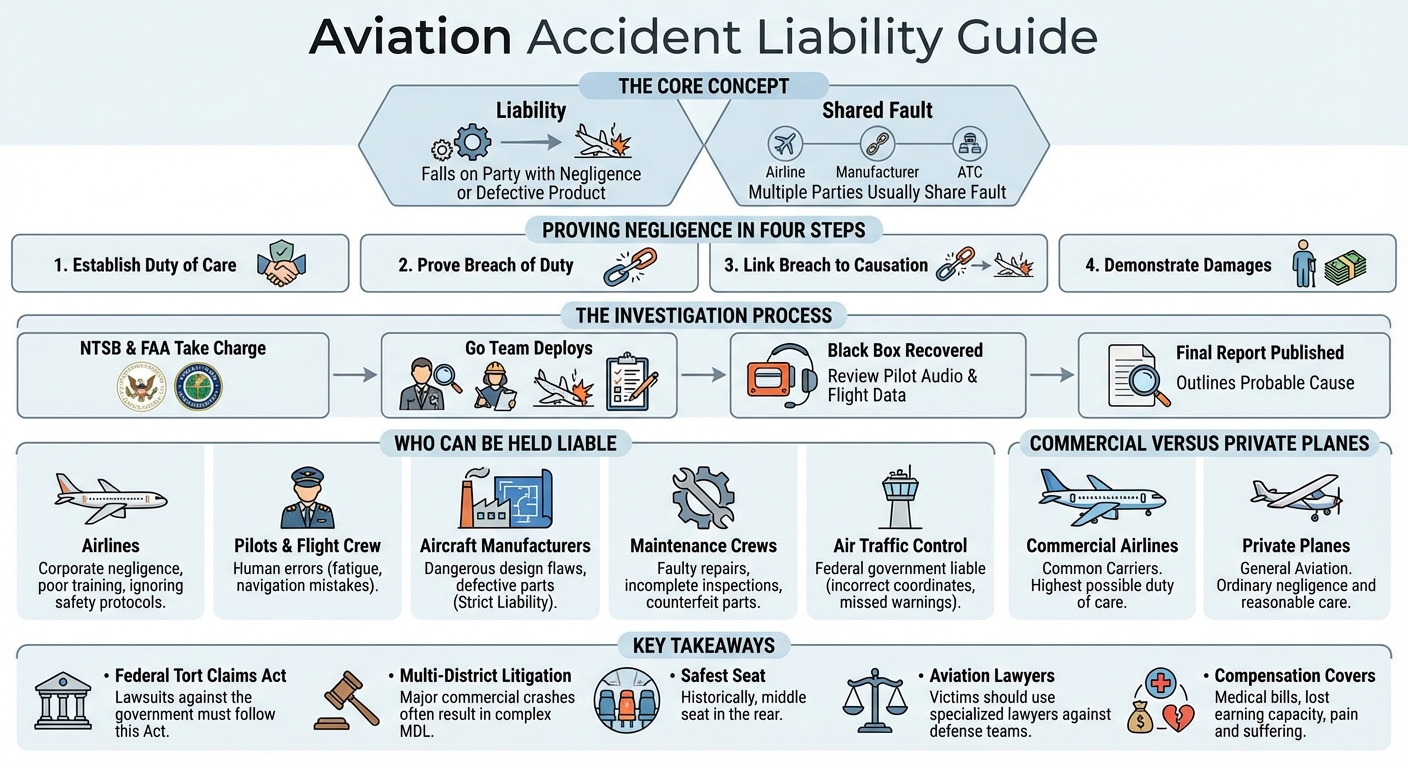
In an aviation accident, liability typically falls on the negligent party whose actions caused the crash. Responsible parties can include the airline, aircraft manufacturer, pilot, maintenance crew, or air traffic control. They are legally liable for resulting injuries, fatalities, and property damage.
Who Is Liable in an Aviation Accident? (The Short Answer)
In the aftermath of an aviation accident, determining who is legally responsible is the most critical step for victims seeking justice. Unlike a typical car crash, plane crashes rarely involve a single responsible party. Liability in an aviation accident falls on the person or entity whose negligence, recklessness, or defective product directly caused the crash.
Defining Negligence and Liability in Plane Crashes
In aviation law, negligence means that a party failed to exercise the appropriate level of care, resulting in harm. To establish liability, investigators and attorneys must prove four elements: duty of care, breach of that duty, causation, and damages. Because aircraft operate in a highly regulated environment, a breach of duty can range from a pilot ignoring weather warnings to a manufacturer installing a faulty sensor.
Who is at fault for an airline accident?
Fault for an airline accident can lie with multiple parties, including the airline, the aircraft manufacturer, the pilot, maintenance crews, or air traffic control. Determining exactly who is at fault requires extensive investigations by agencies like the NTSB to identify whose negligence or defective product directly caused the crash.
How the NTSB and FAA Determine Fault
The National Transportation Safety Board (NTSB) and the Federal Aviation Administration (FAA) are the primary agencies tasked with investigating aviation disasters in the United States. The NTSB deploys a “Go Team” to the crash site to analyze wreckage, interview witnesses, and review maintenance logs. Their final report, which can take months or years to publish, outlines the probable cause of the accident and is a foundational piece of evidence in liability claims.
The Role of the Black Box and Flight Data Recorders
Modern aircraft are equipped with two critical devices: the Cockpit Voice Recorder (CVR) and the Flight Data Recorder (FDR), collectively known as the “black box.” The CVR records pilot conversations and engine noises, while the FDR tracks dozens of parameters like altitude, airspeed, and system performance. Data recovered from these devices often provides the definitive answer to whether human error or mechanical failure caused the crash.
The Primary Liable Parties in Plane Crashes
Because aviation relies on a complex web of professionals and corporations, liability is often shared among several defendants.
The Airline or Charter Company (Corporate Negligence)
Airlines are responsible for the safe transport of their passengers. They can be held liable for corporate negligence if they fail to properly train their pilots, enforce safety protocols, or ground aircraft that are unfit to fly. If an airline cuts corners to save money and a crash occurs, they bear the primary legal burden.
The Pilot and Flight Crew (Human Error)
Human error remains one of the leading causes of aviation accidents. A pilot may be held personally liable—though their employer is typically sued under the doctrine of respondeat superior—if they make critical mistakes. Examples include flying while fatigued, miscalculating fuel, ignoring air traffic control instructions, or failing to navigate severe weather properly.
Aircraft Manufacturers (Product Liability and Defective Parts)
If a plane crashes because of a design flaw or a manufacturing defect, the aircraft manufacturer (such as Boeing or Airbus) or the maker of a specific component can be held strictly liable. In product liability cases, victims do not necessarily need to prove negligence; they only need to prove that the product was unreasonably dangerous and caused the injury.
Third-Party Maintenance and Repair Crews
Airlines frequently outsource maintenance to third-party contractors. If a mechanic fails to properly secure a vital engine component, uses counterfeit parts, or signs off on an incomplete inspection, that maintenance company can be held liable for any resulting catastrophic failures.
Can the government be sued for the plane crash?
Yes, the government can be sued for a plane crash under the Federal Tort Claims Act (FTCA). If federal employees, such as FAA air traffic controllers, make negligent errors that lead to a collision or crash, victims and their families can pursue compensation directly from the federal government.
Air Traffic Control (ATC) Errors
Air traffic controllers manage the flow of aircraft on the ground and in the sky. They are responsible for keeping planes at safe distances from one another and providing accurate weather updates. If an ATC employee gives incorrect coordinates, fails to warn a pilot of an incoming storm, or clears two planes for the same runway, the FAA (and by extension, the federal government) can be held liable.
Understanding the Federal Tort Claims Act (FTCA)
Suing the federal government requires navigating the Federal Tort Claims Act. Unlike standard personal injury lawsuits, FTCA claims involve strict administrative prerequisites, shorter deadlines, and specific procedural rules. You must first file an administrative claim with the responsible federal agency before you are allowed to file a lawsuit in federal court.
Commercial Airlines vs. Private Plane Liability
The legal standards for liability shift significantly depending on whether the accident involved a major commercial airliner or a small private plane.
The Common Carrier Standard of Care
Commercial airlines operate as “common carriers.” Under the law, common carriers owe their passengers the highest possible degree of care and vigilance. Even the slightest degree of negligence on the part of a commercial airline can result in liability. They are expected to anticipate dangers and take extraordinary measures to ensure passenger safety.
General Aviation and Private Pilot Liability
Private planes, helicopters, and small corporate jets fall under “general aviation.” Unlike commercial airlines, private pilots and owners are generally held to a standard of “ordinary negligence”—meaning they must simply exercise reasonable care. Liability in general aviation crashes often falls on the individual pilot, the owner of the aircraft, or the manufacturer of the small plane.
| Feature | Commercial Airlines | Private Planes (General Aviation) |
|---|---|---|
| Legal Standard | Common Carrier (Highest duty of care) | Ordinary Negligence (Reasonable care) |
| Typical Defendants | Major airlines, aircraft manufacturers, large maintenance firms | Private owners, individual pilots, small charter companies |
| Insurance Limits | Highly regulated, massive corporate policies | Varies widely, often lower policy limits |
Aviation Accident FAQs
Why is 11A the safest seat?
While no seat guarantees survival in a crash, data suggests that middle seats in the rear of the aircraft—such as 11A on certain smaller regional planes—are historically the safest. The back of the plane typically absorbs less impact force during a crash compared to the front rows.
Who made the plane that crashed in Louisville?
The manufacturer of the plane that crashed in Louisville depends on the specific incident in question. Recent general aviation crashes in the Louisville area have involved light aircraft built by manufacturers like Piper Aircraft and Cessna. Always consult official NTSB accident reports for exact aircraft details.
How an Aviation Accident Lawyer Can Protect Your Rights
Aviation litigation is incredibly complex, involving federal regulations, international treaties, and massive corporate defense teams. Attempting to negotiate with an airline’s insurance company without legal representation is a severe disadvantage.
Navigating Complex Multi-District Litigation
When a major commercial flight crashes, dozens or hundreds of victims are affected. These cases are often consolidated into Multi-District Litigation (MDL) to streamline the legal process. An experienced aviation attorney understands how to navigate federal courts, collaborate with aviation experts, and ensure your specific damages are not overlooked in a mass tort setting.
Getting the Compensation You Deserve
Whether you survived a crash with severe injuries or lost a loved one in a fatal aviation disaster, you are entitled to compensation. A skilled lawyer will help you recover damages for medical bills, lost future earning capacity, pain and suffering, and loss of consortium. By identifying every liable party—from the pilot to the manufacturer—your legal team will fight to secure the maximum possible financial recovery.
 Call (713) 747-7777