
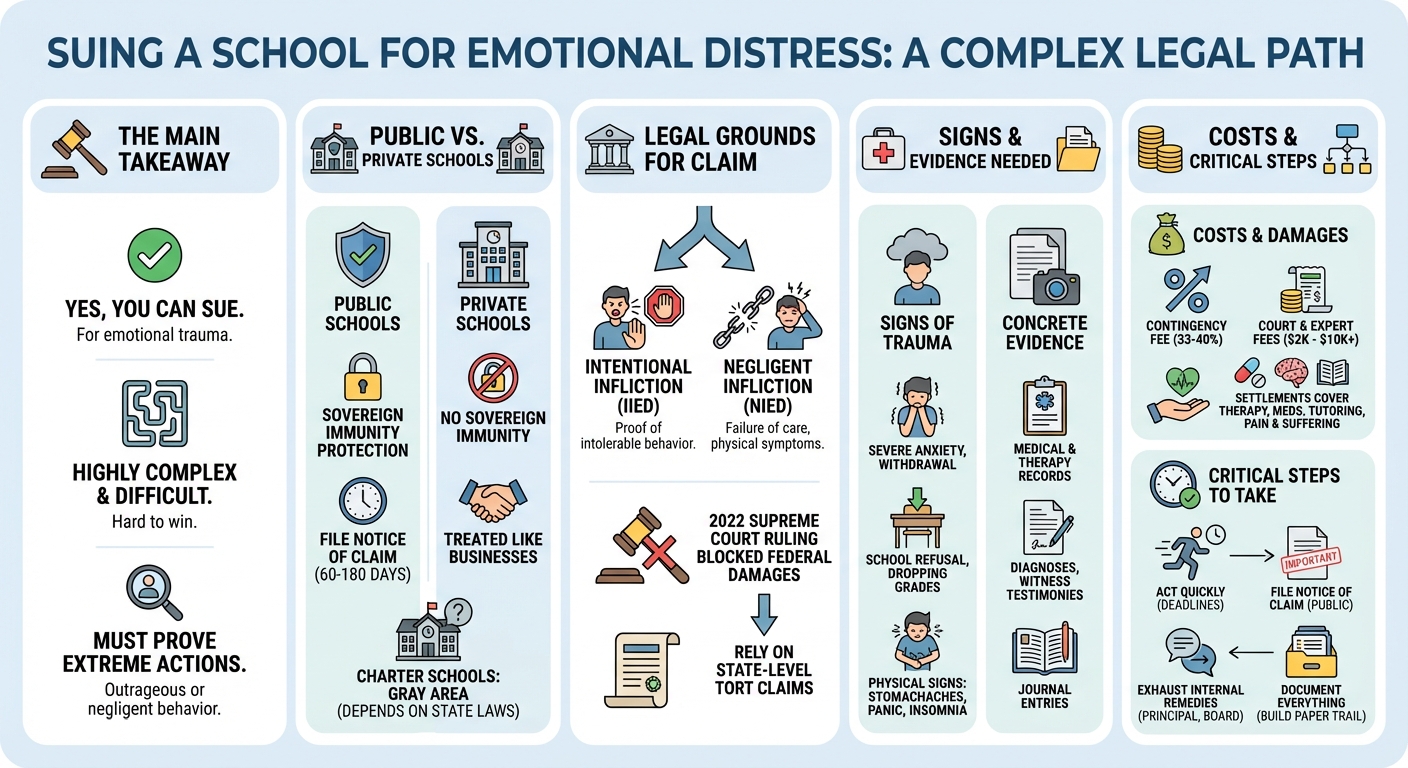
Yes, you can sue a school for emotional distress, but it is a complex legal process. You must prove the school’s actions were extreme, outrageous, or highly negligent. If suing a public school, you must overcome sovereign immunity by filing a formal Notice of Claim within your state’s strict deadlines.
Can You Sue a School for Emotional Distress? The Short Answer
Yes, you can sue a school for emotional distress, but it is a highly complex legal process. To succeed, you must prove that the school or its staff engaged in extreme, outrageous, or grossly negligent conduct that directly caused severe psychological harm. The legal path you take depends heavily on whether the institution is a public district protected by government immunity or a private entity.
Public vs. Private Schools: How Liability Differs
The type of school your child attends dictates the rules, deadlines, and legal hurdles you will face when filing an emotional distress claim.
Sovereign Immunity for Public School Districts
Public schools are government entities, meaning they are protected by a legal doctrine called sovereign immunity. This doctrine generally shields them from standard lawsuits unless the state has explicitly waived that immunity through a Tort Claims Act. To sue a public school, you cannot simply file a lawsuit; you must first file a formal “Notice of Claim” with the district or municipality, often within a strict window of 60 to 180 days after the incident.
Suing Private Schools and Charter Schools
Private schools do not benefit from sovereign immunity. They are treated like private businesses under the law. If a private school’s negligence or intentional actions caused emotional trauma, you can sue them directly under standard state tort laws. Charter schools, however, occupy a gray area; depending on your state’s laws, they may be treated as public entities with immunity or as private corporations.
Legal Grounds: IIED, NIED, and Federal Civil Rights
To win a lawsuit for psychological trauma, your claim must fit into a specific legal framework. The most common grounds include:
Intentional Infliction of Emotional Distress (IIED)
An IIED claim requires you to prove that a school employee acted intentionally or recklessly, and that their conduct was “extreme and outrageous.” The behavior must go beyond mere insults or poor judgment; it must be conduct that society considers completely intolerable, resulting in severe psychological trauma.
Negligent Infliction of Emotional Distress (NIED)
NIED claims arise when a school fails its duty of care, unintentionally causing emotional harm. In many states, winning an NIED claim requires the “zone of danger” rule—meaning the student was at immediate risk of physical harm—or requires the emotional distress to manifest into physical symptoms, such as ulcers, insomnia, or panic attacks.
The 2022 Supreme Court Ruling on Federal Funding Statutes
Historically, parents sued schools for emotional distress under federal civil rights laws like Title IX or Title VI. However, in the 2022 case Cummings v. Premier Rehab Keller, the U.S. Supreme Court ruled 6-3 that emotional distress damages are not recoverable in private lawsuits brought under Spending Clause anti-discrimination statutes. Because of this ruling, plaintiffs must now rely primarily on state-level tort claims (like IIED or NIED) rather than federal civil rights statutes to seek compensation for emotional harm.
What evidence do you need for emotional distress?
To prove emotional distress, you need concrete evidence showing the psychological impact. This includes medical records from therapists or psychiatrists, documented diagnoses (like PTSD or anxiety), witness testimonies from teachers or family, journal entries, and records of declining academic performance or sudden behavioral changes.
What are signs of emotional damage?
Signs of emotional damage in a student often include sudden behavioral changes, severe anxiety, depression, or withdrawal from social activities. You may also notice a sharp drop in academic performance, school refusal, sleep disturbances, nightmares, or physical symptoms like unexplained stomachaches, headaches, and panic attacks.
How hard is it to win an emotional distress case?
It is very hard to win an emotional distress case against a school. Courts require proof of “extreme and outrageous” conduct or a physical manifestation of the trauma. Additionally, public schools are protected by sovereign immunity, which places strict limits and high evidentiary thresholds on these lawsuits.
How much money is it to sue a school?
Suing a school typically costs nothing upfront if you hire a personal injury lawyer on a contingency fee basis. The lawyer takes a percentage (usually 33% to 40%) of the final settlement. However, case expenses for expert witnesses, depositions, and court filing fees can range from $2,000 to over $10,000.
Understanding Damages and Settlement Averages
If successful, damages in an emotional distress case are designed to “make the victim whole.” Compensation typically covers out-of-pocket costs like ongoing psychiatric therapy, medications, and specialized tutoring, as well as non-economic damages for pain and suffering. Because emotional distress is subjective, settlements vary wildly based on the severity of the trauma and the egregiousness of the school’s conduct.
Steps to Take If Your Child Suffered Psychological Trauma at School
If you believe your child has grounds for an emotional distress lawsuit, you must act quickly to preserve your legal rights.
Filing a Notice of Claim
If dealing with a public school, your first step is filing a Notice of Claim. This document informs the government entity that you intend to sue and outlines the basic facts of the incident. Missing the deadline for this notice—which can be as short as a few months—will permanently bar you from recovering compensation.
Exhausting Administrative Remedies
Before a judge will hear your case, you often must prove that you tried to resolve the issue internally. This means “exhausting administrative remedies” by filing formal grievances with the school principal, the district superintendent, and the local school board. Document every meeting, email, and formal complaint to build a paper trail for your attorney.
 Call (713) 747-7777