

Table of contents
Yes, you can sue for emotional distress in Texas, but generally only if it accompanies a physical injury or results from “extreme and outrageous” intentional conduct. Texas law does not recognize a standalone claim for negligent infliction of emotional distress unless you are a bystander witnessing a close relative’s severe injury.
Can You Sue for Emotional Distress in Houston, Texas?
The short answer is yes, you can sue for emotional distress in Texas, but it is significantly harder than in many other states. Unlike states that allow broad claims for “Negligent Infliction of Emotional Distress” (NIED), Texas law generally does not recognize NIED as a standalone cause of action.
In Houston courts, you typically cannot file a lawsuit solely because someone hurt your feelings or caused you anxiety through carelessness. Instead, emotional distress damages are usually awarded only when they are attached to another recognized legal claim, such as physical injury or defamation.
The Difference Between ‘Mental Anguish’ Damages and a Standalone Lawsuit
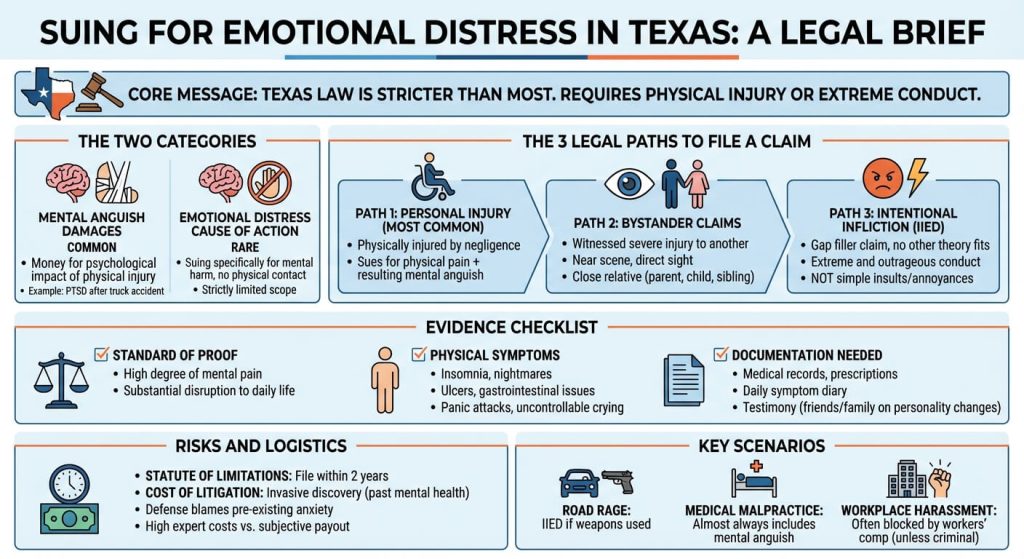
It is critical to distinguish between emotional distress as a type of damage and emotional distress as a lawsuit:
- Mental Anguish Damages: This is money awarded to compensate you for the psychological impact of a physical injury (e.g., PTSD after a truck accident on I-10). This is very common.
- Emotional Distress Cause of Action: This is suing someone specifically for causing you mental harm, without any physical contact. This is rare and strictly limited.
Why Texas Law is Stricter: The ‘Boyles v. Kerr’ Rule
The legal hurdle in Texas stems from the Supreme Court case Boyles v. Kerr (1993). The court ruled that there is no general legal duty to avoid negligently causing emotional distress to others. This means that if a business or individual acts carelessly and stresses you out—even severely—you likely do not have a case unless that carelessness also caused you physical harm or property damage.
The Three Main Paths to an Emotional Distress Claim
Because Texas limits standalone claims, plaintiffs in Houston generally must fit their situation into one of three specific legal “paths.”
Path 1: Emotional Distress as Part of a Personal Injury Case (Most Common)
This is the “parasitic” claim. If you are physically injured due to someone else’s negligence, you can sue for the physical pain and the resulting mental anguish. For example, if you suffer a spinal injury in a car crash, you can recover damages for the depression and anxiety caused by your loss of mobility.
Path 2: Bystander Claims (Witnessing a Loved One’s Injury)
Texas allows you to sue for emotional distress even if you weren’t physically hit, provided you meet the strict “Bystander” criteria:
- Proximity: You were located near the scene of the accident.
- Direct Perception: You saw the accident happen directly (not hearing about it later).
- Relationship: The victim is a close relative (parent, child, or sibling).
Path 3: Intentional Infliction of Emotional Distress (IIED)
This is known as a “gap-filler” tort. It is used when no other legal theory fits. To win an IIED claim in Texas, the defendant’s conduct must be extreme and outrageous—so terrible that it goes beyond all possible bounds of decency. Simple insults, annoyances, or indignities are not enough.
How Do You Prove Emotional Distress in Texas?
Proving mental anguish requires more than just stating you are upset. Texas courts require a “high degree of mental pain and distress” that causes a substantial disruption in your daily routine.
The ‘High Degree of Mental Pain’ Standard
To recover damages, the distress must be more than mere worry, anxiety, vexation, embarrassment, or anger. The jury must be convinced that the emotional response was severe. In many Houston courtrooms, this means showing that the distress is “nature, duration, and severity” enough to disrupt your ability to function.
The Necessity of Physical Manifestations
While not strictly required for all intentional torts, having physical symptoms significantly strengthens a negligence-based claim. Common physical manifestations accepted as proof include:
- Chronic insomnia or nightmares
- Ulcers or severe gastrointestinal issues
- Uncontrollable crying spells
- Panic attacks requiring medication
What Evidence Is Needed to Prove Emotional Distress?
Because mental pain is invisible, you must make it visible to a jury through concrete evidence. A “he said, she said” argument rarely wins these damages.
Medical Records and Psychologist Notes
The strongest evidence is a paper trail from medical professionals. Records showing a diagnosis of PTSD, depression, or anxiety after the incident—and the subsequent prescription of medication—are powerful. They provide an objective timeline connecting the incident to your mental state.
Journaling Your Symptoms: ‘Day-in-the-Life’ Evidence
Attorneys often recommend keeping a daily symptom diary. Entries should be specific: “Could not sleep until 4 AM due to flashbacks,” or “Missed son’s baseball game due to panic attack.” This contemporaneous record is often more persuasive than recalling feelings months later during a deposition.
Witness Testimony and Expert Analysis
Testimony from friends, family, and coworkers can establish a “before and after” picture of your personality. Additionally, in high-value cases, your attorney may hire a forensic psychiatrist to evaluate you and testify regarding the long-term psychological impact of the trauma.
Is Suing for Emotional Distress Worth It?
Before filing a lawsuit in Harris County, you must weigh the potential recovery against the personal and financial costs of litigation.
Calculating Potential Damages vs. Legal Costs
Emotional distress damages are “non-economic,” meaning they are subjective. Juries can award $1 or $1 million. However, these cases are expensive to litigate due to the need for expert witnesses. If the defendant has limited insurance coverage or assets, the cost of the lawsuit might exceed the payout.
The Emotional Toll of Litigation
Filing for emotional distress opens your entire mental health history to scrutiny. Defense attorneys will subpoena your past medical records to see if you had prior depression or anxiety, arguing that the defendant didn’t cause your condition. You will be deposed and asked invasive questions about your personal life. For some, this process is re-traumatizing.
Specific Scenarios for Houston Residents
- Road Rage on I-45 or 610 Loop: If a driver brandishes a weapon or intentionally tries to run you off the road, this may qualify as Intentional Infliction of Emotional Distress (IIED), even if they don’t hit your car.
- Workplace Harassment: In Houston’s oil and gas or medical sectors, severe harassment may lead to claims, though these are often preempted by workers’ compensation or federal employment laws unless the conduct is criminal in nature.
- Medical Malpractice in the Texas Medical Center: If a doctor’s negligence causes a traumatic injury, mental anguish is almost always included in the damages model.
Frequently Asked Questions About Emotional Distress Claims
What evidence is needed for distress? (Summary Checklist)
To summarize the evidentiary requirements, a strong case file should include:
- Clinical Evidence: Therapy notes, psychiatrist evaluations, and prescription records.
- Lay Testimony: Statements from family/coworkers confirming personality changes.
- Personal Documentation: A symptom journal or diary.
- Physical Proof: Evidence of physical symptoms (e.g., weight loss, hair loss, high blood pressure) linked to the stress.
Can I sue for stress without physical injury in Texas?
Generally, no—unless the conduct was intentional (IIED) or you are a qualifying bystander. Simple negligence that causes stress without physical injury is usually not grounds for a lawsuit in Texas due to the Boyles v. Kerr ruling.
What is the statute of limitations for emotional distress in Texas?
In Texas, the statute of limitations for personal injury and emotional distress claims is generally two years from the date of the incident. Failing to file within this window will likely result in your case being dismissed.
FAQs
How do you prove emotional distress in Texas?
Proving emotional distress in Texas requires demonstrating a “high degree of mental pain” that is more than mere worry or anger. You must show that the distress caused a substantial disruption to your daily routine. Evidence typically includes medical records, expert testimony, and proof of physical manifestations like insomnia or ulcers.
What evidence is needed to prove emotional distress?
To prove emotional distress, you need objective evidence such as medical records from a therapist or psychiatrist, prescriptions for anxiety or depression medication, and a personal journal documenting your symptoms. Witness testimony from friends and family regarding changes in your personality or daily functioning is also critical.
Is suing for emotional distress worth it?
It depends on the severity of the harm and the defendant’s ability to pay. While jury awards can be substantial, these cases are invasive; defense attorneys will scrutinize your entire mental health history. You must weigh the potential financial recovery against the emotional toll of a lawsuit and legal fees.
What evidence is needed for distress?
Successful claims typically require a combination of clinical evidence (therapy notes, diagnoses), lay testimony (statements from loved ones about your behavior), and physical proof (medical records showing physical symptoms like weight loss, migraines, or panic attacks resulting from the trauma).
What is the statute of limitations for emotional distress in Texas?
The statute of limitations for emotional distress claims in Texas is generally two years from the date the incident occurred. If you do not file your lawsuit within this two-year window, you will likely lose your right to pursue compensation.