

Table of contents
Yes, you can sue for defamation in Houston if someone publishes a false statement of fact that harms your reputation. Under Texas law, you must prove the statement was communicated to a third party, caused specific damages, and was made with negligence or actual malice, depending on your public status.
Can You Sue for Defamation of Character in Houston, Texas?
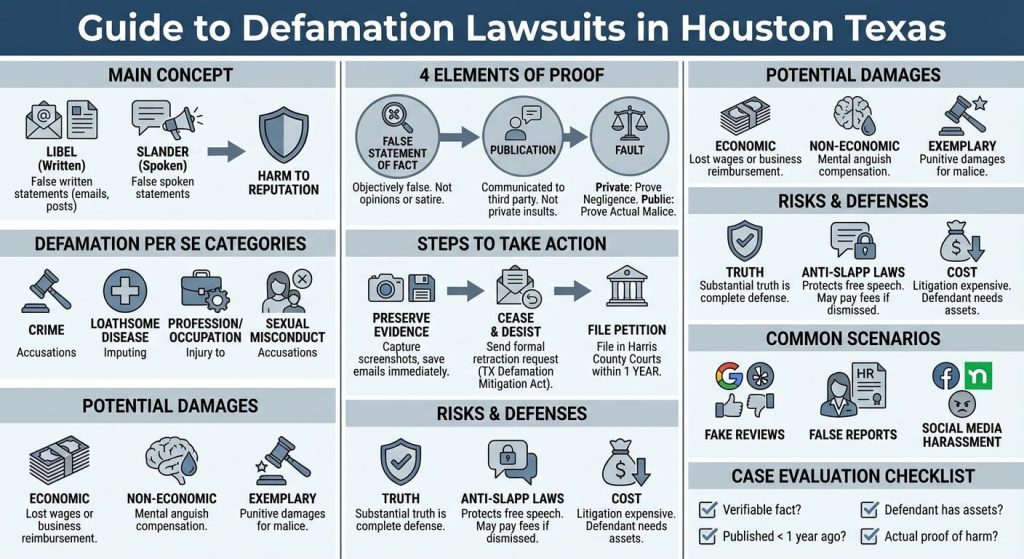
Yes, you can sue for defamation of character in Houston if you can prove that a false statement of fact was made about you to a third party, resulting in harm to your reputation or financial loss. Texas law distinguishes between two primary forms of defamation:
- Libel (Written): Defined under the Texas Civil Practice & Remedies Code Chapter 73, this includes false statements published in writing, online posts, emails, or other permanent media.
- Slander (Spoken): This covers oral defamatory statements made to others. While not defined by a specific statute like libel, slander is actionable under Texas common law.
To win a lawsuit in Harris County courts, you must move beyond hurt feelings and demonstrate that the statement meets specific legal standards of falsity and harm.
What proof is needed for defamation?
Texas courts require plaintiffs to satisfy four distinct elements to establish a valid defamation claim. Without these, a case is likely to be dismissed.
1. A false statement of fact (not opinion)
The statement must be objectively false. Opinions, satire, and hyperbole are generally protected by the First Amendment. For example, calling someone a “bad landlord” is likely an opinion; stating “this landlord stole my security deposit” is a verifiable fact.
2. Publication to a third party
You cannot sue someone for saying something mean directly to your face if no one else heard it. The false statement must be communicated to at least one other person.
3. Fault: Negligence vs. Actual Malice
The level of fault you must prove depends on who you are:
- Private Individuals: Must prove negligence (the defendant did not act with reasonable care in verifying the truth).
- Public Figures: Must prove actual malice (the defendant knew the statement was false or acted with reckless disregard for the truth).
4. Damages: Proving financial or reputational harm
Generally, you must quantify how the defamation hurt you financially (e.g., lost a client, fired from a job). However, in cases of Defamation Per Se, damages are assumed, and you do not need to prove specific financial loss. In Texas, statements are per se defamatory if they:
- Accuse you of a crime.
- Impute a loathsome disease.
- Injure you in your office, profession, or occupation.
- Accuse you of sexual misconduct.
How to sue someone for defamation in Texas?
Filing a lawsuit requires strategic preparation to avoid early dismissal.
Step 1: Preservation of evidence
Immediately capture screenshots, save emails, and download videos. If the content is deleted, your case becomes significantly harder to prove. In Houston, digital evidence is often the cornerstone of modern libel cases.
Step 2: The Cease and Desist Letter
Before filing suit, it is standard practice to send a formal notice requesting a retraction. Under the Texas Defamation Mitigation Act, requesting a correction or retraction is often a prerequisite to recovering certain types of damages.
Step 3: Filing the Petition in Harris County Courts
If the damages exceed jurisdictional limits of small claims, your attorney will file a petition in a Harris County District Court or County Civil Court at Law. The petition must outline the specific defamatory statements and the damages sought.
Critical Deadline: The 1-Year Statute of Limitations
Texas has a strict one-year statute of limitations for defamation. You must file suit within one year of the date the statement was first published. If you miss this window, your case will almost certainly be thrown out.
Is it worth suing for defamation in Texas?
Deciding to sue is a business decision as much as a legal one. You must weigh the potential recovery against the costs and risks.
The High Bar: Understanding the cost of litigation
Defamation lawsuits are fact-intensive and expensive. Legal fees can easily run into the tens of thousands of dollars. Unless the defendant has significant assets or insurance coverage, you may win a judgment but never collect the money.
The Risk: Texas Citizens Participation Act (Anti-SLAPP)
Texas has strong Anti-SLAPP laws designed to protect free speech. If a defendant successfully argues that your lawsuit is an attempt to silence their right to free speech on a matter of public concern, the court can dismiss your case early and order you to pay the defendant’s legal fees.
Why truth is the absolute defense
If the defendant can prove their statement was true, you will lose. In Texas, substantial truth is a complete defense to defamation.
How much can you sue for defamation of character in Texas?
There is no fixed cap on the amount you can sue for, but damages must be supported by evidence. Awards generally fall into three categories:
- Economic Damages: Reimbursement for quantifiable losses, such as lost wages, lost business revenue, or medical bills for therapy.
- Non-Economic Damages: Compensation for mental anguish, emotional distress, and loss of reputation in the community.
- Exemplary (Punitive) Damages: Awarded in cases where the defendant acted with malice or specific intent to harm. These are designed to punish the wrongdoer rather than compensate the victim.
Common Defamation Scenarios in Houston
False online reviews (Google, Yelp)
Business owners in Houston frequently face fake 1-star reviews. While platforms are protected by Section 230 of the Communications Decency Act, the individual poster is not. You can sue the individual if you can identify them.
Workplace accusations and professional licensing
False reports made to HR or licensing boards (like the Texas Medical Board or State Bar) can destroy careers. These statements often qualify as defamation per se because they attack professional integrity.
Social media harassment
Posts on Facebook, Nextdoor, or X (Twitter) that falsely accuse neighbors of crimes or illicit behavior are actionable libel.
Consulting a Houston Defamation Attorney
Defamation law in Texas is complex due to the interplay of common law, statutes, and constitutional protections. A local attorney familiar with Harris County judges and the specific procedural rules of the Texas Anti-SLAPP statute is essential.
Case evaluation checklist:
- Is the statement a verifiable fact?
- Was it published less than one year ago?
- Does the defendant have assets to pay a judgment?
- Can you prove actual damage to your reputation?
FAQs
What proof is needed for defamation?
To prove defamation in Texas, you must demonstrate four elements: (1) a statement of fact, (2) the statement was false, (3) the statement was published to a third party, and (4) the statement caused injury or financial harm.
How to sue someone for defamation in Texas?
To sue for defamation, you must first preserve all evidence (screenshots, recordings), hire an attorney, and file a lawsuit in the appropriate Texas court. Your attorney will then conduct discovery to prove the defendant’s intent or negligence.
Is it worth suing for defamation in Texas?
It depends on the damages and the defendant’s ability to pay. While you can win a judgment, collecting the money can be difficult if the defendant has no assets. It’s best reserved for cases where you have suffered clear financial harm.
How much can you sue for defamation of character?
There is no fixed limit. You can sue for economic damages (lost wages), non-economic damages (pain and suffering), and potentially punitive damages if the defendant acted with malice.