
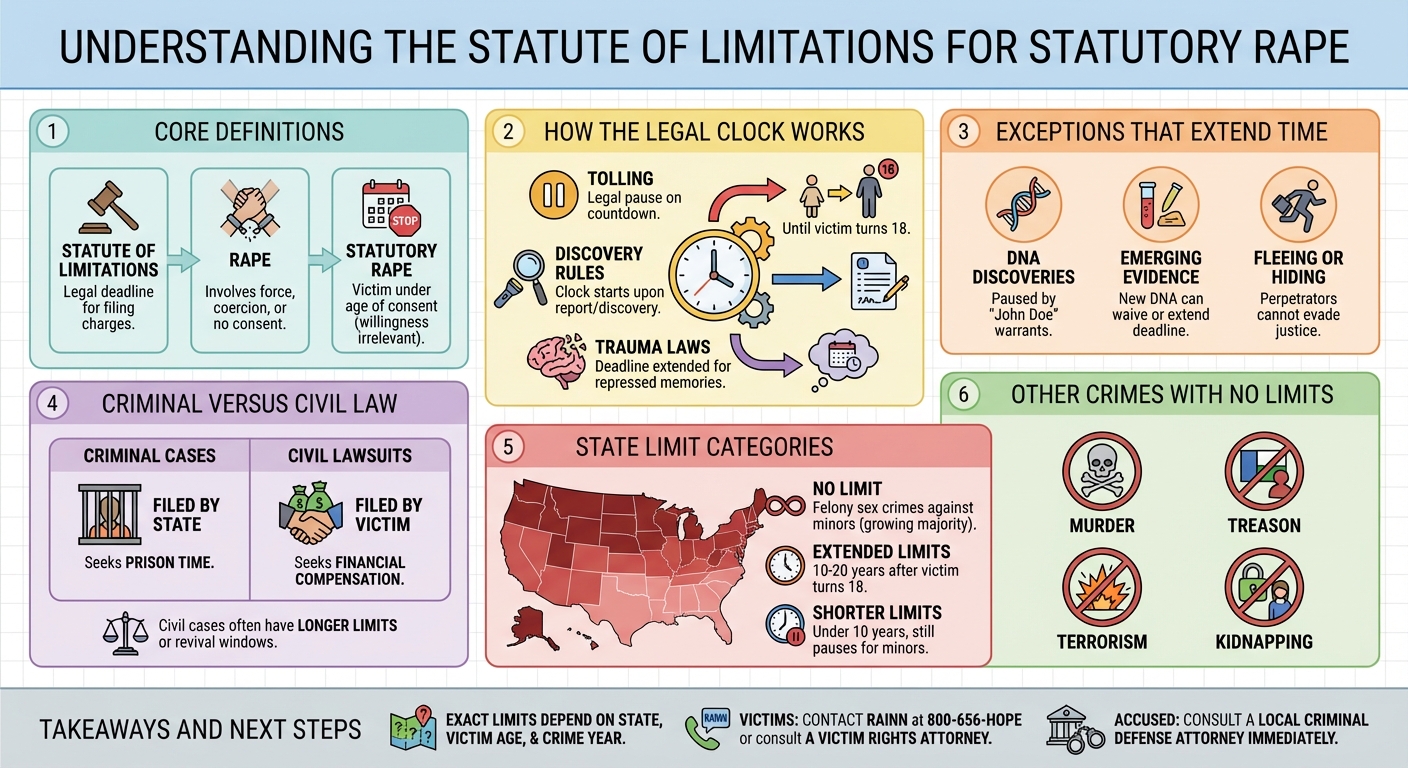
The statute of limitations for statutory rape varies significantly by state. Many states have eliminated the time limit entirely for felony sex crimes against minors. In states with limits, the clock typically pauses (tolls) until the victim turns 18.
What is the Statute of Limitations for Statutory Rape?
A statute of limitations is a legal time limit within which prosecutors must file criminal charges. For statutory rape, this time limit varies drastically depending on the state where the crime occurred, the severity of the charge (misdemeanor vs. felony), and the age of the victim.
Historically, many states enforced strict deadlines of three to ten years. However, due to widespread legal reforms, a growing number of jurisdictions have either completely eliminated the statute of limitations for sex crimes involving minors or extended the deadlines significantly through “tolling” laws.
What is the difference between rape and statutory rape?
The primary difference between rape and statutory rape lies in consent and force. Traditional rape involves non-consensual sexual acts achieved through force, coercion, or incapacitation. Statutory rape involves sexual activity with someone under the legal age of consent, regardless of whether they willingly participated or not.
How the ‘Clock’ Works: Tolling and Minor Victims
In states that still enforce a time limit on statutory rape, the countdown clock rarely starts on the day the crime occurs. Instead, the law uses a mechanism called “tolling” to pause the clock.
Tolling Until the Victim Turns 18
The most common tolling provision pauses the statute of limitations until the minor victim reaches the age of majority (usually 18). For example, if a state has a 10-year statute of limitations and the victim was 14 at the time of the abuse, the 10-year clock does not begin ticking until their 18th birthday, giving prosecutors until the victim turns 28 to file charges.
The Discovery Rule
Some jurisdictions apply a “discovery rule,” which delays the start of the statute of limitations until the crime is reported to law enforcement or discovered by a parent, guardian, or state agency. This ensures perpetrators cannot run out the clock simply by keeping the crime hidden.
Delayed Reporting and Memory Recovery
Recognizing the trauma associated with childhood sexual abuse, several states have enacted lookback windows or extended deadlines specifically for victims who delay reporting due to trauma or repressed memories. These laws often apply more to civil lawsuits than criminal prosecutions, but they reflect a broader legal shift toward accommodating delayed disclosure.
Exceptions That Extend or Eliminate the Time Limit
Even in states with strict deadlines, certain exceptions can indefinitely extend or completely remove the statute of limitations.
DNA Evidence Discoveries (John Doe Warrants)
If biological evidence is collected but the perpetrator is unknown, prosecutors can file a “John Doe” warrant based on the DNA profile. This effectively pauses the statute of limitations. Furthermore, many states explicitly state that if new DNA evidence emerges implicating a suspect, the statute of limitations is waived or extended (often by an additional year or more from the date of the DNA match).
The Perpetrator Leaves the State (Fleeing Justice)
If a suspect flees the state or goes into hiding to avoid prosecution, the statute of limitations clock is paused for the duration of their absence. A perpetrator cannot evade justice simply by crossing state lines until the deadline expires.
Criminal Prosecution vs. Civil Lawsuits
It is crucial to distinguish between the state prosecuting a perpetrator and a victim suing a perpetrator for damages.
Criminal Statutes of Limitations
These govern how long the government has to file criminal charges (e.g., felony statutory rape) resulting in prison time. As noted, these are increasingly being abolished or extended for crimes against minors.
Civil Statutes of Limitations for Childhood Sexual Abuse
Civil lawsuits allow victims to seek financial compensation from the perpetrator or institutions that enabled the abuse (like schools or churches). Civil statutes of limitations are often longer or subject to special “revival windows.” For instance, a state might have a 13-year civil limit after the victim turns 18, or a two-year window following a criminal conviction.
State-by-State Overview of Statutory Rape Time Limits
Because statutory rape laws are governed at the state level, there is no universal federal rule. Here is a general breakdown of how states handle these limits.
| Category | Typical Legal Framework | Example States |
|---|---|---|
| No Statute of Limitations | Felony sex crimes against minors can be prosecuted at any time, regardless of when they occurred. | Virginia, Florida (for certain felonies) |
| Extended Limits (10–20 Years) | The clock typically starts when the victim turns 18, giving a 10 to 20-year window to prosecute. | New York (10-20 yrs), Utah (10 yrs post-18) |
| Shorter Limits (Under 10 Years) | Strict deadlines, though often tolled until the victim reaches a certain age or reports the crime. | Georgia (7 yrs, tolled until age 16 or reported) |
States with No Statute of Limitations for Sex Crimes Involving Minors
A growing majority of states have abolished the statute of limitations for first-degree or felony sex offenses against children. In these jurisdictions, law enforcement can press charges decades after the incident.
States with Extended Limits (10 to 20 Years)
States like New York and Utah provide extended windows. For example, New York allows up to twenty years for second-degree rape and ten years for third-degree rape, while Utah allows 10 years from the time the victim reaches age 18.
States with Shorter Limits (Under 10 Years)
A minority of states maintain shorter limits, such as Florida’s eight-year limitation for certain sexual batteries or Georgia’s seven-year limit. However, even these states usually toll the clock until the victim reaches a specific age (e.g., 16) or the crime is reported.
What crimes have no statute of limitations in the USA?
In the United States, crimes with no statute of limitations universally include murder and treason. Additionally, many states and the federal government have eliminated time limits for terrorism, kidnapping, and severe felony sex crimes, particularly those involving minor victims, allowing prosecution at any time.
Next Steps: Consulting a Legal Professional
Because the statute of limitations for statutory rape is heavily dependent on the specific year the crime occurred, the exact age of the victim, and the state’s evolving legal code, online research is no substitute for legal counsel.
- For Victims: Contact the Rape, Abuse & Incest National Network (RAINN) at 800-656-HOPE or consult a local victim’s rights attorney to understand your criminal and civil options.
- For the Accused: Speak immediately with a criminal defense attorney in your jurisdiction to understand how local tolling laws and recent legislative lookback windows apply to your specific case.
 Call (713) 747-7777