
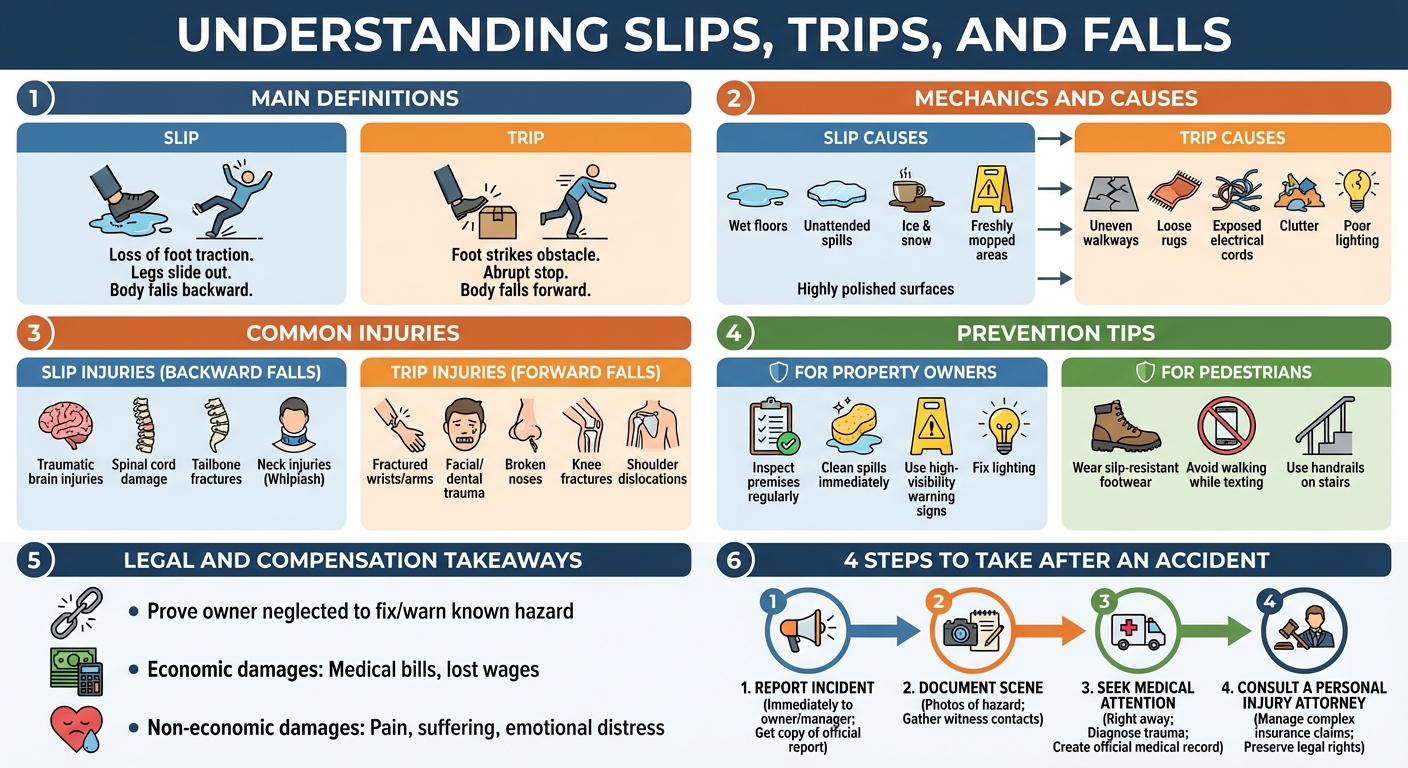
A slip occurs when there is a loss of traction between your shoe and the floor, usually causing you to fall backward. A trip happens when your foot strikes an object or uneven surface, interrupting your momentum and typically causing you to fall forward.
Introduction: Understanding Slips, Trips, and Falls
While often grouped together in safety manuals and personal injury law, slips, trips, and falls are distinct events. Understanding the mechanics behind a slip and trip is crucial for both preventing accidents and determining liability when injuries occur. Whether you are a property owner looking to improve safety or an injured party exploring your legal options, knowing how these accidents happen is the first step toward resolution.
What is a slip and trip?
A slip and trip refers to two distinct types of premises liability accidents where a person loses their balance due to hazardous conditions. While a slip involves losing traction on a slippery surface, a trip involves catching your foot on an obstacle, both frequently resulting in painful falls.
What is the difference between slip and trip?
The main difference between a slip and a trip is the mechanics of the fall. A slip occurs when your foot loses traction, causing your legs to slide out and your body to fall backward. A trip happens when your foot hits an object, throwing your body forward.
The Mechanics of a Slip
A slip happens when there is too little friction between your footwear and the walking surface. As your foot strikes the ground, it slides forward instead of gripping. Because your lower body moves forward faster than your upper body, your center of gravity shifts backward, typically resulting in a backward fall.
The Mechanics of a Trip
A trip occurs when your foot strikes an unexpected object or drops into an uneven surface while you are in motion. Your foot stops abruptly, but your upper body’s momentum continues forward. This sudden interruption of your stride throws you off balance, usually causing a forward fall.
Slip vs. Trip Comparison Table
| Feature | Slip Accident | Trip Accident |
|---|---|---|
| Primary Cause | Lack of friction/traction | Obstacle or uneven surface |
| Body Mechanics | Foot slides forward | Foot stops abruptly |
| Direction of Fall | Backward | Forward |
| Common Hazards | Spills, ice, wet floors | Clutter, cables, broken concrete |
What causes slips, trips, and falls?
Slips, trips, and falls are primarily caused by poorly maintained environments. Slips are typically caused by wet floors, spills, ice, or highly polished surfaces lacking friction. Trips are usually caused by uneven walkways, loose rugs, exposed cables, poor lighting, or unexpected clutter blocking a pedestrian pathway.
Common Causes of Slips (Wet floors, spills, weather)
- Spills and Leaks: Unattended liquid spills in grocery stores or restaurants.
- Weather Conditions: Rain, snow, or ice tracked into entryways.
- Cleaning Hazards: Freshly mopped or waxed floors without proper warning signs.
- Flooring Types: Highly polished stone or tile with inadequate slip resistance.
Common Causes of Trips (Uneven surfaces, clutter, poor lighting)
- Uneven Surfaces: Cracked sidewalks, potholes, or torn carpeting.
- Clutter: Boxes, tools, or merchandise left in walkways.
- Hidden Obstacles: Exposed electrical cords or low-lying furniture.
- Poor Lighting: Dimly lit stairwells or parking lots that hide hazards.
Workplace vs. Public Property Hazards
In the workplace, hazards often stem from industrial debris, manufacturing spills, or office clutter. On public property, such as retail stores or sidewalks, hazards are frequently tied to poor maintenance, weather-related neglect, or structural defects like broken stairs.
Common Injuries: Slip Accidents vs. Trip Accidents
Because the direction of the fall differs between slips and trips, the resulting injuries often differ as well.
Typical Slip Injuries (Spinal cord, traumatic brain injuries)
Because victims of a slip typically fall backward, they have little time to catch themselves. This exposes the back of the body to severe impact. Common injuries include:
- Traumatic brain injuries (TBIs) from the back of the head striking the floor.
- Spinal cord damage and herniated discs.
- Tailbone (coccyx) fractures.
- Neck injuries and whiplash.
Typical Trip Injuries (Fractured wrists, broken noses, knee trauma)
When tripping and falling forward, the natural human instinct is to reach out with the arms to brace for impact. This leads to a specific set of trauma, including:
- Fractured wrists and arms (often referred to as FOOSH injuries: Fall On Outstretched Hand).
- Broken noses, jaw fractures, and dental trauma.
- Knee and patella fractures.
- Shoulder dislocations.
How much compensation for a slip-and-fall?
Compensation for a slip-and-fall varies widely based on injury severity, ranging from a few thousand dollars for minor injuries to hundreds of thousands for severe trauma. Settlement amounts depend on medical bills, lost wages, pain and suffering, and the ability to clearly prove the property owner’s negligence.
Factors Influencing Settlement Amounts
The value of a claim is heavily influenced by the severity of the injuries, the clarity of liability, the victim’s age and occupation, and the insurance policy limits of the at-fault party.
Economic vs. Non-Economic Damages
- Economic Damages: Quantifiable losses such as hospital bills, physical therapy costs, and lost wages.
- Non-Economic Damages: Subjective losses like pain and suffering, emotional distress, and loss of enjoyment of life.
Proving Negligence in Premises Liability
To win compensation, you must prove that the property owner owed you a duty of care, breached that duty by failing to fix or warn about a hazard, and directly caused your injuries and subsequent financial damages.
Prevention and Safety: Avoiding Slips and Trips
Both property owners and pedestrians play a role in preventing these dangerous accidents.
Best Practices for Property Owners and Employers
Employers and property managers should implement routine inspections, clean up spills immediately, use high-visibility warning signs, secure loose rugs, and ensure all walkways and stairwells are brightly lit.
Personal Safety Tips (Footwear, awareness)
Individuals can protect themselves by wearing slip-resistant footwear, avoiding distractions like texting while walking, and using handrails when navigating stairs.
What to Do After a Slip or Trip Accident
If you are injured in a slip or trip accident, taking immediate action is vital for your health and any future legal claims.
Report the Incident
Notify the property owner, store manager, or your employer immediately. Request that an official incident report be filed and ask for a copy.
Document the Scene and Gather Evidence
Take clear photos of the hazard (e.g., the puddle, the broken step) before it is cleaned up or repaired. Collect contact information from any eyewitnesses.
Seek Immediate Medical Attention
Even if you feel fine, adrenaline can mask pain. See a doctor immediately to ensure your injuries are properly diagnosed and officially documented in your medical records.
Consult a Personal Injury Attorney
Premises liability claims are notoriously complex. Consulting with an experienced personal injury attorney can help you navigate insurance adjusters, preserve critical evidence, and fight for the compensation you deserve.
 Call (713) 747-7777