
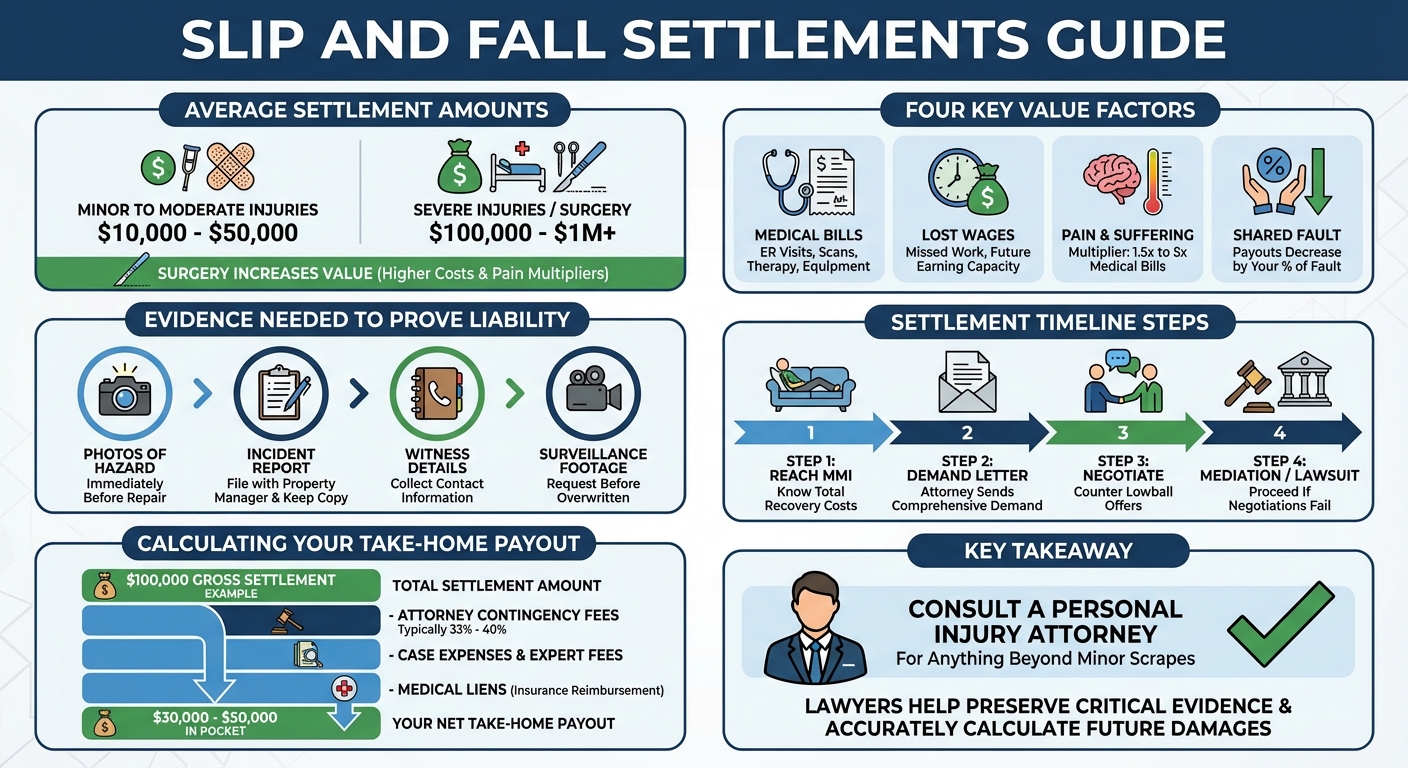
The average slip and fall settlement ranges from $10,000 to $50,000 for minor to moderate injuries. However, cases involving severe injuries or surgery can settle for $100,000 to over $1 million. Settlement amounts are determined by medical bills, lost wages, pain and suffering, and the property owner’s degree of liability.
Understanding Slip and Fall Settlements: A Complete Guide
A slip and fall accident can result in devastating injuries, mounting medical bills, and extended time away from work. When these accidents occur due to a property owner’s negligence, victims have the right to seek compensation through a premises liability claim. Understanding how slip and fall settlements are calculated, negotiated, and finalized is critical to ensuring you receive a fair payout.
This guide breaks down average settlement amounts, the factors that drive case value, and the timeline you can expect when pursuing a claim.
What is the Average Slip and Fall Settlement Amount?
Because every accident involves unique circumstances, there is no single “standard” payout. However, reviewing national averages provides a helpful baseline for what victims might expect.
How much compensation for a slip-and-fall?
Compensation for a slip-and-fall typically ranges from $10,000 to $50,000 for minor to moderate injuries. However, severe cases involving broken bones, traumatic brain injuries, or surgery can settle for $100,000 to over $1 million. The exact amount depends on your medical bills, lost wages, and the property owner’s liability.
Key Factors That Influence Your Settlement Value
Insurance adjusters and attorneys evaluate several core elements to determine the financial value of a slip and fall claim.
Severity of Injuries and Total Medical Bills
Your medical expenses form the foundation of your settlement. This includes emergency room visits, diagnostic imaging (X-rays, MRIs), physical therapy, prescription medications, and any required medical equipment. The more severe your injury, the higher your medical costs, which directly increases your baseline settlement value.
Lost Wages and Future Earning Capacity
If your injuries force you to miss work, you are entitled to compensation for lost income. In catastrophic cases where a victim cannot return to their previous profession, settlements will factor in “loss of future earning capacity,” which can add hundreds of thousands of dollars to a claim.
Pain and Suffering (General Damages)
Unlike medical bills, pain and suffering is subjective. Insurance companies often calculate this by multiplying your total medical expenses by a number between 1.5 and 5, depending on the severity and permanence of your injuries.
Comparative Negligence: Did You Share Fault?
Most states follow a comparative negligence rule, meaning your settlement can be reduced if you are found partially at fault for the fall (e.g., you were texting while walking). For example, if you are awarded $100,000 but found 20% at fault, your payout is reduced to $80,000.
High-Value Cases: Slip and Fall Settlements with Surgery
Cases that require surgical intervention are inherently more valuable. Surgery not only increases the hard medical costs but also justifies a higher multiplier for pain, suffering, and emotional distress.
What is the maximum settlement for a slip-and-fall with surgery?
There is no strict maximum settlement for a slip-and-fall with surgery, as payouts depend on insurance policy limits and total damages. However, cases requiring major surgeries—like spinal fusion or joint replacement—frequently settle between $100,000 and $500,000, and catastrophic injury cases can exceed several million dollars.
Proving Fault and Premises Liability
To win a settlement, simply falling on someone else’s property is not enough. You must prove the property owner was negligent.
How hard is it to win a slip-and-fall lawsuit?
Winning a slip-and-fall lawsuit can be hard because you must prove the property owner knew or should have known about the hazard and failed to fix it. Insurance companies often argue that the victim was clumsy or distracted, making strong evidence like video footage and witness statements crucial for success.
Evidence Needed: Photos, Incident Reports, and Witnesses
- Photographs: Take pictures of the hazard (e.g., a wet floor, broken stair, or icy sidewalk) immediately, before it is cleaned or repaired.
- Incident Reports: Always report the fall to a store manager or property owner and request a copy of the written report.
- Witness Testimony: Collect contact information from anyone who saw the fall or noticed the hazard beforehand.
- Video Surveillance: Request CCTV footage as soon as possible before it is overwritten.
Calculating Your Take-Home Payout
The gross settlement amount is rarely the amount that ends up in your bank account. Various deductions must be made before you receive your check.
How much of a $100K settlement will I get?
From a $100K settlement, you will typically take home between $30,000 and $50,000. After deducting the standard attorney contingency fee (usually 33% to 40%), case expenses (like expert witness fees), and medical liens to reimburse your health insurance or doctors, the remaining balance goes directly to you.
Understanding Attorney Contingency Fees and Medical Liens
Personal injury lawyers work on a contingency basis, meaning they only get paid if you win. Their fee is a percentage of the gross settlement. Additionally, if your health insurance or a hospital paid for your initial care, they have a legal right (a lien) to be reimbursed from your settlement proceeds.
The Slip and Fall Settlement Timeline
Patience is vital in personal injury claims. Settling too early can leave you paying out of pocket for future medical needs.
Maximum Medical Improvement (MMI) and the Demand Letter
Your attorney will wait until you reach Maximum Medical Improvement (MMI)—the point where you have fully recovered or your condition has stabilized. Once MMI is reached, your lawyer sends a comprehensive demand letter to the insurance company detailing your injuries, expenses, and the compensation required.
Negotiation, Mediation, and Potential Litigation
The insurance company will respond with an initial, often lowball, offer. This triggers a negotiation phase. If a fair agreement cannot be reached, your attorney may recommend formal mediation or filing a personal injury lawsuit to take the case to court.
When to Consult a Slip and Fall Accident Lawyer
If you have suffered more than minor scrapes and bruises, consulting a personal injury attorney is highly recommended. An experienced lawyer can help preserve critical evidence, handle aggressive insurance adjusters, and accurately calculate your future damages to ensure you do not settle for less than you deserve.
 Call (713) 747-7777