
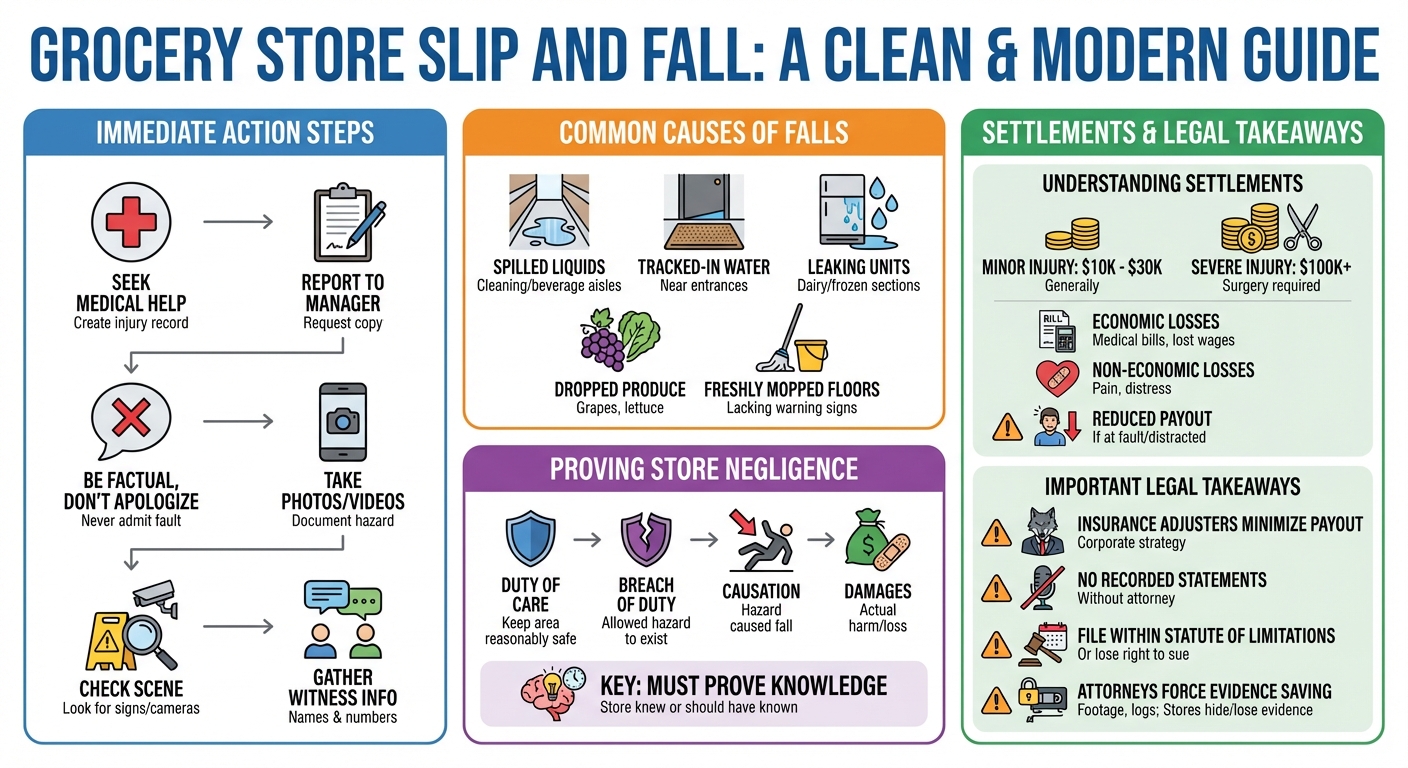
If you slip and fall in a grocery store, seek immediate medical attention to document your injuries. Next, report the accident to the store manager and request an incident report. Finally, take photos of the hazard and collect witness contact information.
Immediate Steps: What to Do After a Slip and Fall in a Grocery Store
A quick trip to the grocery store can turn into a nightmare if you slip on a wet floor or trip over misplaced merchandise. If you experience a slip and fall in a grocery store, the actions you take in the first few minutes are critical for your health and any future premises liability claim.
Seek Medical Attention Immediately
Your health is the top priority. Even if you feel fine, adrenaline can mask the pain of serious injuries like concussions, soft tissue damage, or hairline fractures. Seeing a doctor immediately not only protects your well-being but also creates an official medical record linking your injuries directly to the fall.
Report the Incident to Store Management
Never leave the store without reporting the accident. Ask to speak with the store manager and request that they fill out an official incident report. Be sure to ask for a copy of the report before you leave. Keep your comments brief and factual—do not apologize or admit fault.
Document the Scene and Gather Witness Info
Evidence disappears quickly in a busy supermarket. If you are physically able, use your smartphone to document the scene.
- Take photos and videos: Capture the exact hazard (e.g., a puddle, a squashed grape, a leaking freezer) and the surrounding area. Note if there were any wet floor signs.
- Collect witness information: Get the names and phone numbers of anyone who saw you fall or noticed the hazard beforehand.
- Look for cameras: Note the location of any ceiling surveillance cameras pointing toward the aisle.
Understanding Grocery Store Liability and Negligence
Just because you fell in a supermarket does not automatically mean the store is legally responsible. You must prove that the store’s negligence caused your accident.
What are the 4 proofs of negligence?
To hold a grocery store liable for your injuries, your claim must successfully establish the four pillars of negligence. If any of these are missing, your case will likely fail.
| Element | Description |
|---|---|
| 1. Duty of Care | The store had a legal obligation to keep the premises reasonably safe for customers (invitees). |
| 2. Breach of Duty | The store failed to meet that obligation by allowing a dangerous condition to exist. |
| 3. Causation | The store’s breach of duty was the direct cause of your slip and fall accident. |
| 4. Damages | You suffered actual, quantifiable harm (e.g., medical bills, lost wages, pain) as a result of the fall. |
Common Causes: Spills, Leaks, and Hazards
Supermarkets are filled with potential hazards. The most common causes of slip and fall accidents include:
- Spilled liquids in the beverage or cleaning aisles.
- Water tracked in from outside near the entrances.
- Leaking refrigeration units in the frozen food or dairy sections.
- Dropped produce (like grapes or lettuce) in the fresh food department.
- Freshly mopped floors without adequate warning signs.
The Role of Constructive Knowledge
Proving a store was negligent often comes down to constructive knowledge. You do not always have to prove the manager actually knew about the spill. Instead, you must prove they should have known about it. For example, if a puddle of milk was on the floor long enough to turn sticky and track cart marks through it, a jury can infer that employees had ample time to discover and clean it up.
Grocery Store Slip and Fall Settlements
If you have established negligence, the next question is usually about the financial recovery you can expect.
How much can you get from a slip and fall in a grocery store?
Settlements for a grocery store slip and fall vary widely based on the severity of your injuries. Minor injuries, such as sprains or minor bruising, might settle between $10,000 and $30,000. However, severe cases requiring surgery, such as a broken hip or a traumatic brain injury, can easily exceed $100,000 or even reach into the millions. The exact amount depends heavily on your specific medical bills and lost wages.
How much compensation do you get for falling in a supermarket?
The compensation you get for falling in a supermarket typically covers two main categories of damages. Economic damages reimburse you for out-of-pocket costs like ambulance fees, hospital bills, physical therapy, and lost income. Non-economic damages compensate you for subjective losses, such as physical pain, emotional distress, and a reduced quality of life. The total compensation is directly tied to the extent of these damages and the store’s level of fault.
Factors That Impact Your Settlement Value
Several variables will influence the final settlement offer from the supermarket’s insurance company:
- Severity of Injuries: Permanent or long-lasting injuries yield higher settlements.
- Clarity of Liability: If video footage clearly shows an employee ignoring a spill, the store is more likely to settle quickly and generously.
- Comparative Negligence: If you were distracted by your phone or running down the aisle, your compensation may be reduced by your percentage of fault.
Filing a Lawsuit: Challenges and Legal Process
Most slip and fall claims are settled out of court, but sometimes filing a lawsuit is the only way to get fair compensation.
How hard is it to win a slip and fall lawsuit?
Winning a slip and fall lawsuit can be challenging because the burden of proof rests entirely on the injured person. You must prove the store knew or should have known about the hazard and failed to act. Supermarkets aggressively defend these claims. However, with strong evidence—like surveillance video footage, detailed incident reports, and credible witness statements—your chances of winning increase significantly.
Dealing with Corporate Insurance Adjusters
Grocery store chains are backed by massive corporate insurance policies and teams of defense lawyers. Their primary goal is to minimize your payout. An adjuster may call you shortly after the accident, acting friendly and asking for a recorded statement. Do not give a recorded statement without a lawyer. Adjusters are trained to ask leading questions that trick you into admitting fault or downplaying your injuries.
Statute of Limitations for Premises Liability
You do not have unlimited time to take legal action. Every state has a statute of limitations for personal injury and premises liability claims, typically ranging from one to four years from the date of the accident. If you miss this deadline, you lose your right to seek compensation entirely.
When to Contact a Slip and Fall Lawyer
Handling a premises liability claim on your own is risky, especially when dealing with large supermarket chains.
Why You Shouldn’t Fight a Supermarket Alone
Supermarkets have protocols designed to protect them, not you. They may conveniently lose surveillance footage or claim that a wet floor sign was present when it wasn’t. An experienced attorney can send a spoliation letter to legally force the store to preserve video evidence and maintenance logs before they are destroyed.
How Our Legal Team Can Help
If you or a loved one has been injured in a grocery store, you need an advocate who understands the complexities of premises liability law. Our legal team can investigate the scene, consult with medical experts, handle all communications with the insurance company, and fight for the maximum compensation you deserve. Focus on your recovery, and let us handle the legal heavy lifting.
 Call (713) 747-7777