
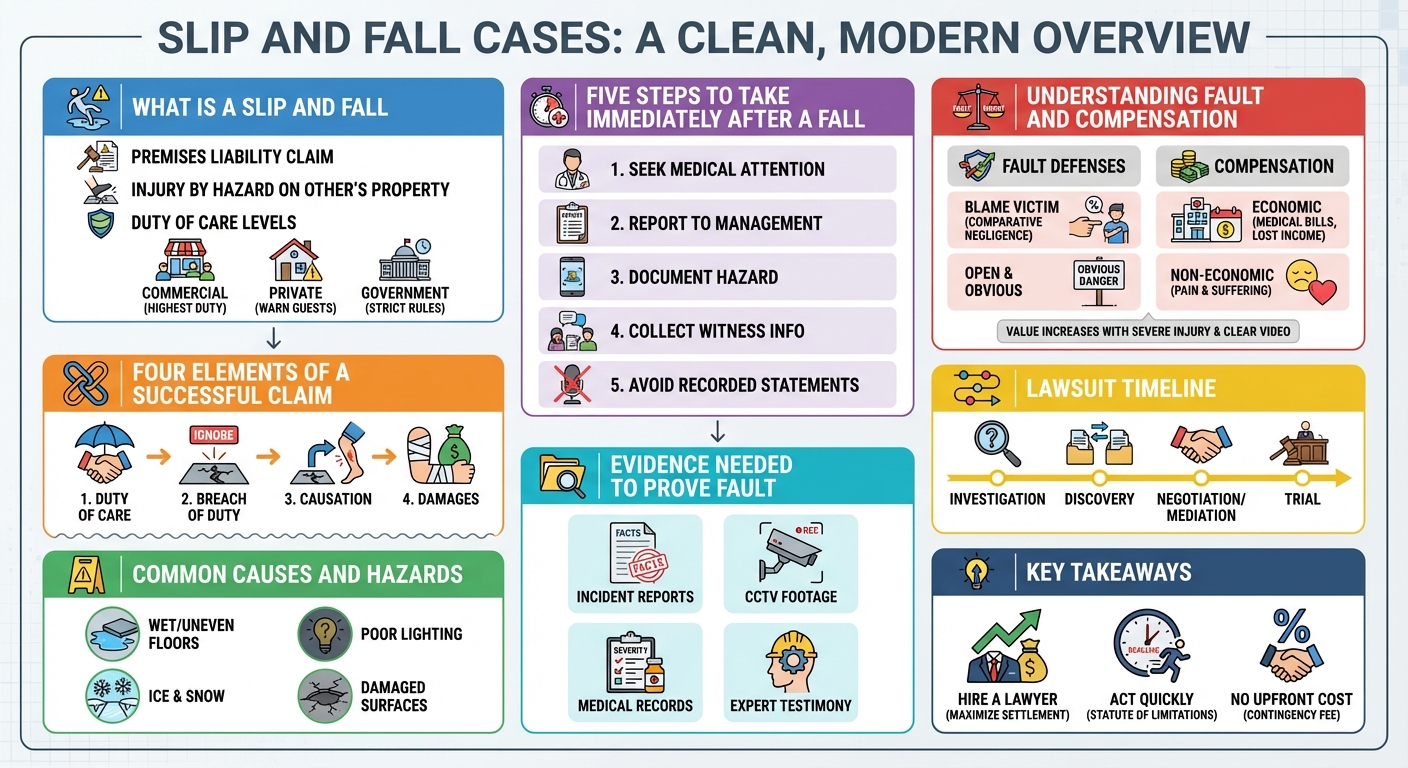
A slip and fall case is a personal injury claim based on premises liability laws. It occurs when a person is injured on someone else’s property due to a dangerous condition—like a wet floor or broken stair—that the property owner negligently failed to fix or warn visitors about.
A sudden slip and fall can change your life in an instant, leading to severe injuries, mounting medical bills, and lost wages. Navigating the legal aftermath can feel overwhelming, but understanding your rights is the first step toward recovery. This comprehensive guide breaks down everything you need to know about slip and fall cases, from proving negligence to maximizing your settlement.
1. What Constitutes a Slip and Fall Case?
The Definition of a Slip and Fall Accident
A slip and fall accident occurs when a person loses their footing and is injured on someone else’s property due to a hazardous condition. Legally, these cases fall under a broader category of personal injury law known as premises liability.
Understanding Premises Liability Law
Premises liability law dictates that property owners and managers have a legal obligation to keep their environments reasonably safe for visitors. If they fail to maintain the property, repair known hazards, or provide adequate warnings, they can be held financially responsible for resulting injuries.
Commercial vs. Private vs. Government Properties
The rules governing your claim depend heavily on where the accident occurred:
- Commercial Properties: Stores, restaurants, and hotels owe the highest duty of care to customers (invitees). They must actively inspect for hazards.
- Private Properties: Homeowners must warn guests (licensees) of known hidden dangers but generally have a lower burden to constantly inspect the premises.
- Government Properties: Falling on a public sidewalk or inside a municipal building involves strict rules, sovereign immunity limits, and significantly shorter deadlines for filing a notice of claim.
2. The 4 Essential Elements of a Successful Claim
To win a slip and fall settlement, you cannot simply prove that you fell. You must establish four critical legal elements:
1. Duty of Care: Did the property owner owe you a safe environment?
You must prove you were legally allowed on the premises. Trespassers are generally owed very little duty of care, whereas paying customers are owed the highest.
2. Breach of Duty: How was the hazard ignored or created?
You must show that the owner or their employees either created the dangerous condition, knew about it and ignored it, or should have known about it through routine inspections.
3. Causation: Linking the hazard directly to your fall
There must be a direct link between the breached duty (e.g., a spilled drink left for hours) and your specific accident. The defense will often try to argue that your own clumsiness caused the fall.
4. Damages: Proving actual physical and financial harm
A successful claim requires verifiable losses. If you slipped but were uninjured, you do not have a case. You must present medical records, bills, and proof of lost income.
3. Common Causes of Slip and Fall Accidents
Hazards can appear anywhere, but the most frequently litigated causes include:
Wet or Uneven Flooring
Freshly mopped floors without warning signs, spilled liquids in grocery aisles, torn carpeting, and loose floorboards are leading culprits in retail and commercial falls.
Poor Lighting and Hidden Hazards
Stairwells, parking garages, and hallways with blown-out bulbs make it impossible for visitors to see changes in elevation, debris, or steps.
Weather-Related Conditions (Ice and Snow)
While property owners cannot control the weather, they are required to clear ice and snow from walkways and entryways within a reasonable timeframe after a storm.
Damaged Sidewalks and Potholes
Cracked pavement, deep potholes in parking lots, and uneven sidewalk slabs pose major tripping hazards, often leading to complex liability disputes between private owners and municipalities.
4. Step-by-Step Checklist: What to Do Immediately After a Fall
The moments following a fall are critical for your health and your potential legal claim. Follow this checklist to protect your rights:
Seek Immediate Medical Attention
Your health is the priority. Even if you feel fine, adrenaline can mask severe injuries like concussions or internal bleeding. A prompt medical evaluation also creates an official record linking your injuries to the fall.
Report the Incident to Management or Property Owners
Notify a store manager, landlord, or property owner immediately. Ask them to file an official incident report and request a copy for your records before you leave.
Document the Scene (Photos and Videos)
Evidence disappears quickly. Use your phone to photograph the exact hazard that caused your fall, the surrounding area, lighting conditions, and any lack of warning signs.
Collect Witness Contact Information
If anyone saw you fall or noticed the hazard beforehand, get their names, phone numbers, and email addresses. Independent witness testimony is incredibly powerful.
Avoid Giving Recorded Statements to Insurance Adjusters
Insurance companies will often call quickly, hoping you will inadvertently admit fault or downplay your injuries. Decline to give a recorded statement until you have consulted an attorney.
5. Gathering Evidence to Prove Fault
Strong evidence is the backbone of any slip and fall case. Your legal team will focus on securing the following:
The Importance of the Incident Report
An official report establishes the time, date, and basic facts of the accident, preventing the property owner from later denying that the fall occurred on their premises.
Securing CCTV and Surveillance Footage
Video footage can show exactly how the fall happened and, crucially, how long the hazard was present before your accident. Lawyers often send “spoliation letters” to prevent owners from deleting this footage.
Medical Records and Bills
Comprehensive medical documentation proves the severity of your injuries, the treatments required, and the exact financial cost of your recovery.
Expert Testimony and Accident Reconstruction
In complex cases, attorneys may hire safety engineers or medical experts to testify about building code violations, the mechanics of your fall, or the long-term impact of your injuries.
6. Understanding Comparative Negligence
Property owners rarely accept full blame. They will likely argue that you were distracted, wearing improper footwear, or ignoring warning signs.
What if You Were Partially at Fault?
Most states follow comparative negligence rules, meaning you can still recover damages even if you were partially to blame, though your payout will be reduced by your percentage of fault.
Open and Obvious Hazards
If a danger was so obvious that a reasonable person would have avoided it (e.g., a massive, brightly lit sinkhole), the defense will use the “open and obvious” doctrine to try and dismiss your claim.
How State Laws Impact Your Payout (Modified vs. Pure Comparative Fault)
| Negligence Rule | How It Works |
|---|---|
| Pure Comparative Fault | You can recover damages even if you are 99% at fault (your payout is simply reduced by 99%). |
| Modified Comparative Fault | You can only recover damages if your fault is below a certain threshold (usually 50% or 51%). If you exceed it, you get nothing. |
| Contributory Negligence | Used in very few states; if you are even 1% at fault, you are barred from recovering any compensation. |
7. How Much is a Slip and Fall Case Worth?
There is no standard settlement calculator. The value of your case depends on the specific damages you have suffered.
Economic Damages: Medical Bills and Lost Wages
These are your quantifiable financial losses. They include emergency room visits, surgeries, physical therapy, prescription medications, and any income you lost while recovering.
Non-Economic Damages: Pain and Suffering
These compensate you for subjective losses, such as physical pain, emotional distress, loss of enjoyment of life, and permanent disfigurement or disability.
Factors That Increase or Decrease Settlement Value
- Severity of Injury: Traumatic brain injuries or spinal cord damage yield higher settlements than minor sprains.
- Clarity of Liability: Cases with undeniable video evidence settle for more than cases relying on conflicting witness accounts.
- Insurance Policy Limits: The maximum payout is often capped by the property owner’s liability insurance policy.
8. The Timeline of a Slip and Fall Lawsuit
While some cases settle in a few months, others can take years. Here is the typical progression:
Initial Investigation and Demand Letter
Your attorney investigates the claim, gathers evidence, and waits until you reach Maximum Medical Improvement (MMI). Then, they send a demand letter outlining your injuries and requesting a specific settlement amount.
The Discovery Phase
If the insurance company refuses to settle, a lawsuit is filed. During discovery, both sides exchange evidence, take depositions (sworn interviews), and build their arguments.
Negotiation and Mediation
Before going to trial, both parties usually attempt to resolve the case through mediation, where a neutral third party helps facilitate a settlement agreement.
Going to Trial (If Necessary)
If a fair agreement cannot be reached, the case proceeds to trial. A judge or jury will hear the evidence, determine fault, and award damages accordingly.
9. When to Hire a Slip and Fall Lawyer
Handling a premises liability claim on your own is risky, especially when facing aggressive corporate legal teams and insurance adjusters.
Why Legal Representation Maximizes Settlements
An experienced personal injury lawyer knows how to counter comparative negligence arguments, accurately calculate your future medical needs, and negotiate from a position of strength. Statistics consistently show that injury victims with legal representation secure significantly higher payouts than those who self-represent.
Statute of Limitations: Don’t Wait Too Long
Every state has a strict deadline—known as the statute of limitations—for filing a personal injury lawsuit. This window is typically between one and four years from the date of the fall. If you miss this deadline, you permanently lose your right to sue.
How to Get a Free Case Evaluation Today
If you or a loved one has been injured in a slip and fall accident, do not wait to seek legal guidance. Most personal injury attorneys work on a contingency fee basis, meaning you pay nothing upfront and only owe legal fees if you win your case. Reach out for a free consultation to protect your rights and start building your claim.
 Call (713) 747-7777