
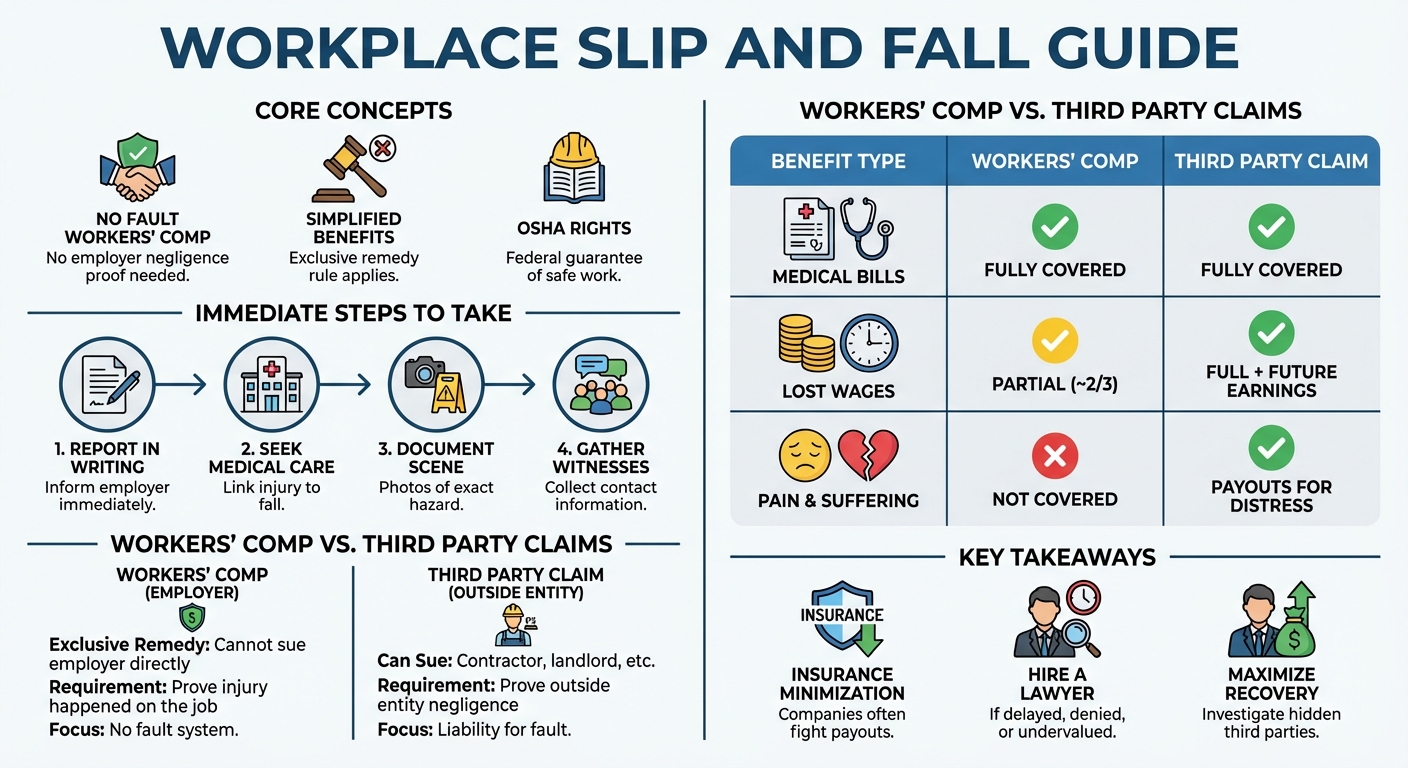
If you slip and fall at work, your primary right is to file a workers’ compensation claim. This no-fault system covers your medical expenses and a portion of your lost wages. While you generally cannot sue your employer directly, you may pursue a third-party personal injury lawsuit if an outside contractor or property owner caused your fall.
Slip and Fall at Work: Understanding Your Workers’ Rights
When you experience a slip and fall at work, your legal rights differ significantly from a fall in a public grocery store or private residence. Understanding these distinctions is crucial for securing the compensation you need to recover.
The Difference Between Workplace Falls and Public Falls
If you fall in a public space, you typically file a premises liability claim against the property owner, requiring you to prove their negligence. In contrast, workplace falls fall under workers’ compensation law. This is a no-fault system, meaning you do not need to prove your employer was careless to receive benefits; you only need to prove the injury occurred while performing your job duties.
Your Fundamental Right to a Safe Workplace Under OSHA
Under the Occupational Safety and Health Administration (OSHA), federal law guarantees your right to a safe work environment. Your employer is legally obligated to keep the workplace free from known health and safety hazards, which includes maintaining clean, dry floors, providing proper lighting, and securing loose cables or rugs.
What happens if you slip and fall at work?
If you slip and fall at work, you must immediately report the incident to your employer in writing and seek prompt medical attention. Your employer should initiate a workers’ compensation claim to cover your medical bills and a portion of your lost wages, regardless of who was at fault.
Report the Incident to Your Employer Immediately
Do not wait to see if your pain worsens. Notify your supervisor or HR department immediately. Most states have strict deadlines for reporting workplace injuries (often within 30 days). Always submit this report in writing and keep a copy for your records to establish a clear timeline.
Seek Immediate Medical Attention
Visit an approved workers’ compensation doctor or an emergency room as soon as possible. Delaying medical care gives insurance companies room to argue that your injuries are not work-related or are less severe than claimed.
Document the Scene and Gather Witness Information
If you are physically able, take photos of the exact location where you fell, capturing the hazard (e.g., a wet floor, missing warning sign, or torn carpet). Collect the names and contact information of any coworkers who witnessed the fall.
Workers’ Compensation vs. Suing Your Employer
Navigating the aftermath of a workplace fall requires understanding the boundaries of workers’ compensation and civil lawsuits.
How No-Fault Workers’ Compensation Works
Workers’ compensation acts as a safety net. Because it is a no-fault system, you are entitled to benefits even if your own clumsiness contributed to the fall, provided you were engaged in work-related activities and not violating company policy or under the influence of substances.
The Exclusive Remedy Rule Explained
In exchange for no-fault benefits, the law imposes the “Exclusive Remedy Rule.” This rule states that workers’ compensation is the sole remedy available to injured employees against their employers. In almost all cases, you are legally barred from filing a standard personal injury lawsuit against your employer for a workplace slip and fall.
Exceptions: When Can You Actually Sue Your Employer?
There are rare exceptions to the Exclusive Remedy Rule. You may be able to sue your employer directly if they do not carry legally mandated workers’ compensation insurance, or if your injury resulted from their intentional act or gross negligence (depending on state laws).
Third-Party Claims: When Someone Else is at Fault
While you generally cannot sue your employer, you may have grounds for a third-party personal injury claim if an outside entity caused your fall.
What is a Third-Party Personal Injury Claim?
A third-party claim is a civil lawsuit filed against an individual or company—other than your employer—whose negligence contributed to your workplace injury. This runs concurrently with your workers’ compensation claim.
Examples of Liable Third Parties
- Cleaning Contractors: A vendor who mopped the floor but failed to place “Wet Floor” signs.
- Equipment Manufacturers: The maker of a defective ladder or scaffolding that collapsed.
- Property Owners: If your employer rents the office space, the building landlord may be liable for structural hazards like a leaking roof or broken staircase.
Why Pursuing a Third-Party Claim Matters
Workers’ compensation only pays a fraction of your lost wages and offers nothing for pain and suffering. A third-party claim allows you to seek full compensation, bridging the financial gap left by the workers’ comp system.
| Benefit Type | Workers’ Compensation | Third-Party Lawsuit |
|---|---|---|
| Medical Bills | 100% Covered | 100% Covered |
| Lost Wages | Partial (Usually 2/3) | 100% Covered |
| Pain & Suffering | Not Available | Available |
| Proof Required | No-Fault | Must Prove Negligence |
How much compensation do you get for injury at work?
For a work injury, workers’ compensation typically covers 100 percent of your reasonable and necessary medical bills. Additionally, you receive partial wage replacement—usually two-thirds of your average weekly wage—while recovering, along with potential disability benefits if your injury causes permanent impairment.
Coverage for Reasonable and Necessary Medical Bills
Your employer’s insurance must pay for all medical treatments related to your fall. This includes emergency room visits, surgeries, physical therapy, prescription medications, and necessary medical equipment like crutches.
Partial Wage Replacement
While you are unable to work, you will receive temporary disability benefits. These are generally calculated at 66.6% (two-thirds) of your gross average weekly wage, subject to state maximums. These payments continue until your doctor clears you to return to work.
Permanent or Temporary Disability Benefits
If your slip and fall results in a lasting impairment—such as a permanent back injury or joint damage—you may be entitled to permanent partial or total disability benefits. The amount depends on your state’s impairment rating system and the specific body part affected.
How much compensation for a slip and fall?
Compensation for a third-party slip and fall lawsuit varies widely based on injury severity. Unlike workers’ compensation, a successful personal injury claim allows you to recover full lost wages, future earning capacity, and damages for pain and suffering, often resulting in significantly higher payouts.
Calculating Damages in a Third-Party Lawsuit
In a civil lawsuit, damages are categorized into economic (quantifiable financial losses) and non-economic (subjective losses). Your attorney will calculate the total cost of your medical care, out-of-pocket expenses, and the physical toll the injury has taken on your life.
Recovering Full Lost Wages and Future Earning Capacity
Unlike the two-thirds cap in workers’ comp, a third-party claim pursues 100% of your lost income. If your slip and fall prevents you from returning to your previous profession, you can also seek compensation for the loss of future earning capacity.
Compensation for Pain and Suffering
This is often the largest component of a third-party settlement. It compensates you for physical pain, emotional distress, loss of enjoyment of life, and mental anguish—damages entirely excluded from workers’ compensation.
Are slip and fall cases hard to win?
Slip and fall cases can be challenging to win in a third-party lawsuit because you must prove the defendant’s negligence caused your injury. However, securing workers’ compensation for a workplace fall is generally easier since it is a no-fault system, meaning you do not have to prove employer negligence.
Proving a Workers’ Comp Claim (No-Fault System)
To win a workers’ compensation claim, you simply need to prove that you are an employee and that the injury occurred in the course and scope of your employment. The primary hurdle is usually medical disputes, not proving fault.
Proving Negligence in a Third-Party Slip and Fall Lawsuit
Winning a third-party claim is more complex. You must prove four elements: duty of care, breach of that duty (e.g., the contractor knew about the spill but ignored it), causation, and actual damages. This requires robust evidence, expert testimony, and aggressive legal strategy.
Common Employer and Insurance Company Defenses
Insurance companies fight hard to minimize payouts. They may argue that your injury was pre-existing, that you were engaged in “horseplay” when you fell, or in a third-party case, that the hazard was “open and obvious” and you should have avoided it.
Protecting Your Rights: When to Hire a Workplace Injury Attorney
Not every minor scrape requires legal representation, but serious slip and fall injuries demand professional advocacy to protect your financial future.
Signs Your Workers’ Comp Claim is Being Undervalued or Denied
If your employer delays reporting your claim, the insurance company denies essential medical treatments, or your benefit checks are miscalculated, it is time to hire an attorney. Insurers often push injured workers to return to work before they are fully healed.
How a Lawyer Helps Identify Hidden Third-Party Liability
A skilled workplace injury lawyer will investigate your accident beyond the surface level. They will review vendor contracts, maintenance logs, and property records to identify any third parties who share liability, ensuring you do not leave money on the table.
Next Steps for a Free Case Evaluation
If you have suffered a slip and fall at work, consult with an experienced injury attorney immediately. A free case evaluation will help you understand whether you are limited to workers’ compensation or if you have a lucrative third-party claim to pursue.
 Call (713) 747-7777