
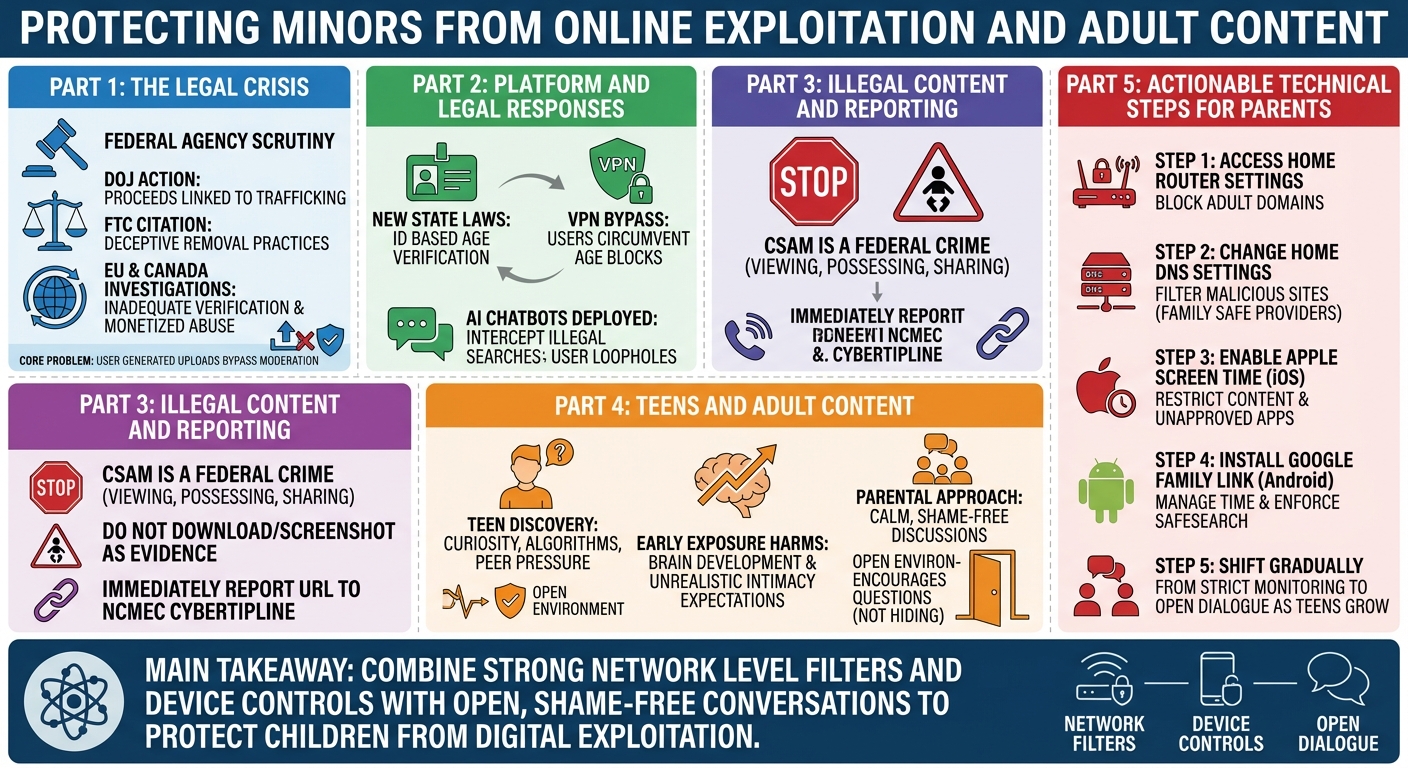
Pornhub and its parent company have faced severe legal scrutiny from the FTC and DOJ for hosting child sexual abuse material (CSAM) and failing to protect minors. Parents should utilize network-level filters, enforce device parental controls, and have open conversations to prevent children from accessing adult platforms.
Pornhub and Child Safety: Understanding the Legal Controversies
Adult content platforms have increasingly become the center of intense legal and regulatory scrutiny regarding child safety. The intersection of user-generated content and inadequate moderation has led to severe consequences for platforms failing to protect minors.
Recent FTC and DOJ Actions Against Pornhub’s Parent Company
Federal agencies have taken aggressive steps against Aylo, the parent company of Pornhub. The Department of Justice (DOJ) recently secured a deferred prosecution agreement after the company admitted to receiving proceeds linked to sex trafficking. Concurrently, the Federal Trade Commission (FTC) has taken action against the operators for deceiving users about their efforts to remove horrific, non-consensual, and exploitative material from their platforms.
International Scrutiny: EU and Canadian Investigations
The legal pressure extends globally. The European Commission has issued preliminary findings under the Digital Services Act, highlighting that platforms like Pornhub lack robust, privacy-preserving age verification systems. Similarly, Canadian parliamentary reports have documented instances where victims of child sexual exploitation found their abuse recorded and monetized on the platform.
The Core Issue: Hosting and Profiting from Exploitative Material
The fundamental controversy lies in the platform’s historical reliance on user-generated uploads. Without stringent pre-screening, bad actors have exploited the system to upload Child Sexual Abuse Material (CSAM) and non-consensual content, allowing the platform to inadvertently host and profit from illegal exploitation before the content is flagged and removed.
How Platforms and Law Enforcement are Responding
In response to public outcry and legal threats, both governments and the platforms themselves are implementing new safeguards, though effectiveness varies.
Age Verification Laws and Existing Loopholes
Several U.S. states have passed mandatory age-verification laws requiring users to prove they are 18 or older using government IDs or third-party verification services. However, significant loopholes remain; many users easily bypass these restrictions using Virtual Private Networks (VPNs) to mask their location.
AI Chatbots and Search Interventions for CSAM
To combat the search for illegal content, some platforms have deployed automated interventions. For example, a recent initiative utilized an AI chatbot that intercepted millions of searches for child abuse material, blocking the search results and instead directing the user to psychological help and law enforcement resources.
State Coalitions Demanding Stricter Safeguards
State attorneys general are actively pushing for tighter regulations. A 26-state coalition recently sent a formal demand to Pornhub’s parent company, demanding the immediate closure of platform loopholes that allow unverified users to access or upload potentially illegal content.
Understanding the Legal Definitions and Risks
Navigating the legal landscape of digital exploitation requires a clear understanding of criminal definitions and reporting obligations.
What does CP mean as a crime?
In the criminal justice system, CP stands for child pornography, though law enforcement and child protection agencies now predominantly use the term Child Sexual Abuse Material (CSAM). It refers to any illegal visual depiction of a minor engaged in sexually explicit conduct, which is classified as a severe federal crime.
Is it illegal to view CP?
Yes, it is strictly illegal to view, possess, download, or distribute Child Sexual Abuse Material (CSAM). Under United States federal and state laws, intentionally accessing or viewing this illegal content carries severe criminal penalties, including mandatory minimum prison sentences and mandatory registration as a sex offender.
Reporting Mechanisms for Illegal Content
If you encounter CSAM online, you should never download, screenshot, or share the material, even to report it. Instead, immediately report the URL and description to the National Center for Missing & Exploited Children (NCMEC) via their CyberTipline, which works directly with federal law enforcement.
Navigating Pornography and Teens: A Guide for Parents
Beyond illegal content, the widespread availability of legal adult content poses significant challenges for parents raising teenagers in a digital-first world.
Why do teens watch porn?
Teens typically watch porn due to natural curiosity about sex and their developing bodies. Other common reasons include peer pressure, accidental exposure through social media algorithms, or a misguided attempt to learn about relationships and intimacy in the absence of comprehensive and open sex education at home or school.
Is it okay for a 13 year old to watch porn?
Child psychology experts strongly advise against 13-year-olds watching pornography. Early exposure can negatively impact adolescent brain development, create highly unrealistic expectations about intimacy, and expose young teens to aggressive or non-consensual themes before they are emotionally equipped to process or understand them.
How to Have Constructive Conversations Without Shaming
If you discover your child has accessed adult content, avoid reacting with anger. Approach the situation calmly, ask open-ended questions about what they saw, and explain your concerns regarding unrealistic portrayals of sex. Creating a shame-free environment ensures they will come to you with future questions.
Actionable Steps to Protect Children Online
Parents must take proactive, technical steps to secure their home networks and devices against inappropriate content.
Setting Up Network-Level Content Filters
- Router Controls: Access your home router’s administrative panel to block specific adult domains.
- DNS Filtering: Change your home network’s DNS settings to a family-safe provider (like OpenDNS FamilyShield) to automatically filter known adult and malicious websites at the network level.
Device-Specific Parental Controls (iOS and Android)
- Apple iOS: Utilize the “Screen Time” feature. Navigate to Content & Privacy Restrictions to limit adult websites and prevent the installation of unapproved apps.
- Android: Install Google Family Link to manage app downloads, set screen time limits, and enforce Google SafeSearch across the device.
Monitoring vs. Privacy: Finding the Right Balance
While strict monitoring is necessary for younger children, teenagers require a gradual shift toward privacy. Transition from heavy surveillance to open communication and random check-ins as they demonstrate responsible digital citizenship. The goal is to teach them how to navigate the internet safely, rather than just blocking it entirely.
 Call (713) 747-7777