
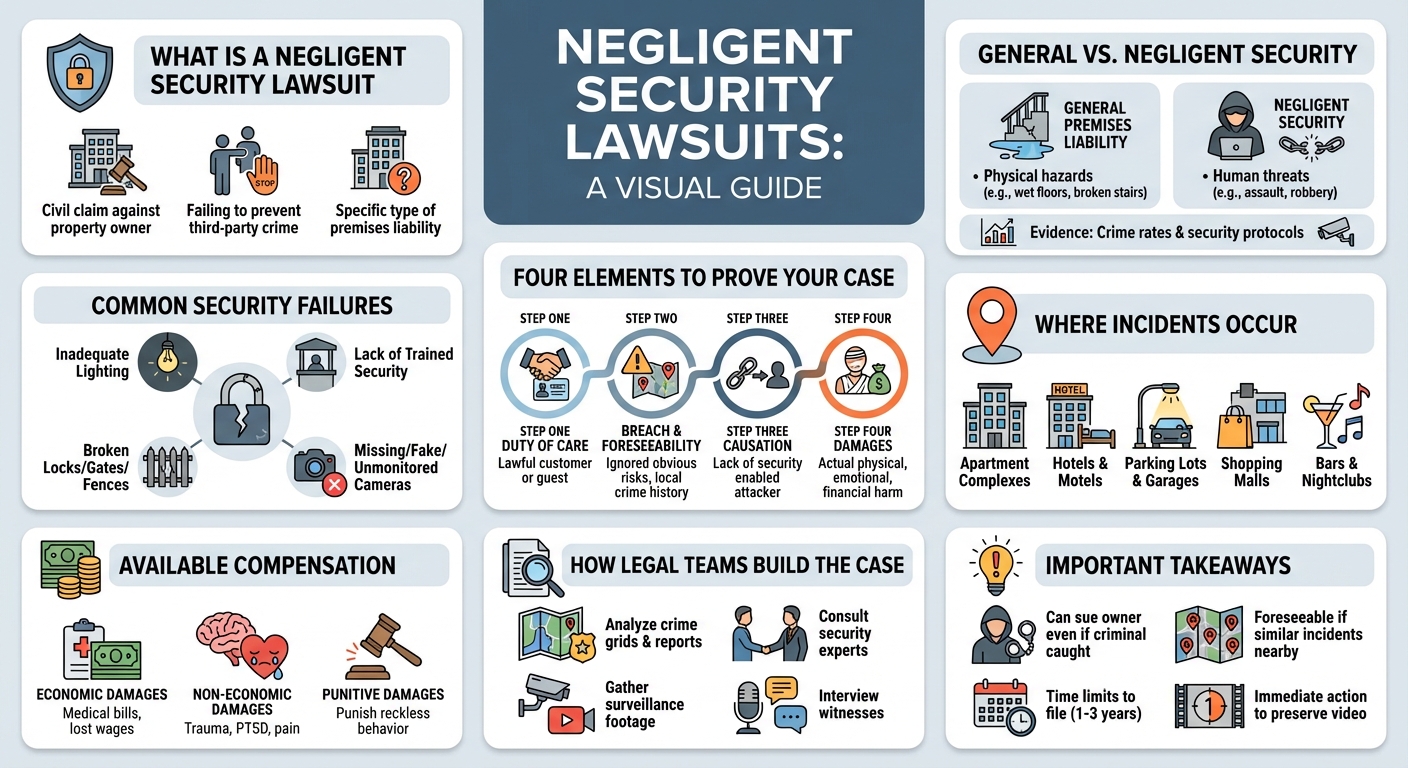
A negligent security lawsuit is a type of premises liability claim filed against a property owner when a visitor is injured by a third-party crime. To win, victims must prove the owner failed to provide reasonable security measures, making the criminal act foreseeable and preventable.
What is a Negligent Security Lawsuit?
A negligent security lawsuit is a civil claim filed by a victim of a crime against the owner or manager of the property where the crime occurred. It falls under the broader legal category of premises liability. In these cases, the property owner is not the one who committed the crime. Instead, they are held liable for failing to implement reasonable security measures that could have prevented the attack, assault, or robbery.
The Link Between Premises Liability and Negligent Security
Premises liability is the legal concept that property owners must maintain a safe environment for visitors, tenants, and customers. Negligent security is a specific subset of this law. While standard premises liability deals with physical hazards, negligent security deals with the risk of third-party criminal acts.
General Premises Liability vs. Negligent Security
| Feature | General Premises Liability | Negligent Security |
|---|---|---|
| Primary Hazard | Environmental dangers (wet floors, broken stairs, uneven sidewalks) | Human threats (assault, robbery, battery by a third party) |
| Owner’s Failure | Failing to repair or warn about physical property defects | Failing to deter crime through adequate security measures |
| Focus of Evidence | Maintenance logs, building codes, hazard visibility | Crime rates, security protocols, lighting, broken locks |
Common Examples of Negligent Security
Property owners must adapt their security measures to the specific risks associated with their location and business type. When they cut corners, visitors are put in danger.
Inadequate or Broken Lighting
Criminals rely on darkness to hide their activities. Poorly lit parking lots, stairwells, and alleyways create blind spots. If a property owner knows a light is out and fails to replace it, they can be held liable if an attack occurs in that unlit area.
Lack of Security Personnel or Bouncers
High-risk environments, such as nightclubs, large apartment complexes, or busy shopping malls, often require trained security guards. If a venue has a history of violence but refuses to hire security—or hires untrained staff who fail to intervene—they may be guilty of negligent security.
Broken Locks, Gates, and Fences
Physical barriers are the first line of defense against trespassers. A landlord who ignores maintenance requests for a broken apartment gate, a malfunctioning key fob system, or a shattered window is directly compromising tenant safety.
Missing or Unmonitored Security Cameras
Visible security cameras act as a strong deterrent to crime. If a property owner installs fake cameras, lets a camera system fall into disrepair, or fails to monitor live feeds in a high-risk building, they strip visitors of a crucial layer of protection.
The 4 Elements Needed to Prove a Negligent Security Claim
Winning a negligent security lawsuit requires more than just proving a crime happened on the property. Your attorney must establish four distinct legal elements.
1. Duty of Care Owed by the Property Owner
You must prove that you had a legal right to be on the property. Property owners owe a high duty of care to invitees (customers) and licensees (social guests). Trespassers generally do not have the right to claim negligent security.
2. Breach of Duty and the Role of ‘Foreseeability’
This is the most critical element. You must prove the owner breached their duty by failing to provide reasonable security. To do this, the crime must have been foreseeable. If there were five muggings in a store’s parking lot over the last year, a sixth mugging is highly foreseeable. If the area has zero history of crime, proving foreseeability becomes much harder.
3. Causation (Connecting the Breach to the Crime)
You must draw a direct line between the lack of security and the crime. For example, you must prove that if the landlord had fixed the broken gate, the assailant would not have been able to enter the complex and attack you.
4. Damages Suffered by the Victim
Finally, you must prove that you suffered actual harm. This includes physical injuries, emotional trauma, and financial losses resulting from the incident.
Where Do Negligent Security Incidents Typically Occur?
While a crime can happen anywhere, negligent security claims frequently arise in specific commercial and residential settings.
Apartment Complexes and Condominiums
Tenants rely on landlords to secure common areas. Broken lobby doors, unlit hallways, and unmonitored parking garages make residents vulnerable to burglaries and assaults.
Hotels and Motels
Guests expect a safe environment when traveling. Negligent security in hospitality often involves unauthorized access to guest rooms, poorly lit corridors, or a lack of front desk monitoring.
Parking Lots and Parking Garages
These are prime locations for robberies and carjackings. The combination of isolated spaces, poor lighting, and multiple hiding spots requires strict security measures, such as patrols and emergency call boxes.
Shopping Malls and Retail Stores
Large crowds and valuable merchandise attract criminal activity. Malls must employ adequate security patrols and monitor surveillance feeds to protect shoppers from muggings or violent altercations.
Bars, Nightclubs, and Entertainment Venues
Where alcohol is served, the risk of physical altercations increases. Venues must have trained bouncers, strict weapon-screening protocols, and crowd-control measures to prevent patrons from harming one another.
Compensation Available in a Negligent Security Lawsuit
Victims of violent crimes often face a long road to physical and emotional recovery. A successful lawsuit can recover various types of damages.
Economic Damages (Medical Bills, Lost Wages)
These are the quantifiable financial losses caused by the attack. They include emergency room bills, ongoing physical therapy, trauma counseling, and wages lost while recovering from injuries.
Non-Economic Damages (Pain and Suffering, Trauma)
Violent crimes leave lasting psychological scars. Non-economic damages compensate victims for PTSD, anxiety, loss of enjoyment of life, and the physical pain endured during and after the attack.
Punitive Damages in Cases of Gross Negligence
If a property owner’s failure to provide security was exceptionally reckless—such as intentionally ignoring repeated violent crimes on their property to save money—a judge or jury may award punitive damages to punish the owner and deter future negligence.
How a Premises Liability Attorney Builds Your Case
Proving a property owner is liable for a third-party crime is complex. Experienced attorneys use specific tactics to build an airtight case.
Analyzing Local Crime Grids and Police Reports
Lawyers will subpoena local police records to map out crime trends in the immediate area. A documented history of 911 calls to the property is the strongest way to prove the crime was foreseeable.
Consulting with Security and Criminology Experts
Attorneys often hire former law enforcement officers or private security consultants. These experts testify about industry standards and explain exactly what security measures the property owner should have implemented.
Gathering Surveillance Footage and Witness Testimony
Evidence disappears quickly. A lawyer will send a spoliation letter to the property owner, legally forcing them to preserve all CCTV footage, maintenance logs, and incident reports. They will also interview witnesses and employees who can testify about the property’s chronic security failures.
Frequently Asked Questions About Negligent Security
Can I sue a property owner for a crime committed by a third party?
Yes. While the criminal is responsible for the act itself, the property owner can be held civilly liable if their failure to provide adequate security allowed the crime to happen. You can pursue a civil lawsuit against the owner even if the criminal is never caught.
How do I know if the crime was ‘foreseeable’?
A crime is generally considered foreseeable if similar incidents have occurred on or near the property in the past. Courts look at the frequency, recency, and severity of prior crimes, as well as the overall crime rate in the surrounding neighborhood.
How long do I have to file a negligent security lawsuit?
The time limit, known as the statute of limitations, varies by state. In many states, you have between one and three years from the date of the incident to file a claim. However, it is crucial to consult an attorney immediately, as vital evidence like security footage can be deleted within days.
 Call (713) 747-7777