
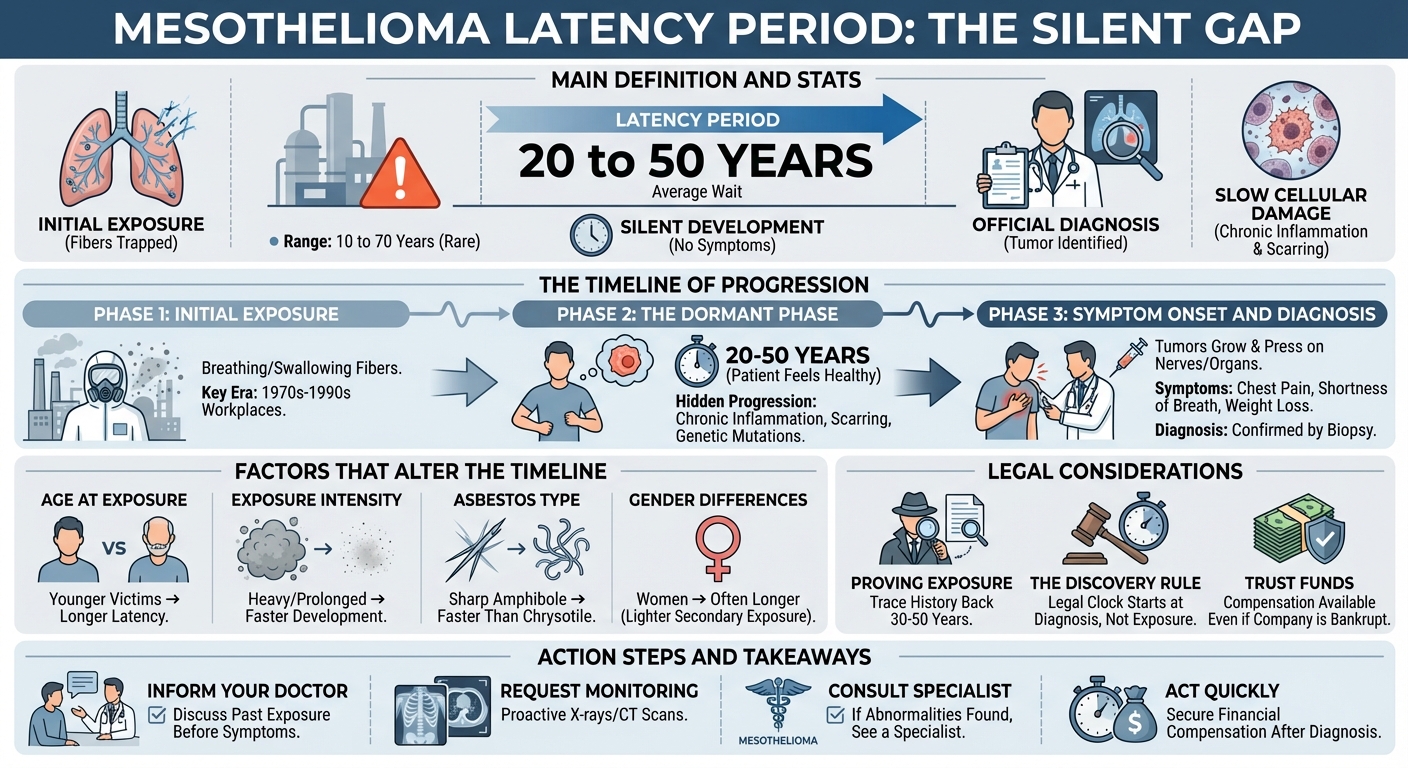
The mesothelioma latency period is the time between a person’s initial exposure to asbestos and their official diagnosis. This period typically ranges from 20 to 50 years. Because asbestos fibers cause cellular damage very slowly, patients usually do not experience symptoms until decades after their first exposure.
Understanding the Mesothelioma Latency Period
Defining latency: The gap between asbestos exposure and diagnosis
The mesothelioma latency period refers to the amount of time that passes between a person’s initial exposure to asbestos and the moment they are officially diagnosed with the disease. Unlike acute illnesses that show symptoms immediately, mesothelioma develops silently. When microscopic asbestos fibers are inhaled or ingested, they become permanently lodged in the mesothelium (the protective lining of the lungs, abdomen, or heart). Over decades, these trapped fibers cause continuous irritation, inflammation, and eventual genetic mutations that lead to cancer.
What is the average latency period for mesothelioma?
The average latency period for mesothelioma is typically between 20 and 50 years after a person’s initial exposure to asbestos. In some rare cases, symptoms can appear in as little as 10 years or take up to 70 years to develop, depending on various exposure factors.
How long can you have mesothelioma without knowing?
You can have mesothelioma without knowing for 20 to 50 years. Because the disease remains dormant while microscopic asbestos fibers slowly cause cellular damage, patients experience no symptoms during this extended latency period. Once symptoms finally emerge, the cancer is usually in an advanced stage.
Key Factors That Influence the Latency Timeline
While the median latency period hovers around 38 to 40 years, the exact timeline varies significantly from patient to patient. Several distinct factors dictate how quickly the disease progresses.
Age at first asbestos exposure
Research indicates that individuals exposed to asbestos at a younger age tend to experience a longer latency period. Conversely, those exposed later in life may see a shorter gap between exposure and diagnosis, partly due to the natural weakening of the immune system as the body ages.
Intensity, duration, and frequency of exposure
The volume of asbestos a person inhales plays a critical role. Heavy, prolonged occupational exposure (such as working daily in a shipyard or insulation factory) often correlates with a slightly shorter latency period compared to secondary or occasional exposure. The more fibers trapped in the body, the faster cellular damage accumulates.
Type of asbestos fibers (Chrysotile vs. Amphibole)
There are different types of asbestos, and they affect the body differently:
- Amphibole asbestos: These fibers are straight, needle-like, and highly toxic. They lodge deep into tissue and are associated with shorter latency periods and higher malignancy rates.
- Chrysotile asbestos: Known as white asbestos, these fibers are curly and slightly easier for the body to expel, though still highly carcinogenic. They often result in longer latency periods.
Gender differences and occupational hazards
Statistically, women often exhibit longer latency periods than men. This is largely because men historically faced direct, heavy occupational exposure in industrial settings, whereas women frequently experienced secondary exposure (such as washing a spouse’s asbestos-covered work clothes). Secondary exposure generally involves fewer fibers, extending the time it takes for cancer to develop.
The Timeline: From Initial Asbestos Exposure to Diagnosis
Understanding the progression of mesothelioma requires breaking down the decades-long timeline into three distinct phases.
Phase 1: Initial Exposure (Typically 1970s–1990s)
The timeline begins the moment asbestos fibers enter the body. For many patients diagnosed today, this exposure occurred between the 1970s and 1990s, before stringent federal regulations severely restricted asbestos use in construction, manufacturing, and the military.
Phase 2: The Dormant Phase (Cellular changes over decades)
This is the actual latency period. During this phase, the patient feels perfectly healthy. However, on a microscopic level, the trapped asbestos fibers are causing chronic inflammation. Over 20 to 50 years, this irritation leads to scarring (asbestosis) and DNA damage, eventually triggering the formation of malignant mesothelioma tumors.
Phase 3: Symptom Onset and Medical Diagnosis
The latency period ends when tumors grow large enough to press against nerves or organs, causing noticeable symptoms. Patients may experience shortness of breath, chest pain, chronic coughing, or unexplained weight loss. Because these symptoms mimic common respiratory illnesses, diagnosis is often delayed until a biopsy confirms the presence of mesothelioma cells.
Famous Cases and Survivor Timelines
How did Steve McQueen get mesothelioma?
Actor Steve McQueen likely got mesothelioma from heavy asbestos exposure during his service in the United States Marine Corps, where he stripped asbestos insulation from pipes aboard ships. He also suspected exposure from wearing asbestos-lined racing suits and handling automotive parts during his acting and racing career.
Who is the longest living mesothelioma survivor?
Paul Kraus is widely recognized as the longest living mesothelioma survivor. Diagnosed with peritoneal mesothelioma in 1997, Kraus was given only months to live. Through a combination of radical lifestyle changes, alternative therapies, and a strict diet, he has survived for over two decades post-diagnosis.
Why the Latency Period Matters for Your Legal Claim
The decades-long gap between exposure and diagnosis creates unique challenges and protections within the legal system.
Proving asbestos exposure from decades ago
Because the latency period is so long, pinpointing the exact source of exposure requires extensive investigation. Legal and medical professionals must trace a patient’s work history, military service, and residential background back 30 to 50 years to identify the asbestos-containing products responsible for the illness.
How the statute of limitations works (Discovery Rule)
In standard personal injury cases, the statute of limitations begins at the time of the injury. However, because of the mesothelioma latency period, courts apply the Discovery Rule. This rule dictates that the legal clock does not start ticking until the date you are officially diagnosed with mesothelioma, or the date you reasonably should have known your illness was tied to asbestos exposure.
Connecting your work history to corporate liability
Many companies that manufactured asbestos products have gone bankrupt or merged over the last 50 years. Specialized asbestos trust funds were established to ensure victims are still compensated today, regardless of how much time has passed since the initial exposure.
What to Do If You Were Exposed to Asbestos Decades Ago
Proactive medical monitoring and recognizing early symptoms
If you know you were exposed to asbestos in the past, do not wait for severe symptoms to appear. Inform your primary care physician about your exposure history and request regular chest X-rays or CT scans. Early detection is the most effective way to improve your prognosis.
Consulting a mesothelioma specialist
General oncologists rarely encounter mesothelioma. If imaging shows abnormalities, seek out a dedicated mesothelioma specialist. They have access to the latest clinical trials, targeted therapies, and surgical techniques that can extend life expectancy.
Protecting your legal rights and exploring compensation options
A mesothelioma diagnosis brings overwhelming medical expenses. Because of the Discovery Rule, you have a limited window post-diagnosis to seek financial relief. Exploring your legal rights promptly ensures you can secure compensation from asbestos trust funds or liable corporations to cover treatment costs and protect your family’s financial future.
 Call (713) 747-7777