
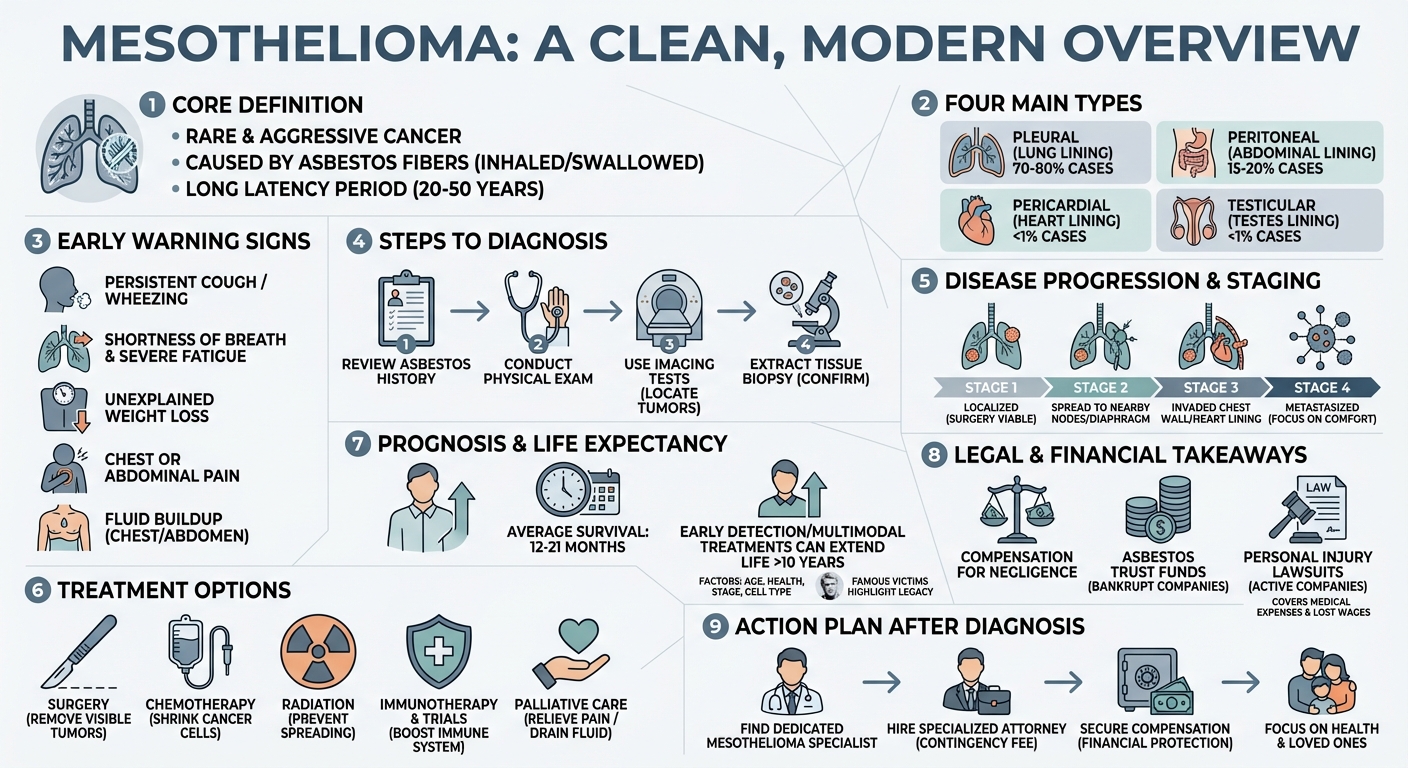
A complete mesothelioma guide provides patients and families with essential information about asbestos-related cancer. It covers the different types of mesothelioma, early warning signs, diagnostic processes, and available treatments. A comprehensive guide also explains life expectancy, palliative care options, and how victims can pursue financial compensation.
The Complete Mesothelioma Guide: Understanding Your Diagnosis and Options
A mesothelioma diagnosis is overwhelming, but having the right information empowers you to make critical medical and financial decisions. This comprehensive mesothelioma guide serves as your roadmap from initial diagnosis to treatment and legal recourse.
How to Use This Guide
We designed this guide for patients and their loved ones who need clear, actionable answers. It covers:
- The four main types of mesothelioma and their symptoms.
- The diagnostic process and staging.
- Current and emerging treatment options.
- Prognosis, life expectancy, and disease progression.
- Your legal rights to financial compensation.
The Link Between Asbestos and Mesothelioma
Mesothelioma is a rare, aggressive cancer caused almost exclusively by exposure to asbestos. When microscopic asbestos fibers are inhaled or swallowed, they become lodged in the protective linings of the body’s internal organs. Over decades, these trapped fibers cause chronic inflammation and genetic scarring, eventually mutating healthy cells into cancerous mesothelioma tumors.
Types of Mesothelioma
Mesothelioma is categorized by where the tumors first develop in the body. Treatment options and prognoses vary significantly depending on the type.
| Type | Location | Percentage of Cases |
|---|---|---|
| Pleural Mesothelioma | Lining of the lungs (pleura) | 70% – 80% |
| Peritoneal Mesothelioma | Lining of the abdomen (peritoneum) | 15% – 20% |
| Pericardial Mesothelioma | Lining of the heart (pericardium) | < 1% |
| Testicular Mesothelioma | Lining of the testes (tunica vaginalis) | < 1% |
Recognizing the Symptoms and Getting a Diagnosis
Common Early Warning Signs
Because mesothelioma has a latency period of 20 to 50 years, early symptoms are often mistaken for common illnesses like pneumonia or the flu. Key warning signs include:
- Persistent, dry cough or wheezing.
- Shortness of breath (dyspnea).
- Unexplained weight loss and severe fatigue.
- Chest or abdominal pain.
- Fluid buildup in the chest or abdomen.
How Doctors Diagnose Mesothelioma (Imaging and Biopsies)
Diagnosis begins with a physical exam and a review of your asbestos exposure history. Doctors use imaging tests like X-rays, CT scans, and MRIs to locate tumors or fluid buildup. However, the only way to definitively diagnose mesothelioma is through a tissue biopsy, where a sample is extracted and examined under a microscope by a pathologist.
Understanding the 4 Stages of Mesothelioma
Only pleural mesothelioma has a formalized staging system (the TNM system). Stages range from localized cancer to widespread metastasis:
- Stage 1: Cancer is localized to the lining of one lung. Surgery is highly viable.
- Stage 2: Tumors have spread to nearby lymph nodes or the diaphragm.
- Stage 3: Cancer has invaded deeper into the chest wall, heart lining, or surrounding tissues.
- Stage 4: Tumors have metastasized to distant organs. Treatment shifts to palliative care.
Treatment Options for Mesothelioma Patients
Surgery, Chemotherapy, and Radiation
Most specialists recommend a multimodal approach—combining two or more traditional treatments to maximize effectiveness. Surgery (like a pleurectomy/decortication) aims to remove visible tumors. Chemotherapy shrinks remaining cancer cells, and radiation therapy prevents tumors from spreading further.
Emerging Treatments and Clinical Trials
Medical advancements are extending survival rates. Immunotherapy drugs, such as Opdivo and Yervoy, are now FDA-approved for certain mesothelioma patients and work by boosting the immune system’s ability to destroy cancer cells. Patients may also qualify for clinical trials testing gene therapy and targeted therapies.
Palliative Care for Symptom Management
Palliative care focuses on improving your quality of life rather than curing the disease. Procedures like thoracentesis (draining fluid from the chest) or paracentesis (draining fluid from the abdomen) provide immediate relief from pain and breathing difficulties.
Prognosis, Life Expectancy, and Disease Progression
What’s the longest you can live with mesothelioma?
While the average life expectancy for mesothelioma is 12 to 21 months, some patients live much longer. The longest survivors have lived for more than 10 to 15 years after diagnosis. Exceptional survival is usually linked to early detection, aggressive multimodal treatments, and favorable cell types.
Factors That Impact Survival Rates
Your prognosis depends on several variables, including your age, overall health, the cancer’s stage at diagnosis, and the tumor’s cell type. Epithelioid cells respond better to treatment, whereas sarcomatoid cells are more aggressive and harder to treat.
What are the signs that mesothelioma is getting worse?
Signs that mesothelioma is getting worse include worsening shortness of breath, severe chest or abdominal pain, extreme fatigue, and sudden, unexplained weight loss. Patients may also experience difficulty swallowing, chronic coughing, or fluid buildup. If these symptoms intensify, consult your oncology team immediately.
Mesothelioma and Asbestos Exposure: Famous Cases
What famous person died from mesothelioma?
Several famous people have died from mesothelioma, bringing public awareness to the dangers of asbestos. Notable figures include actor Steve McQueen, musician Warren Zevon, and politician Paul Kraus. Their high-profile battles highlighted how decades-old asbestos exposure can unexpectedly lead to terminal cancer.
How did Steve McQueen get mesothelioma?
Steve McQueen likely got mesothelioma from heavy asbestos exposure during his time in the United States Marine Corps, where he removed asbestos insulation from ship pipes. He also suspected exposure from wearing asbestos-lined racing suits and working on movie soundstages insulated with asbestos.
Your Legal Rights: Compensation and Lawsuits
Why Asbestos Victims Are Entitled to Compensation
Mesothelioma is not just a tragedy; it is the result of corporate negligence. For decades, manufacturers of asbestos-containing products knew the material was toxic but hid the dangers from workers and the public to protect their profits. Because of this, victims are legally entitled to compensation.
Asbestos Trust Funds vs. Personal Injury Lawsuits
There are two primary ways to seek compensation. If the company responsible for your exposure filed for bankruptcy, you can file a claim with an asbestos trust fund (billions of dollars have been set aside for victims). If the company is still in business, you can file a personal injury lawsuit to recover damages for medical bills, lost wages, and pain and suffering.
How to Find the Right Mesothelioma Lawyer in Texas
Asbestos litigation is highly complex. You need a specialized attorney who understands state-specific statutes of limitations and has a proven track record of securing high-value settlements. Look for a law firm that offers free case evaluations and works on a contingency fee basis, meaning you pay nothing unless you win.
Next Steps: What to Do After a Diagnosis
Building Your Medical Team
Do not rely solely on a general oncologist. Seek out a dedicated mesothelioma specialist at a comprehensive cancer center (such as MD Anderson in Houston) to ensure you have access to the latest treatments and clinical trials.
Protecting Your Family’s Financial Future
Cancer treatments are incredibly expensive. Securing compensation through legal channels ensures that your medical debts are covered and your family is financially protected in the long term.
Accessing Free Legal and Medical Resources
Take action immediately. Reach out to a dedicated legal team to review your exposure history and outline your options. By securing expert medical care and experienced legal representation, you can focus entirely on your health and your loved ones.
 Call (713) 747-7777