
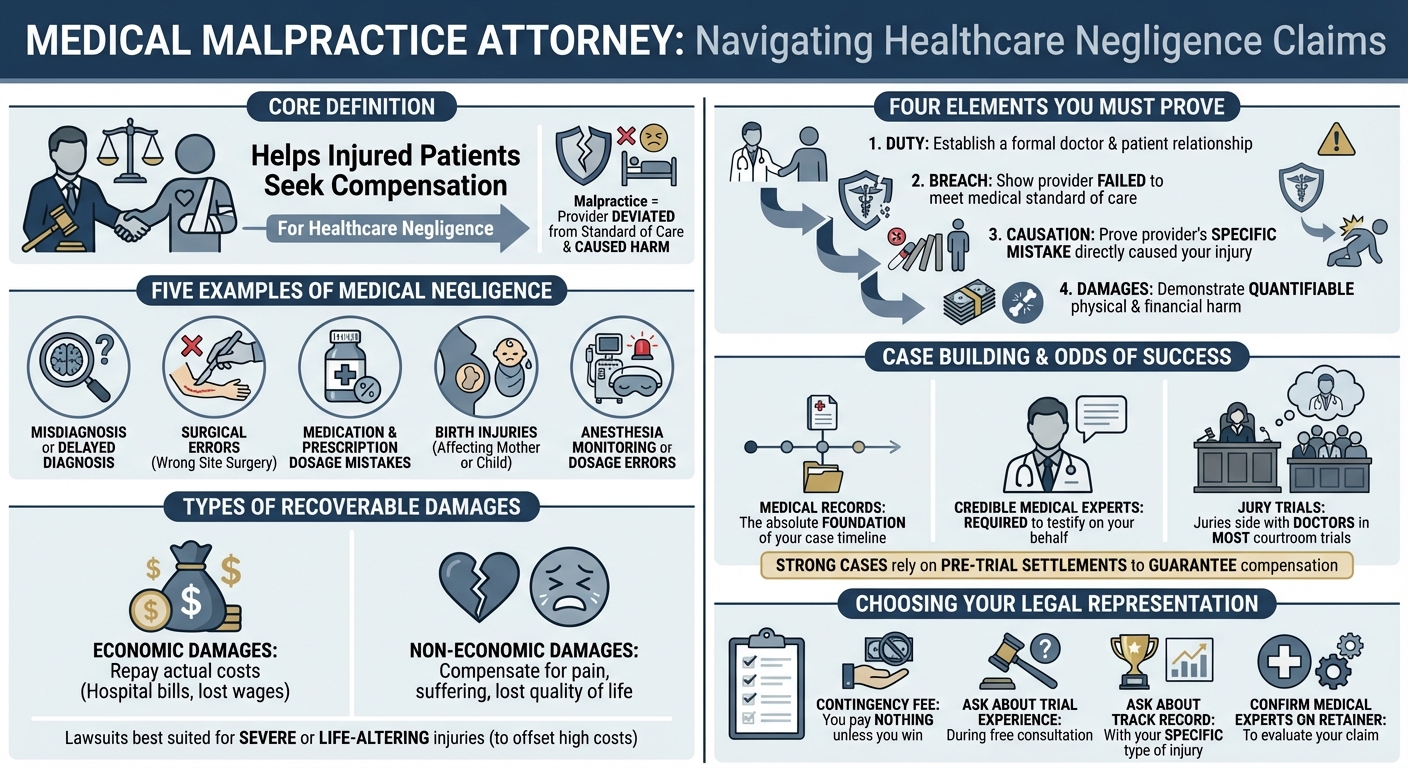
A medical malpractice attorney is a specialized personal injury lawyer who helps patients seek financial compensation when a healthcare provider’s negligence causes harm. They investigate claims, consult medical experts, and prove the four elements of malpractice: duty, breach, causation, and damages.
Why You Need a Medical Malpractice Attorney
When you seek medical care, you trust that healthcare professionals will heal you, not harm you. Unfortunately, medical errors are a leading cause of injury and death in the United States. If you have been injured by a negligent doctor, hospital, or nurse, a medical malpractice attorney is essential to help you navigate the complex legal system and fight for the compensation you deserve.
Understanding Medical Malpractice vs. Bad Outcomes
It is important to understand that a negative medical outcome does not automatically equal medical malpractice. Medicine is an inexact science, and some treatments carry inherent risks. Medical malpractice occurs specifically when a healthcare provider deviates from the accepted standard of care, resulting in patient harm. An experienced attorney can differentiate between an unavoidable complication and actionable negligence.
How a Lawyer Evaluates Your Potential Claim
Because these cases are incredibly resource-intensive, a medical malpractice law firm will rigorously evaluate your claim before proceeding. This evaluation typically involves gathering all relevant medical records, consulting with independent medical experts to establish the standard of care, and assessing the full extent of your financial and physical damages.
What are 5 examples of medical negligence?
Five common examples of medical negligence include misdiagnosis or delayed diagnosis, surgical errors (such as wrong-site surgery), medication and prescription dosage errors, birth injuries to the mother or child, and anesthesia errors during procedures. These mistakes occur when healthcare providers deviate from accepted medical standards.
1. Misdiagnosis or Delayed Diagnosis
When a doctor fails to diagnose a condition accurately or in a timely manner, the patient loses valuable treatment time. This is especially devastating in cases of cancer, heart attacks, or strokes, where early intervention is critical to survival.
2. Surgical Errors and Wrong-Site Surgery
Surgical errors range from leaving medical instruments inside a patient’s body to operating on the wrong body part entirely. These catastrophic mistakes often require additional surgeries to correct and can cause permanent disability or fatal infections.
3. Medication and Prescription Dosage Errors
Administering the wrong medication, prescribing an incorrect dosage, or failing to check for dangerous drug interactions can lead to severe allergic reactions, organ failure, or fatal overdoses. This negligence can occur at the prescribing, dispensing, or administration stage.
4. Birth Injuries to Mother or Child
Failure to monitor fetal distress, improper use of delivery instruments like forceps, or delaying a necessary C-section can result in permanent conditions such as cerebral palsy, Erb’s palsy, or severe maternal hemorrhaging.
5. Anesthesia Errors During Procedures
Anesthesiologists must carefully monitor vital signs and administer precise dosages. Errors in this specialty can lead to anesthesia awareness (waking up during surgery), brain damage from lack of oxygen, or even death.
What are the four things that must be proven to win a medical malpractice suit?
To win a medical malpractice suit, you must prove four essential elements: a professional duty of care existed between the doctor and patient, the provider breached the medical standard of care, this breach directly caused your injury, and you suffered quantifiable damages as a result.
Element 1: A Professional Duty of Care Existed
You must first establish that a doctor-patient relationship existed. This means you hired the doctor and the doctor agreed to be hired, thereby creating a legal duty to provide competent care.
Element 2: Breach of the Medical Standard of Care
You must prove that the healthcare provider failed to act as a reasonably prudent professional with similar training would have acted under similar circumstances. This almost always requires testimony from a qualified medical expert.
Element 3: Direct Causation Between the Breach and Your Injury
It is not enough to show that the doctor made a mistake; you must prove that this specific mistake directly caused your injury. Defense attorneys often argue that the patient’s underlying illness, rather than the doctor’s error, caused the harm.
Element 4: Quantifiable Damages Resulting from the Injury
Finally, you must show that the injury resulted in specific damages. If a doctor made a mistake but you suffered no harm or financial loss, there is no viable malpractice claim.
Is it worth suing for medical malpractice?
Yes, suing for medical malpractice is often worth it if you suffered severe, life-altering injuries. While these cases are complex and time-consuming, a successful lawsuit can provide essential compensation for mounting medical bills, lost wages, and long-term care, securing your family’s financial future.
Weighing Legal Costs Against Potential Compensation
Medical malpractice cases are expensive to litigate due to the need for expert witnesses and extensive discovery. However, because most medical malpractice attorneys work on a contingency fee basis, you pay nothing upfront. If your injuries require lifelong care, the potential compensation far outweighs the time investment.
Types of Economic and Non-Economic Damages You Can Recover
Victims of medical negligence can recover various forms of compensation. Here is a breakdown of what a settlement or verdict may cover:
| Damage Type | Description | Examples |
|---|---|---|
| Economic Damages | Calculable, out-of-pocket financial losses. | Hospital bills, rehabilitation costs, lost wages, loss of future earning capacity. |
| Non-Economic Damages | Subjective losses related to quality of life. | Pain and suffering, emotional distress, loss of consortium, permanent disfigurement. |
How Severe Injuries Justify the Legal Process
Minor errors with temporary consequences rarely justify the rigors of a malpractice lawsuit. However, if you have suffered a spinal cord injury, traumatic brain injury, or the wrongful death of a loved one, pursuing legal action is often the only way to afford the specialized care required moving forward.
What are the odds of winning a medical malpractice lawsuit?
The odds of winning a medical malpractice lawsuit at trial are historically low, with doctors winning about 70% to 80% of jury verdicts. However, the majority of strong medical malpractice cases never reach the courtroom, as they are successfully resolved through pre-trial settlements negotiated by experienced attorneys.
Pre-Trial Settlement Rates vs. Courtroom Verdicts
Insurance companies know that facing a sympathetic jury can result in massive verdicts. Therefore, if your attorney builds an airtight case backed by credible medical experts, the defense is highly likely to offer a fair settlement before the trial begins. Settlements provide guaranteed compensation without the unpredictable nature of a jury trial.
Why Expert Testimony and Legal Representation Increase Your Odds
Your odds of success depend heavily on the quality of your legal representation. A seasoned medical malpractice attorney will have a network of respected medical specialists ready to testify on your behalf. Without strong expert testimony, winning a malpractice claim is virtually impossible.
Building Your Case: Medical Records and Examinations
Why Your Medical Records Are the Foundation of Your Case
In any medical negligence claim, your medical records are your case. They provide the chronological timeline of your treatment, the medications administered, and the physician’s notes. Securing these records immediately is crucial before they can be altered or lost.
Navigating Independent Medical Examinations (IMEs)
During the litigation process, the defense will likely request that you undergo an Independent Medical Examination (IME). Despite the name, these doctors are hired by the defense’s insurance company to minimize your injuries. Your attorney will prepare you for this examination to ensure your rights are protected.
How to Choose the Right Medical Malpractice Law Firm
Questions to Ask During Your Free Consultation
Not all personal injury lawyers have the resources or experience to handle medical malpractice. During your free consultation, ask the attorney:
- How many medical malpractice cases have you taken to trial?
- Do you have medical experts on retainer to review my file?
- What is your track record with cases similar to mine?
Understanding Contingency Fees (No Win, No Fee)
Reputable medical malpractice attorneys operate on a contingency fee basis. This means the firm fronts all the costs for investigating your claim, hiring experts, and filing the lawsuit. You only pay attorney fees if they successfully recover a settlement or jury verdict on your behalf. This structure allows injured patients to access top-tier legal representation without financial risk.
 Call (713) 747-7777