
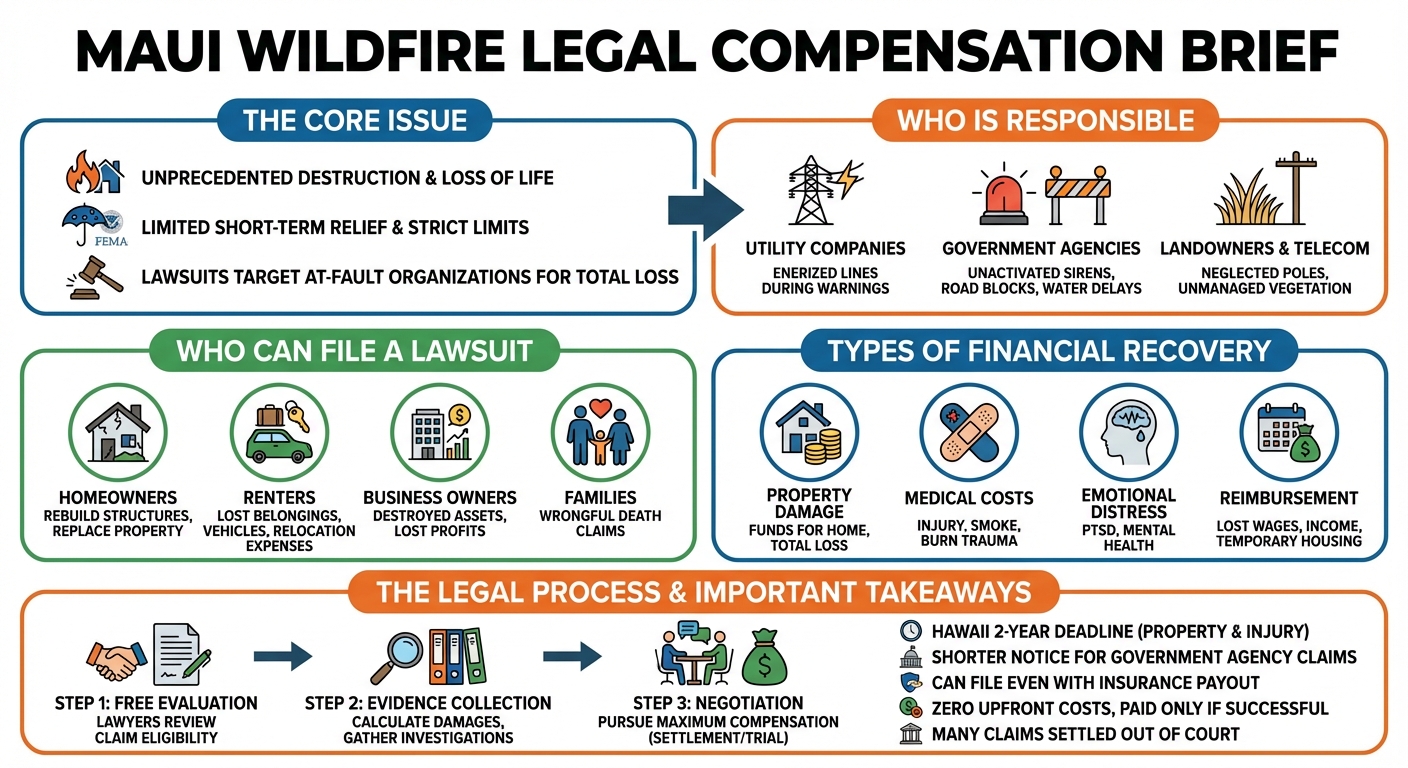
A Maui wildfire lawyer helps victims of the devastating 2023 Lahaina fires seek financial compensation from negligent parties, such as utility companies. By filing a lawsuit, homeowners, renters, and business owners can recover damages for property loss, emotional distress, and wrongful death that insurance or FEMA will not cover.
Maui Wildfire Lawyer: Pursuing Justice and Compensation for Lahaina Victims
The August 2023 Maui wildfires changed the lives of thousands of residents forever. As the deadliest U.S. wildfire in over a century, the disaster left behind unimaginable grief, destroyed historic communities, and caused billions of dollars in property damage. If you lost your home, your business, or a loved one, a Maui wildfire lawyer can help you fight for the comprehensive financial recovery you deserve.
While insurance payouts and government assistance provide immediate relief, they are rarely enough to rebuild your life. Our legal team is actively investigating the causes of the fires and holding negligent utility companies and government entities accountable.
The 2023 Maui Wildfires: Understanding Your Legal Rights
The Devastation of Lahaina and Upcountry Maui
Driven by hurricane-force winds and dry brush, the fires rapidly engulfed Lahaina and parts of Upcountry Maui. The catastrophic event resulted in tragic loss of life, the displacement of thousands of families, and the total destruction of homes, cultural landmarks, and local businesses. The sheer scale of the devastation has left many survivors overwhelmed and uncertain about their financial future.
Why Legal Action is Necessary Beyond Insurance Claims
Many victims quickly discover that their homeowners’ or renters’ insurance policies contain strict limits, high deductibles, or exclusions that leave them severely undercompensated. Furthermore, insurance does not cover non-economic damages like emotional trauma or the wrongful death of a family member. Filing a civil lawsuit allows you to pursue the at-fault parties directly, ensuring you receive full restitution for your total losses.
Who is Liable for the Maui Fires?
Wildfires of this magnitude are rarely just “acts of God.” Investigations into the Maui fires point to a cascade of human errors, ignored warnings, and infrastructure failures.
Hawaiian Electric Company (HECO) Negligence and Power Line Failures
Mounting evidence suggests that Hawaiian Electric Company (HECO) failed to de-energize its power lines despite severe “Red Flag” weather warnings and high winds from Hurricane Dora. Downed, energized power lines are believed to have ignited the dry brush that sparked the catastrophic blazes. Utility companies have a legal duty to maintain their infrastructure and implement public safety power shutoffs during extreme weather.
State and Local Government Mismanagement
Liability may also extend to state and local agencies. Critical failures during the disaster included the decision not to activate the island’s emergency warning sirens, inadequate water supply for firefighters due to delayed water diversion approvals, and road blockages that trapped fleeing residents.
Telecommunications and Infrastructure Companies
In addition to power utilities, telecommunications companies and private landowners may bear responsibility. Poorly maintained utility poles that snapped in the wind, combined with overgrown, unmanaged vegetation on private and state-owned lands, created the perfect conditions for the fire to spread uncontrollably.
Who Can File a Maui Wildfire Lawsuit?
You do not need to be a property owner to have a valid legal claim. Our Maui wildfire attorneys represent a wide range of victims:
Homeowners and Property Owners
If your house, condo, or land was damaged or destroyed, you can seek compensation for the cost of rebuilding, replacing personal property, and the diminished value of your land.
Renters and Displaced Tenants
Renters who lost their personal belongings, vehicles, and housing can file claims for their lost assets and the costs associated with emergency relocation and temporary housing.
Business Owners (Business Interruption and Asset Loss)
Lahaina was a thriving economic and tourist hub. Business owners can pursue damages for destroyed commercial property, lost inventory, and ongoing business interruption (lost profits) caused by the disaster.
Families Filing Wrongful Death Claims
If you tragically lost a family member in the fires, you may be eligible to file a wrongful death lawsuit. While no amount of money can replace a loved one, compensation can cover funeral expenses, loss of future income, and loss of companionship.
Types of Compensation Available for Maui Fire Victims
A successful wildfire lawsuit aims to make you “whole” again in the eyes of the law. Compensation typically includes:
- Property Damage and Total Loss of Homes: Funds to rebuild your home and replace destroyed vehicles, furniture, heirlooms, and electronics.
- Personal Injury and Severe Burn Trauma: Coverage for medical bills, skin grafts, respiratory treatments for smoke inhalation, and ongoing physical therapy.
- Emotional Distress and PTSD: Financial recovery for the severe psychological trauma, anxiety, and post-traumatic stress disorder resulting from fleeing the flames.
- Lost Wages, Business Income, and Relocation Costs: Reimbursement for time missed from work, lost business revenue, and the exorbitant costs of long-term temporary housing.
FEMA Assistance vs. Wildfire Lawsuits: What You Need to Know
Limitations of FEMA and State Aid
FEMA and state emergency funds are designed to provide immediate, short-term survival assistance—such as temporary lodging, food, and minor emergency repairs. FEMA grants are strictly capped and are not intended to rebuild your home or replace your total lost wealth.
How a Lawsuit Recovers What Government Aid Won’t
A lawsuit targets the root cause of the fire. Unlike FEMA aid, a civil lawsuit has no arbitrary cap. It is designed to calculate the exact dollar amount of your past, present, and future losses, forcing the negligent utility or corporation to pay for the damage they caused.
The Maui Wildfire Litigation Process: What to Expect
Taking legal action can feel daunting, but our legal team handles the heavy lifting so you can focus on healing.
Step 1: Free Case Evaluation and Eligibility Check
We start with a confidential, no-obligation consultation. We will listen to your story, review your losses, and determine if you have a viable claim against HECO or other entities.
Step 2: Evidence Collection and Damage Assessment
Our team works with fire investigators, utility experts, and financial analysts to build a rock-solid case. We will meticulously document your property damage, medical records, and financial losses.
Step 3: Settlement Negotiations and Mass Tort Proceedings
Because thousands of people were affected, Maui fire lawsuits are being handled as complex mass tort litigation. We will aggressively negotiate with corporate defense lawyers to secure a maximum settlement. If a fair settlement cannot be reached, we are fully prepared to take your case to trial.
Why Choose Our Wildfire Litigation Attorneys?
Experience in Complex Mass Torts and Utility Negligence
Taking on multi-billion-dollar utility companies requires extensive resources and legal firepower. Our firm has a proven track record in complex personal injury and mass tort litigation. We understand the tactics corporations use to deny liability, and we know how to defeat them.
Zero Upfront Costs: Our Contingency Fee Promise
We believe that fire victims have already lost enough. That is why we operate on a strict contingency fee basis. You pay absolutely zero upfront costs, and we only get paid if we successfully recover compensation for you.
Frequently Asked Questions About Maui Fire Lawsuits
Is there a deadline (statute of limitations) to file a Maui wildfire claim?
Yes. In Hawaii, the statute of limitations for property damage and personal injury claims is generally two years from the date of the incident. However, claims against government entities may have much shorter notice requirements. It is critical to speak with an attorney immediately to protect your rights.
Can I still sue if I already received an insurance payout?
Yes. Insurance payouts rarely cover the total cost of rebuilding or account for non-economic damages like emotional distress. A lawsuit targets the at-fault parties to recover the remaining balance of your actual losses.
Will I have to go to court in Hawaii?
Not necessarily. Many mass tort and wildfire claims are resolved out of court through negotiated settlements. If your case does require litigation, your legal team will handle the vast majority of the proceedings on your behalf.
How much does it cost to hire a Maui fire lawyer?
Our attorneys work on a contingency fee basis. This means you pay nothing out of pocket. Our fees are deducted as a percentage of your final settlement or court award, meaning we only win if you win.
 Call (713) 747-7777