
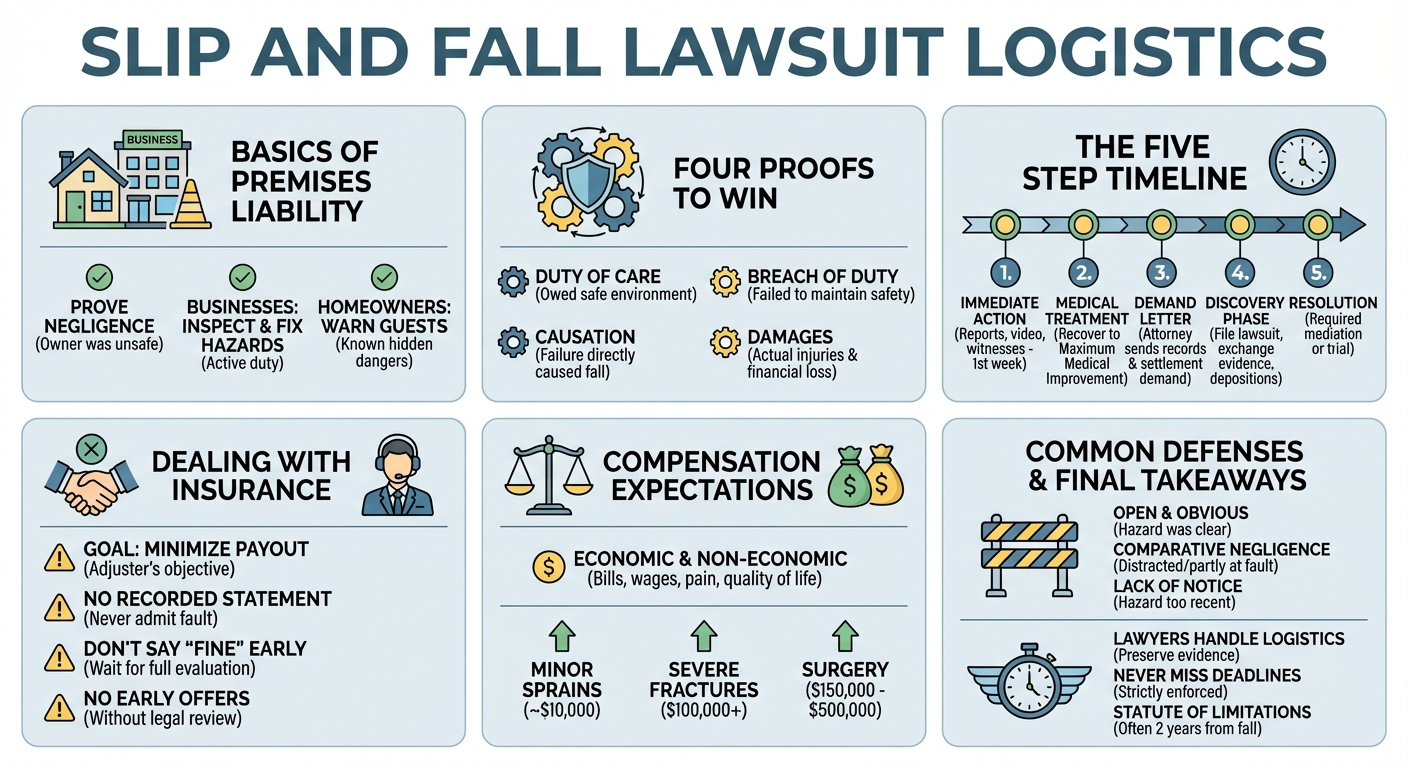
The logistics of a slip and fall lawsuit involve five main steps: gathering immediate evidence at the scene, reaching maximum medical improvement, sending a formal demand letter, entering the discovery phase, and negotiating a settlement or going to trial. Most cases settle out of court through mediation.
The Logistics of Slip and Fall Accident Lawsuits: A Step-by-Step Guide
Navigating the aftermath of a severe fall can be overwhelming. While you focus on physical recovery, the legal process—often referred to as premises liability—operates on a strict timeline. What makes a slip and fall case unique is the burden of proof: simply falling on someone else’s property does not automatically make them liable. You must prove they were negligent in maintaining a safe environment.
The logistical timeline of a slip and fall lawsuit moves from the moment of injury through medical recovery, evidence gathering, formal demands, and eventually, settlement negotiations or trial. Understanding this step-by-step process is crucial for protecting your right to fair compensation.
Understanding Slip and Fall Lawsuits and Premises Liability
Premises liability is the legal concept that holds property owners responsible for accidents that occur on their land due to unsafe conditions. However, the legal duty a property owner owes you depends on your status on the property.
- Commercial Properties: Businesses (like grocery stores or hotels) owe the highest duty of care to “invitees” (customers). They must actively inspect for hazards and fix them promptly.
- Residential Properties: Homeowners owe a duty to “licensees” (social guests) to warn them of known, hidden dangers, but they generally do not have the same rigorous duty to inspect the property constantly.
What are the 4 proofs of negligence?
To win a slip and fall case, you must establish four proofs of negligence: 1) Duty of care (the owner owed you a safe environment), 2) Breach of duty (they failed to maintain safety), 3) Causation (their failure directly caused your fall), and 4) Damages (you suffered actual injuries and financial losses).
The Step-by-Step Logistics of a Slip and Fall Claim
Phase 1: Immediate Actions and Evidence Gathering (Days 1-7)
The logistics of a successful lawsuit begin the moment you fall. Immediate evidence gathering is critical because hazards (like a spilled liquid or a broken stair) are often cleaned up or repaired shortly after an accident. In the first week, your legal team will focus on securing incident reports, requesting surveillance footage, and interviewing eyewitnesses.
Phase 2: Medical Treatment and Maximum Medical Improvement (Weeks to Months)
You cannot accurately value a claim until you understand the full extent of your injuries. This phase lasts until you reach Maximum Medical Improvement (MMI)—the point where your condition has stabilized and further treatment will not significantly improve it. Rushing a settlement before reaching MMI can leave you paying out-of-pocket for future medical care.
Phase 3: Sending the Demand Letter and Initial Negotiations
Once you reach MMI, your attorney compiles your medical records, bills, and proof of lost wages into a comprehensive demand letter. This document is sent to the property owner’s insurance company, outlining the facts of the case, the legal arguments for liability, and a specific financial demand. This triggers the first round of settlement negotiations.
Phase 4: Filing the Lawsuit and the Discovery Process
If the insurance company refuses to offer a fair settlement, your lawyer will file a formal complaint in civil court. This initiates the “discovery” phase, where both sides exchange evidence. Discovery logistics include written interrogatories, document requests, and sworn depositions from you, the property owner, and medical experts.
Phase 5: Mediation, Settlement, or Going to Trial
Before a trial begins, courts usually require mediation. A neutral third-party mediator helps both sides negotiate a resolution. The vast majority of slip and fall cases are resolved during mediation. If an agreement cannot be reached, the logistics shift to trial preparation, where a judge or jury will determine liability and damages.
Dealing with Insurance Adjusters After a Fall
Insurance adjusters are trained negotiators whose primary goal is to protect their company’s bottom line. They will investigate the claim looking for ways to shift the blame onto you or argue that your injuries were pre-existing.
What not to tell your insurance company?
Never give a recorded statement, admit fault, or say you feel fine to an insurance adjuster. Do not discuss your specific injuries in detail before completing medical evaluations, and never accept a quick settlement offer without consulting an attorney, as it may severely undervalue your claim.
Calculating Settlement Values and Compensation
Slip and fall compensation is divided into two main categories: economic damages (quantifiable losses like hospital bills, physical therapy, and lost wages) and non-economic damages (subjective losses like pain, suffering, and diminished quality of life).
How much compensation for a slip-and-fall?
Compensation for a slip-and-fall varies widely based on injury severity, typically ranging from $10,000 for minor sprains to over $100,000 for severe fractures. The exact amount depends on your total medical bills, lost wages, pain and suffering, and the clarity of the property owner’s negligence.
What is the maximum settlement for a slip-and-fall with surgery?
There is no strict legal maximum settlement for a slip-and-fall with surgery. However, cases involving invasive procedures like spinal fusion frequently settle between $150,000 and $500,000. Payouts can exceed $1 million if the surgery results in permanent disability, massive future medical costs, or lost earning capacity.
Common Defenses: Why Slip and Fall Cases Can Be Hard to Win
Property owners and their insurers will aggressively defend against your claim. Understanding their logistical playbook helps you and your attorney prepare counter-arguments.
- The Open and Obvious Doctrine: The defense may argue that the hazard was so obvious that any reasonable person would have seen and avoided it.
- Comparative Negligence: They may claim you were partially at fault—for example, by texting while walking, wearing inappropriate footwear, or ignoring warning signs. Depending on your state’s laws, this can reduce or eliminate your compensation.
- Lack of Notice: The most common defense is that the property owner had no “actual or constructive notice” of the hazard. If another customer spilled a drink just two minutes before you slipped, the store owner may not be held liable because they did not have a reasonable amount of time to discover and clean the spill.
How a Personal Injury Lawyer Manages the Logistics for You
Managing the logistics of a slip and fall lawsuit requires legal expertise, financial resources, and time. A personal injury lawyer handles the heavy lifting—from preserving fleeting evidence and hiring safety experts to navigating complex court filing systems.
Crucially, an attorney ensures you do not miss the statute of limitations. Every state sets a strict legal deadline (often two years from the date of the fall) to file a lawsuit. Missing this deadline permanently bars you from recovering compensation. If you have been injured on someone else’s property, securing a free case evaluation is the first logistical step toward protecting your future.
 Call (713) 747-7777