
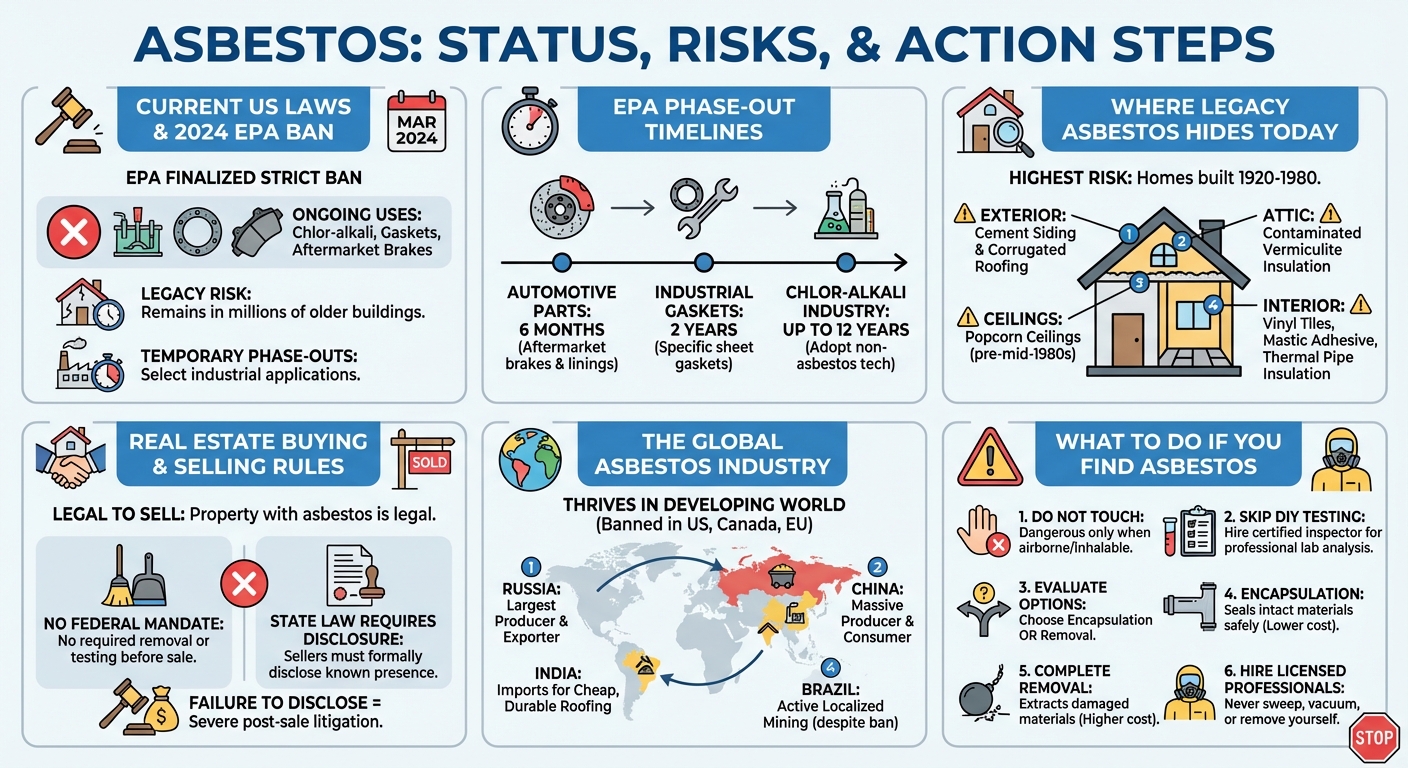
While the US EPA finalized a ban on ongoing uses of chrysotile asbestos in March 2024, asbestos is still present in millions of older homes and commercial buildings. Additionally, a phase-out period allows certain industrial uses to continue temporarily, and it remains heavily used in developing countries globally.
Is Asbestos Still Used in the US? The Short Answer
For decades, the United States lagged behind over 50 other countries in fully banning asbestos. The short answer today is that while new uses of asbestos are finally banned, asbestos is still heavily present in millions of older buildings, and certain industrial applications are currently operating under temporary phase-out periods.
Because asbestos is highly durable and heat-resistant, it was a staple in 20th-century construction. If you live or work in a building constructed before the 1980s, you are likely still surrounded by legacy asbestos products.
Understanding the March 2024 EPA Asbestos Ban
In a landmark decision, the Environmental Protection Agency (EPA) finalized a rule in March 2024 to ban ongoing uses of chrysotile asbestos, the only known form of asbestos currently imported, processed, or distributed in the United States.
What the 2024 EPA Ruling Covers
The 2024 EPA ruling strictly prohibits the import and use of chrysotile asbestos for consumer and commercial products. This effectively closes the loopholes left open by the partial ban of 1989. The ban specifically targets:
- Chrysotile asbestos diaphragms used in the chlor-alkali industry.
- Sheet gaskets used in chemical production.
- Aftermarket automotive brakes and linings.
- Other vehicle friction products.
Exceptions and Phase-Out Periods
To prevent supply chain disruptions, the EPA granted specific phase-out periods rather than an immediate, overnight halt. Depending on the industry, these transition timelines vary:
- Automotive parts: A 6-month phase-out for most aftermarket brakes and linings.
- Industrial gaskets: A 2-year phase-out for certain sheet gaskets used in titanium dioxide production.
- Chlor-alkali industry: Up to a 12-year phase-out for specific facilities transitioning to non-asbestos membrane technology.
What products still contain asbestos today?
Today, asbestos is primarily found in legacy building materials like vinyl floor tiles, roofing shingles, and pipe insulation installed before the 1980s. While new consumer products are banned from using it, some aftermarket automotive brakes, clutches, and specific industrial gaskets may still legally contain asbestos during phase-out periods.
Legacy Building Materials
The vast majority of asbestos exposure today comes from disturbing old materials during renovations or demolitions. Common legacy products include:
- Cement siding and corrugated roofing
- Vinyl floor tiles and the mastic adhesive used to glue them
- Boiler and steam pipe thermal insulation
- Vermiculite attic insulation (often contaminated with amphibole asbestos)
Automotive Parts and Industrial Gaskets
Mechanics and industrial workers face unique risks. Until the 2024 phase-out periods are fully complete, older inventory of aftermarket brake pads, drum brake linings, and heavy-duty transmission clutches may still harbor chrysotile asbestos. Industrial chemical plants also continue to use specialized asbestos sheet gaskets to manage highly corrosive materials safely until their facilities are upgraded.
Asbestos in Homes: Age, Materials, and Risks
Age is the single most reliable indicator of whether a residential property contains asbestos. Homes built between 1920 and 1980 are the highest risk.
Would a 100 year old house have asbestos?
Yes, a 100-year-old house is highly likely to have asbestos. Because asbestos was widely used for insulation, fireproofing, and durability from the early 1900s until the late 1980s, homes built a century ago frequently contain asbestos in pipe wrapping, floor tiles, siding, and outdated electrical insulation.
Is asbestos still used in popcorn ceilings?
No, asbestos is no longer used in new popcorn ceilings. The EPA banned the use of asbestos in textured ceiling paints in 1977. However, existing inventories were legally allowed to be used, meaning popcorn ceilings installed well into the mid-1980s may still contain dangerous asbestos fibers.
Real Estate Rules: Buying and Selling
Navigating the real estate market with an older home requires understanding the legal obligations surrounding hazardous materials.
Can you legally sell a house with asbestos?
Yes, you can legally sell a house with asbestos. There are no federal laws prohibiting the sale of a property containing asbestos materials. However, sellers are legally required in most states to disclose the known presence of asbestos to potential buyers before finalizing the real estate transaction.
Disclosure Requirements by State
While federal law does not mandate asbestos removal prior to a sale, state-level disclosure laws are strict. If a homeowner has had a property tested and knows asbestos is present, they must check the “hazardous materials” box on the standard seller’s disclosure form. Failing to disclose known asbestos can lead to severe post-sale litigation. However, sellers are generally not required to proactively test for asbestos before listing a home.
Global Asbestos Use: Which Countries Still Use It?
While the US, Canada, and the European Union have banned asbestos, it remains a booming industry in the developing world. Several nations continue to mine, export, and utilize asbestos heavily in construction materials, primarily asbestos-cement sheets.
- Russia: The world’s largest producer and exporter of asbestos.
- China: A massive consumer and producer, primarily using it in industrial and building materials.
- India: One of the largest importers of asbestos, utilizing it heavily for cheap, durable roofing in rural areas.
- Brazil: Despite a Supreme Court ban in 2017, localized mining and legal battles over exportation have kept the industry active in certain regions.
What to Do If You Find Asbestos
If you suspect asbestos in your home or workplace, the golden rule is: Do not touch it. Asbestos is only dangerous when it becomes “friable”—meaning the fibers become airborne and can be inhaled.
Testing and Identification
You cannot identify asbestos simply by looking at it. The only definitive way to confirm its presence is through polarized light microscopy (PLM) or transmission electron microscopy (TEM). Hire a certified asbestos inspector to take samples safely rather than attempting a DIY test, which risks releasing toxic fibers into your air.
Safe Removal vs. Encapsulation
If asbestos is confirmed, you generally have two professional remediation options:
| Method | How It Works | Best For | Cost |
|---|---|---|---|
| Encapsulation | Sealing the material with a specialized binding agent to prevent fibers from escaping. | Materials in good condition (e.g., intact pipe insulation, undisturbed floor tiles). | Lower |
| Removal (Abatement) | Completely extracting and disposing of the material under strict containment protocols. | Damaged, crumbling (friable) materials, or areas undergoing major renovation. | Higher |
Both methods require licensed abatement professionals. Never attempt to vacuum, sweep, or tear out suspected asbestos materials yourself.
 Call (713) 747-7777